
A global enterprise is expanding to a Multi-Region Fabric with North America and Europe as separate regions connected through a core, requiring inter-region traffic to transit border routers and preferred hierarchical paths. The design team asks how regions and roles enforce this hierarchy. Which Multi-Region Fabric description answers how access, core, and path selection interact for this requirement?
Select an answer to reveal the explanation.
Short Explanation
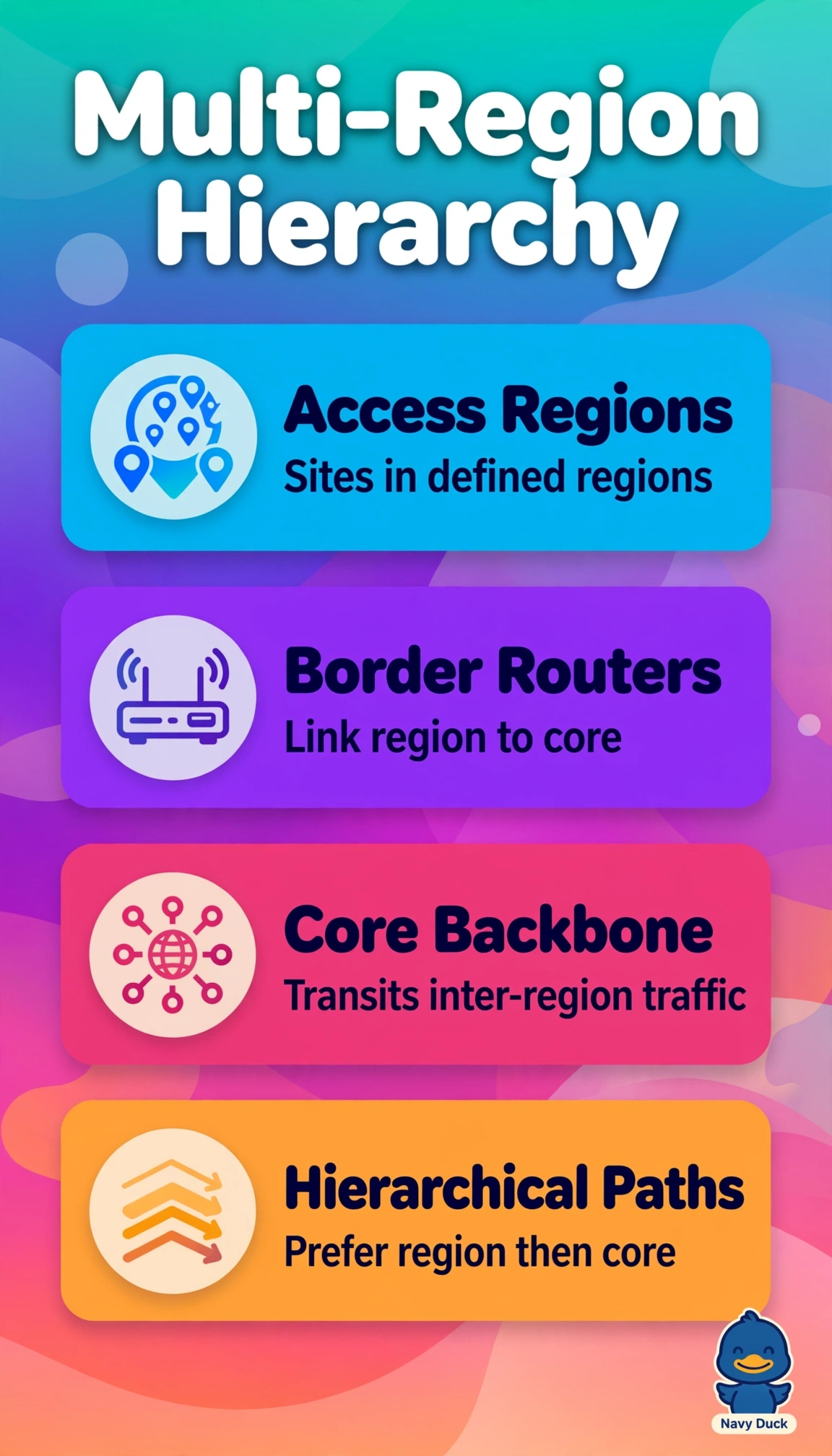
As you scale across North America and Europe, you need clear regional boundaries and orderly inter-region transit. Core border routers connect the regions and enforce preferred hierarchical paths.
Full Explanation
The correct description assigns site-facing access routers to distinct geographic regions and uses core border routers to interconnect those regions. North America and Europe therefore remain separate policy domains, while inter-region traffic transits the core, where hierarchical path preference provides the required ordering and predictable aggregation. Dynamic performance-based path selection can optimize for measured conditions, but it does not enforce the required hierarchical preference and may cause path changes. Direct regional hub peering can reduce hops, but it bypasses the required core border router transit and weakens centralized policy, summarization, and segmentation. Assigning all access routers to one global region merges North America and Europe, removing the required regional separation and region-aware control. As an exam caveat, distinguish hierarchical path enforcement from lowest-latency optimization, and core border routers from regional hubs. As a practical check, verify that access routers belong to the intended regions, that core adjacencies are on border routers, and that path preference follows the hierarchy.