
A manufacturer uses AWS and Azure plus a private cloud exchange to reach SaaS, with branches needing automated optimal paths and consistent segmentation across clouds. New VPCs appear weekly. Which multicloud and interconnect integration best extends the SD-WAN fabric to these clouds?
Select an answer to reveal the explanation.
Short Explanation
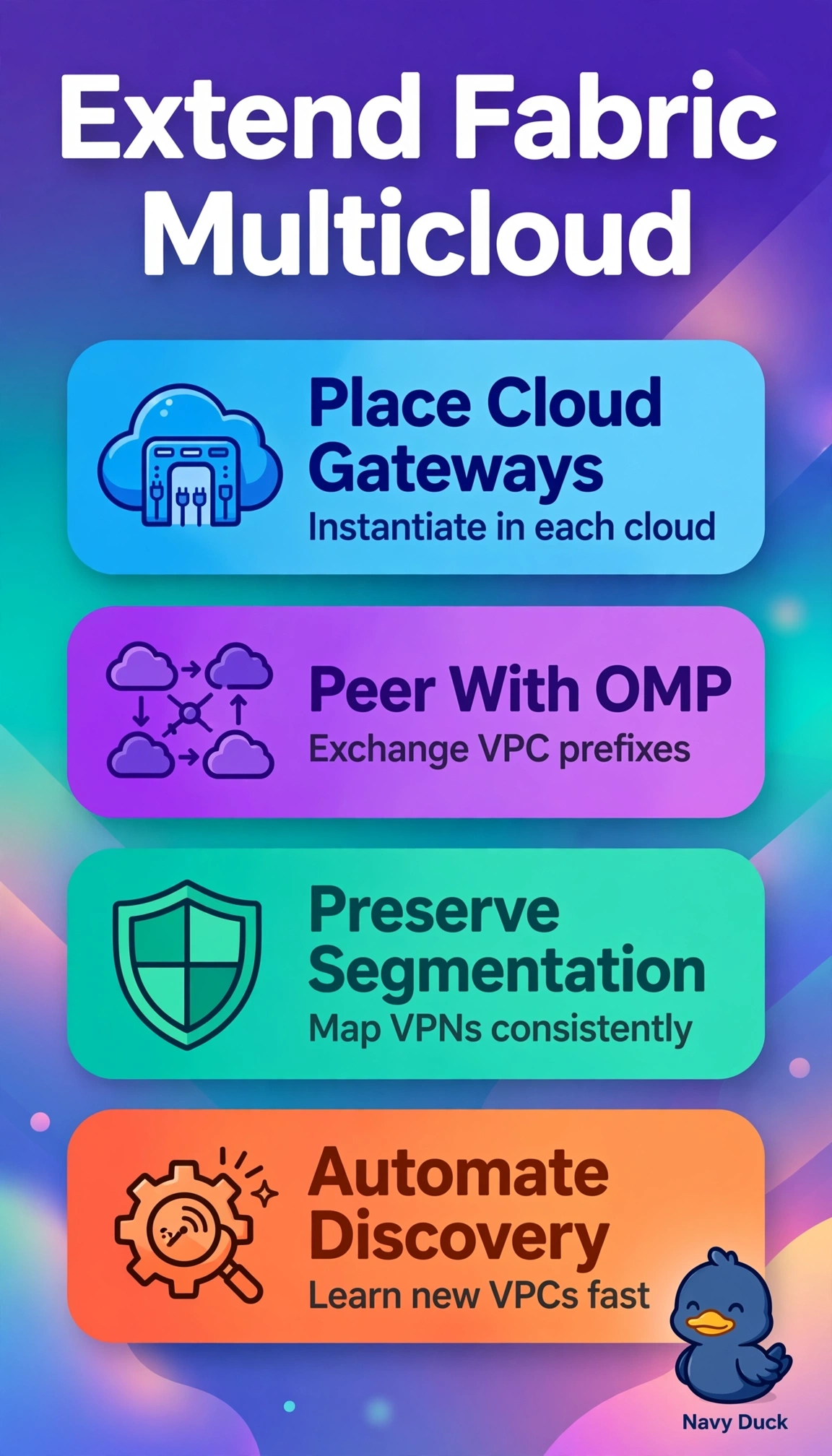
You’re extending one fabric across multiple clouds, so keep routing and segmentation unified. Peer cloud gateways and the private exchange interconnect with OMP for automatic route learning and consistent VPNs. It’s like adding new warehouses to the same inventory system instantly.
Full Explanation
The best fit connects both cloud gateways and the private exchange interconnect to the SD-WAN fabric using OMP peering. OMP advertises VPC/VNet prefixes, TLOCs, and VPN segmentation automatically, keeping policy consistent end to end while branches choose optimal dynamic paths to AWS, Azure, and SaaS; this avoids per-VPC manual work as VPCs appear weekly. Extending OMP only to AWS and Azure gateways supports hyperscaler automation, but leaves SaaS reached through the private exchange outside the fabric, risking suboptimal or unsegmented access. Using BGP between gateways, the exchange, and SD-WAN routers can provide dynamic reachability and path selection, but does not provide OMP VPN route exchange and key distribution for automatic, consistent segmentation across domains. OMP peering combined with static routing can carry segmentation, but static preferences cannot respond to SLA, loss, or latency, so paths are not automatically optimized for branch-to-cloud SaaS performance. Exam caveat: distinguish BGP reachability from OMP segmentation; the issue is whether segmentation and automation propagate, not merely whether routes are learned. Practical check: confirm in the controller that new VPC prefixes appear in the correct VPN as OMP routes, and that branch edges show dynamic TLOC-based next-hop selection for cloud and exchange destinations.