
A bank with 60 branches must prevent direct branch-to-branch routes for audit isolation, must allow all branches to reach two data-center hubs, and must keep OMP peering scalable. Which control policy design should you build to enforce hub-and-spoke topology?
Select an answer to reveal the explanation.
Short Explanation
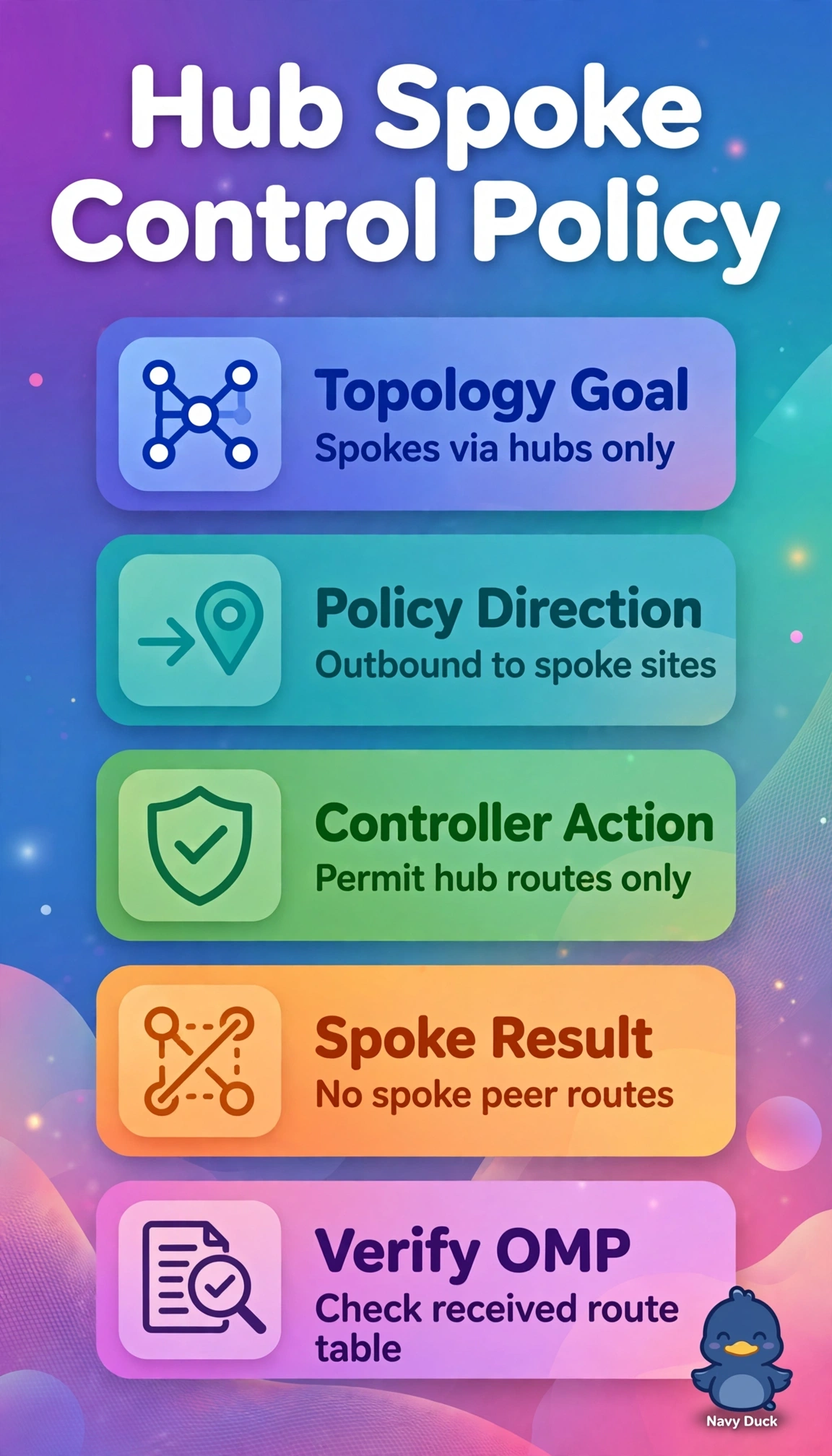
You're the traffic cop for routes, and the Controller is your checkpoint. An outbound control policy toward the spokes passes only hub routes, like giving branches a map with just headquarters marked.
Full Explanation
The correct design is a centralized control policy, defined on the SD-WAN Controller and applied outbound to the spoke site list, that accepts routes and TLOCs originated by the two hub sites and rejects routes originated by other spokes. Spokes therefore receive only hub reachability, which enforces the audit ban on direct branch routes, keeps both data-center hubs reachable, and scales because a single policy on the Controller governs all 60 branches without per-device configuration. A localized route policy on each spoke fails because it must be built and maintained on sixty devices, and the Controller would still send every spoke prefix over OMP, so enforcement is not centralized. Advertising aggregated hub and spoke prefixes fails because it restores spoke reachability, which violates the isolation requirement. Advertising only regional data-center prefixes fails because each branch must reach both data centers. Exam caveat: control policy shapes OMP route and TLOC advertisement and is applied on the Controller, so direction and site-list placement matter more than prefix wording. Practical check: after activation, check OMP routes received on several spokes to confirm hub prefixes are present, spoke prefixes are absent, and both hubs remain reachable.