
A campus WAN Edge connects to legacy EIGRP switches in VPN 10, must advertise three campus subnets to remote sites, and must prevent routing loops when learning OMP routes back. Which configuration approach should the engineer implement to redistribute EIGRP service-side routes into OMP?
Select an answer to reveal the explanation.
Short Explanation
You're translating local gossip for the global network without creating echoes. Redistribution is your interpreter, and filtering keeps the conversation loop-free, so boundaries matter between EIGRP and OMP.
Full Explanation
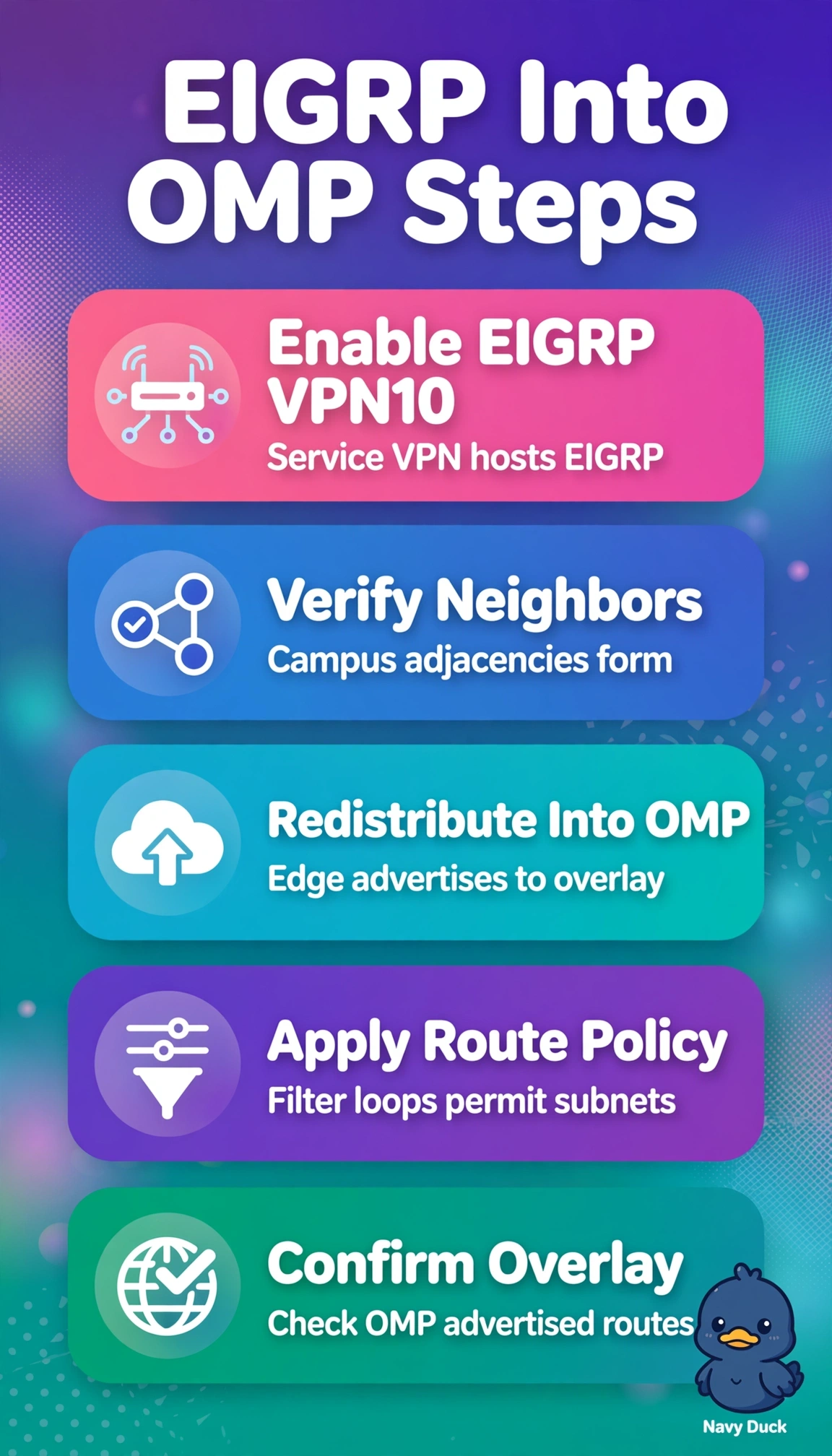
The correct approach succeeds because EIGRP must run in the same service VPN as the legacy switches, so VPN 10 provides adjacency and places the three campus subnets in the proper table, redistribution from EIGRP into OMP exports those local prefixes to the overlay for remote sites, and the route-policy enforces selective advertisement to block feedback when those prefixes are learned back via OMP. The VPN 20 variant fails on segmentation concept because service VPNs maintain separate routing tables, so even with correct protocol, direction and filtering it would peer in the wrong VPN, miss the campus subnets entirely and advertise nothing useful. The OMP-into-EIGRP variant in VPN 10 fails on direction concept because redistribution only moves routes one way, so it correctly imports remote prefixes into campus EIGRP but never exports the three campus subnets into OMP, leaving remotes without reachability. The default permit-all variant fails on filtering and loop-control concept because advertising the entire EIGRP domain without prefix control risks re-advertising feedback, creates churn and violates the loop-prevention requirement. As an exam caveat, VPN 0 is transport-only and never carries service redistribution, so always match the service VPN number in the stem. As a practical check, show EIGRP neighbors in VPN 10, validate the OMP policy prefix-list, then verify the three routes appear as OMP routes on a remote Edge.