
A national retailer is consolidating two data centers as regional hubs for 300 stores in a hub-and-spoke design, requiring continued store-to-DC access if one DC fails and no store-to-store transit through a single point. Budget allows dual routers per DC but not full mesh. Which data center and regional hub deployment approach satisfies resiliency for this hub-and-spoke requirement?
Select an answer to reveal the explanation.
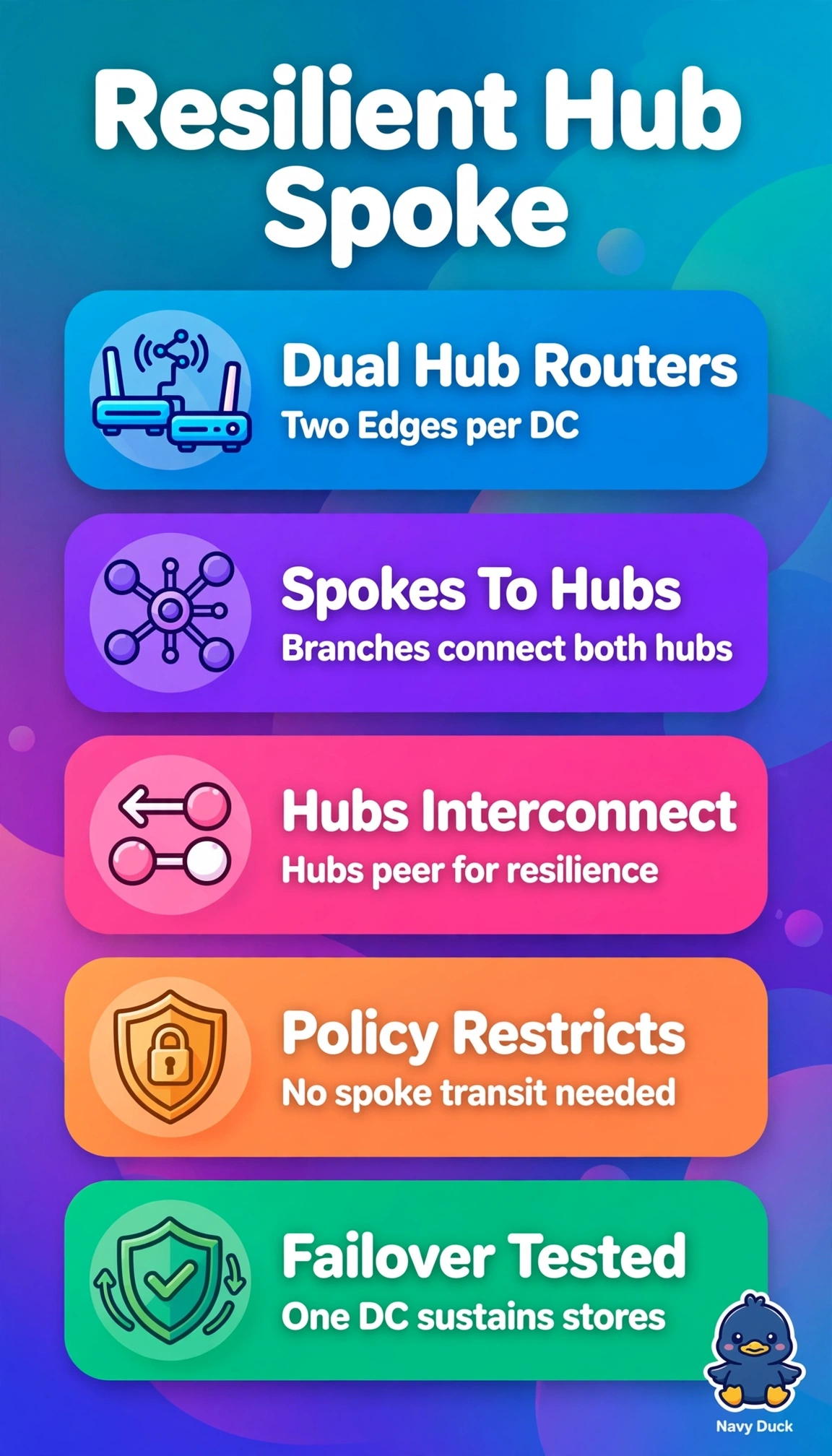
Short Explanation
You can't afford an outage taking every store offline, so redundancy must live at the hubs. Dual hubs with hub-and-spoke policy keep stores connected even if one DC or router fails.
Full Explanation
A resilient hub-and-spoke design uses redundant WAN Edge routers at each data center or regional hub, diverse transports and power, and centralized control policy that restricts branches to hub TLOCs while allowing hubs to interconnect, so loss of one hub router or an entire DC still leaves an alternate hub path without requiring branch-to-branch full mesh. A single router per data center creates a single point of failure and enabling store-to-store tunnels everywhere defeats hub-and-spoke control and increases scale overhead. Configuring hubs as simple repeaters misstates SD-WAN forwarding, hubs must terminate IPsec and participate in routing and policy rather than passively repeat. SD-WAN Controllers (formerly vSmart) distribute routes and policy and do not forward data traffic, so adding Controllers in the data center does not provide data-plane resiliency. For the exam distinguish control-plane redundancy from data-plane hub redundancy, and in practice verify hub TLOC preferences, OMP routes from both hubs, and failover by isolating one hub router.