
A network team must block a specific site prefix from being advertised to partners, keep all other OMP routes flowing, and enforce the filter consistently across the overlay. Which centralized control-policy application best achieves this OMP filtering requirement?
Select an answer to reveal the explanation.
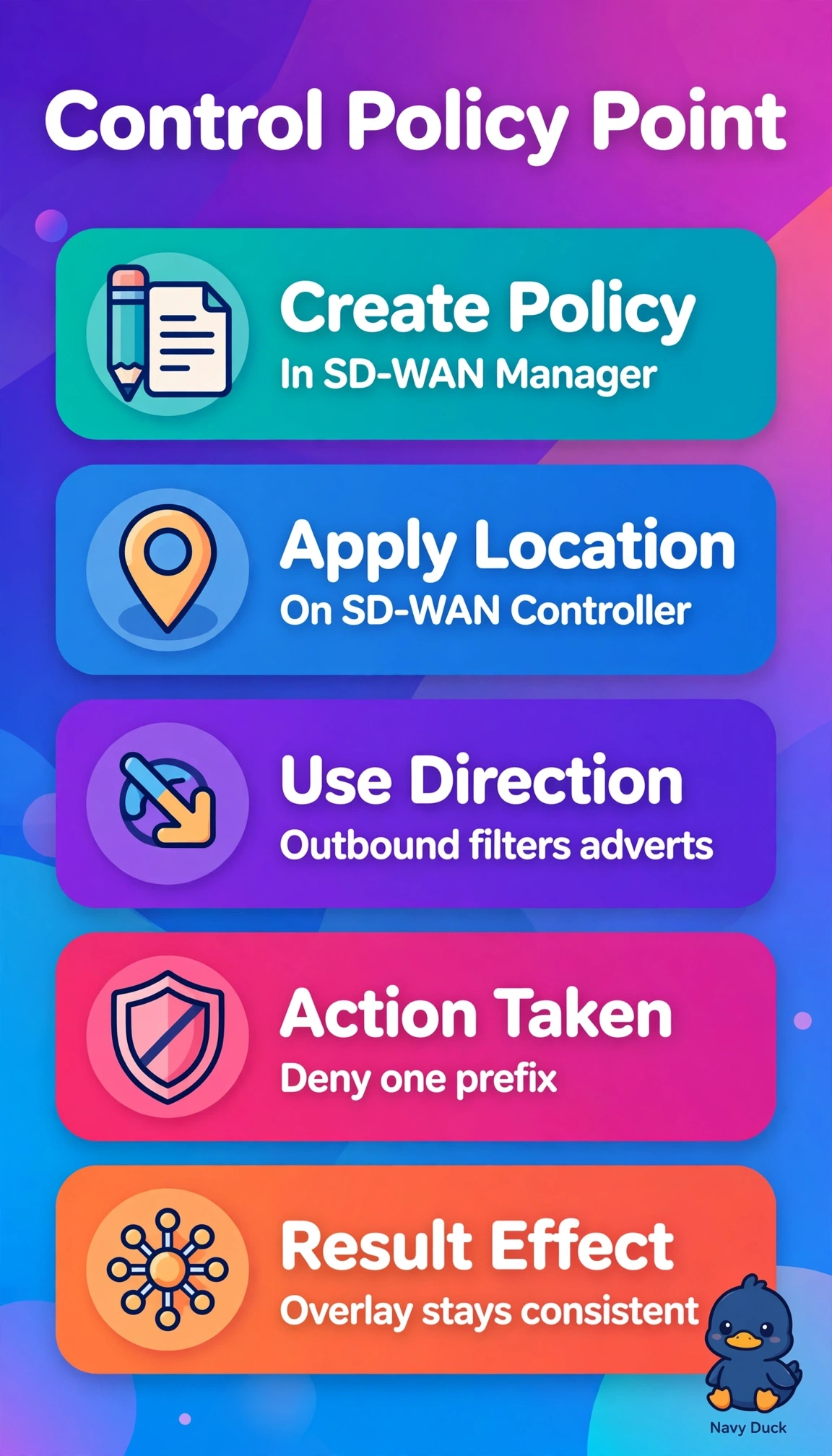
Short Explanation
Filtering at the source of truth keeps your overlay tidy everywhere at once. The controller, formerly vSmart, is like a central post office sorting mail before delivery. An outbound control-policy there stops that prefix cleanly.
Full Explanation
An outbound centralized control policy applied on the SD-WAN Controller is correct because OMP advertisement filtering for the overlay is enforced on the controller toward the partner site-list, where a sequence matching the specific prefix-list with reject and default accept blocks only that prefix while preserving all other routes. The inbound centralized variant fails on direction logic because inbound governs what the controller learns into its RIB from edges rather than what it advertises outward, so it would alter learning instead of controlling distribution to partners. The localized edge variant fails on enforcement scope because a policy applied on an edge device affects only that device and cannot provide consistent overlay-wide control that centralized policy provides from the controller. The filter-all variant fails on selectivity because denying every advertisement to partners creates full isolation and violates the requirement to keep all other OMP routes flowing while blocking only one prefix. Exam caveat is to interpret inbound and outbound relative to the controller and to separate the site-list that selects recipients from the prefix-list that selects routes. Practical check is to inspect the centralized policy for correct site-list, precise prefix-list, reject action with accept default, then verify on the controller advertised routes and on a partner edge received routes that only the intended prefix is missing.