
An international retailer operates 35 stores with dual transports and requires voice traffic to prefer MPLS with failover to broadband at every site, while each store also needs local OSPF redistribution and service-VPN route maps unique to its LAN. The design must apply the common steering once and keep site-specific routing on the routers. Which policy scope and enforcement design correctly separates localized policy from centralized policy?
Select an answer to reveal the explanation.
Short Explanation
You've got one chain-wide rule and lots of site-specific chores, so don't mix them up. Centralized steering is your HQ memo, while localized policy is each store's to-do list handled right on its router.
Full Explanation
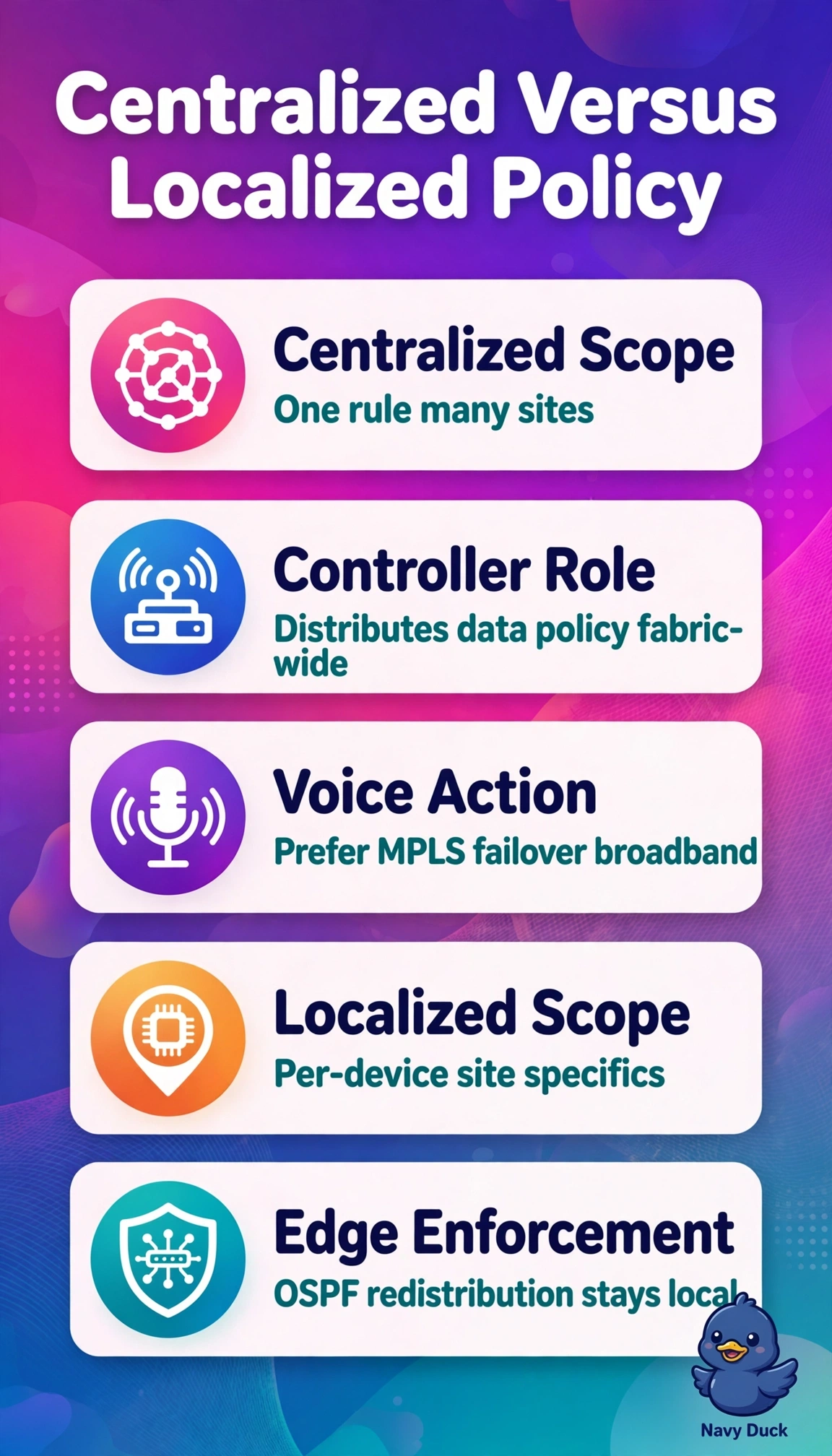
A centralized data policy is defined in SD-WAN Manager and distributed to the SD-WAN Controller (formerly vSmart) for fabric-wide enforcement, which makes it ideal for the single voice-prefers-MPLS intent applied to all 35 site-lists without per-device configuration, and the Controller then programs the WAN Edges with the resulting forwarding behavior. Localized policy is defined in SD-WAN Manager but pushed directly to the selected WAN Edge routers and enforced locally on each device, which makes it the correct place for device-specific service-side functions such as OSPF redistribution, route maps, ACLs, and NAT that vary per LAN. Reversing the scopes fails by concept because localized policy cannot efficiently enforce one consistent path preference fabric-wide and centralized policy cannot express per-device routing details cleanly. Using only centralized policy fails by concept because it forces unique per-site redistribution into a fabric template that is designed for common match-action rules. Using only localized policy fails by concept because it replicates the same voice preference on 35 devices and loses single-point control and visibility. For the exam, remember centralized means Controller-distributed and site-list targeted while localized means device-targeted and Edge-enforced, and in practice verify in SD-WAN Manager that the centralized policy is present on the Controller and the localized policy appears in the device running configuration.