
An e-commerce firm needs subsecond failover for payment traffic and historical loss, latency and jitter per tunnel to guide SLA policies. Links show intermittent brownouts that routing protocols miss, so continuous liveness and quality measurement on every tunnel is required. Which BFD role with timers and path-quality reporting meets this need?
Select an answer to reveal the explanation.
Short Explanation
Routing can look alive while shoppers feel the pain, so you measured the path itself. Fast BFD probes give you both failover and quality insight.
Full Explanation
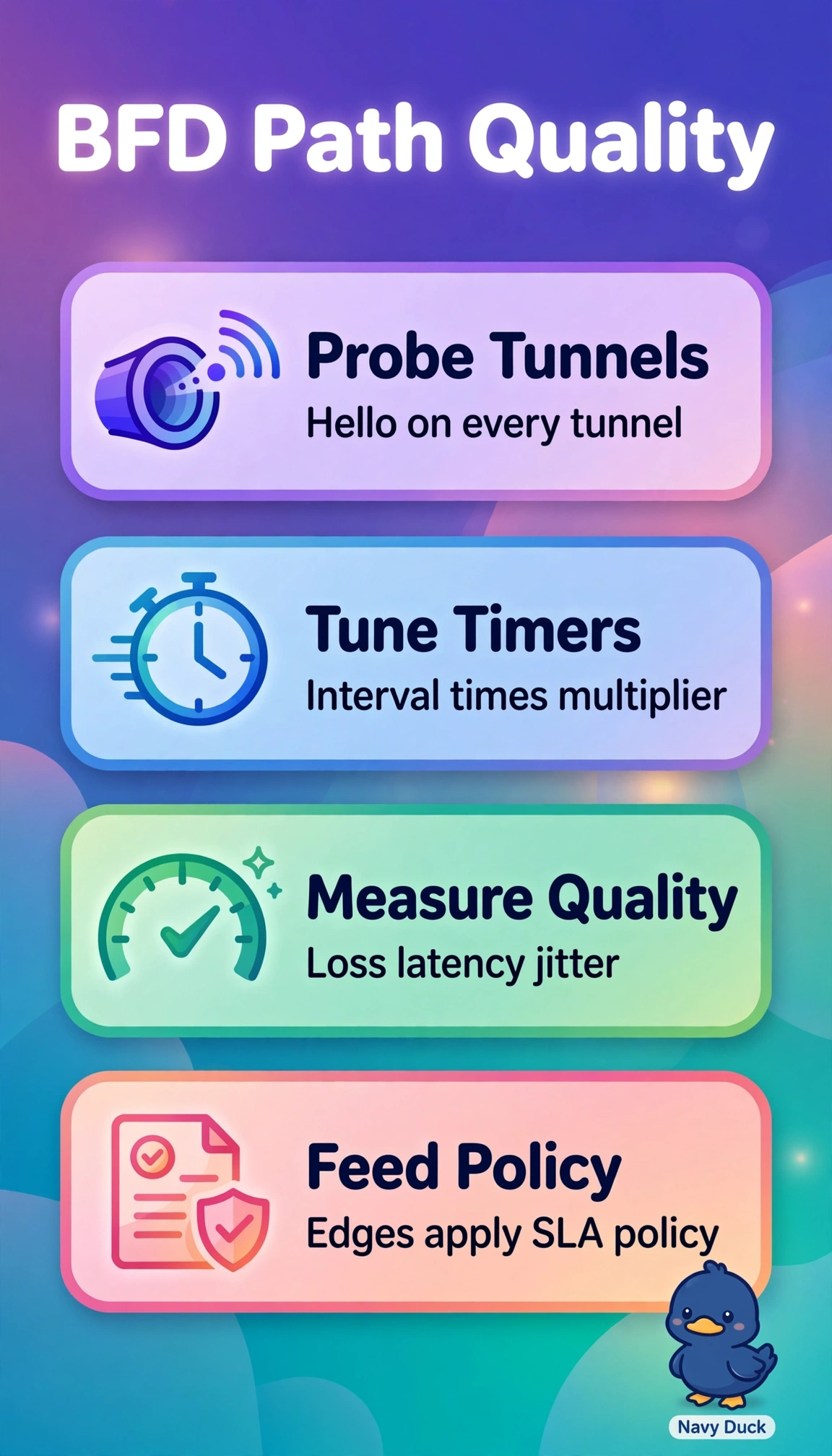
The correct approach is right because BFD runs as a lightweight per-tunnel hello protocol with configurable interval and multiplier that detects data-plane brownouts in hundreds of milliseconds even when routing stays up, while the same session continuously computes loss, latency and jitter and retains per-tunnel history for SLA policy design, directly satisfying subsecond failover plus granular quality visibility. The live-only BFD variant fails by concept because real-time display without retention preserves detection but removes the historical evidence needed to define thresholds and prove compliance, so payment steering would lack auditability. The per-site averaging variant fails by concept because aggregation hides the impaired tunnel inside a healthy site average, preventing selective failover and per-tunnel SLA action during intermittent brownouts. The OMP-hold plus reporting-only variant fails by concept because OMP monitors control-plane peering rather than forwarding-plane path quality and without coupling BFD to forwarding, brownouts persist until slow control timeout instead of triggering immediate data-plane reroute. For exam purposes remember to distinguish control-plane keepalives from data-plane liveness and to associate per-tunnel BFD statistics with both fast detection and application-aware routing decisions rather than confusing polling or aggregation with continuous measurement. In practice verify with show commands for BFD sessions and tunnel statistics, confirm hello interval and multiplier yield the target detection time, and validate that history graphs show loss, latency and jitter per tunnel before applying SLA policies.