
A bank is consolidating two data centers and four regional hubs serving 300 branches that need deterministic exit, sub-second failover, and localized policy without full mesh complexity. Architects debate hub roles, redundancy, and peering. Which data center and regional hub deployment consideration correctly applies hub-and-spoke and resiliency for WAN Edge deployment?
Select an answer to reveal the explanation.
Short Explanation
Hubs are your anchors, not afterthoughts. Layer them, double them, and let branches lean on them — that's steady backbone thinking.
Full Explanation
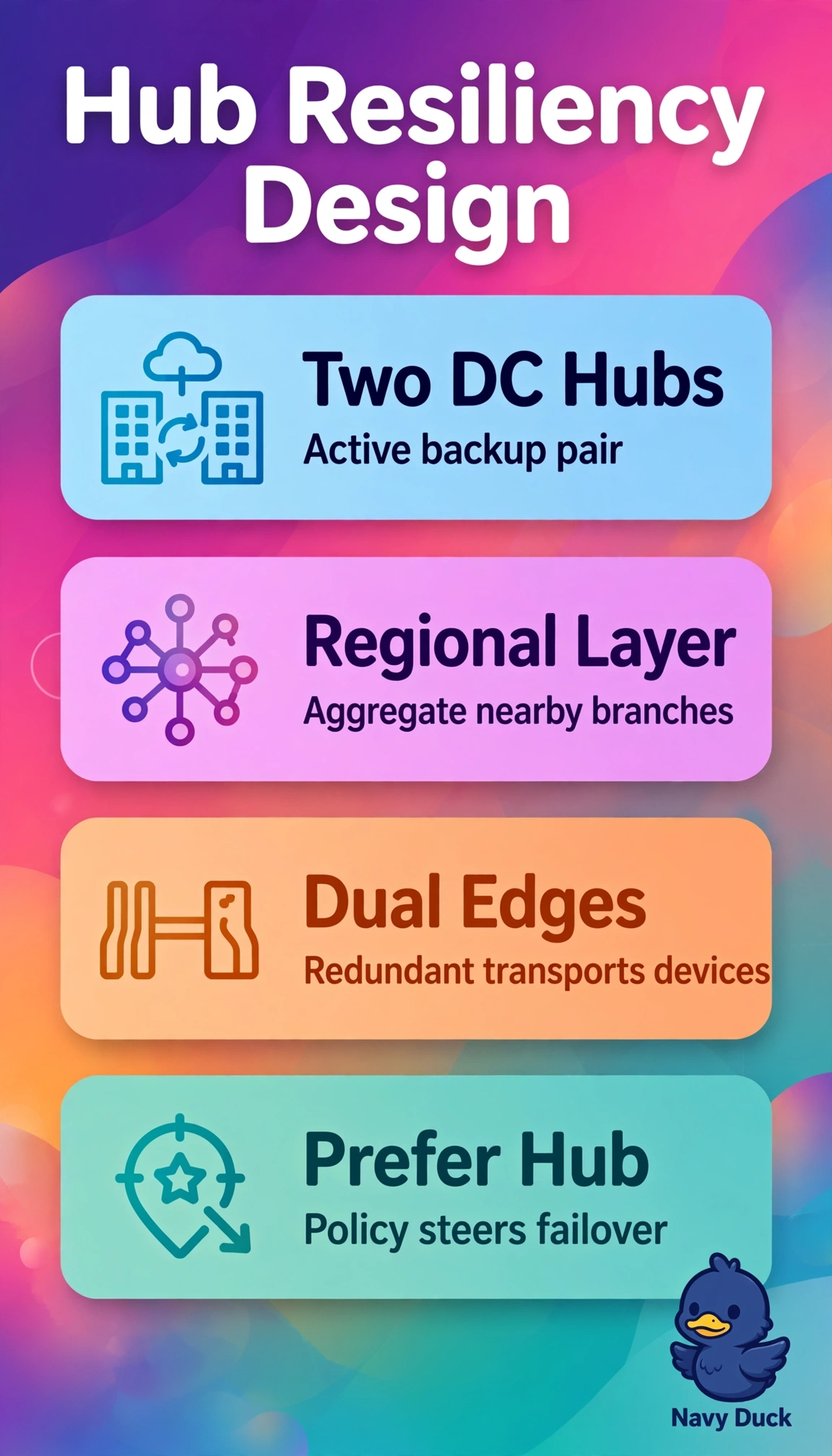
The correct design succeeds because dual data-center hubs provide geographic redundancy while hierarchical regional hubs aggregate the 300 branches, preserve localized policy, and avoid full-mesh scale, with redundant Edges and hub-preferred topology delivering deterministic exit and fast failover through BFD detection and OMP backup paths. A design using hierarchical hubs and redundant Edges but shifting cloud traffic to local direct breakout is a valid DIA pattern for SaaS optimization yet fails deterministic exit because branch-local decisions bypass hub policy, inspection, and controlled failover sequencing. A flat design homing all branches directly to dual data centers with redundant Edges and centralized policy preserves determinism and redundancy but fails hierarchy and locality because it creates excessive control connections, summarized-route sprawl, and operational burden that regional aggregation was intended to solve. A design retaining dual hubs, hierarchy, and hub-preferred routes but relying on a single Edge per hub with dual transports is common for cost savings and still protects against transport loss yet fails resiliency because Edge maintenance, software failure, or hardware fault removes the hub attachment entirely and prevents sub-second device-level switchover. For exams, distinguish transport redundancy from device redundancy and DIA from hub breakout, as wording around preferred versus backup paths often signals expected failover behavior. In practice, verify hub preference, affinity, and OMP advertisements in the lab, then simulate Edge and transport failures while measuring convergence and confirming branch exit remains predictable under both conditions.