
A branch in VPN 20 needs selective DIA so only guest web traffic breaks out locally while corporate traffic stays on OMP overlays. Both transports have NAT, and blanket local default routing is prohibited. Which DIA approach provides app-selective local breakout?
Select an answer to reveal the explanation.
Short Explanation
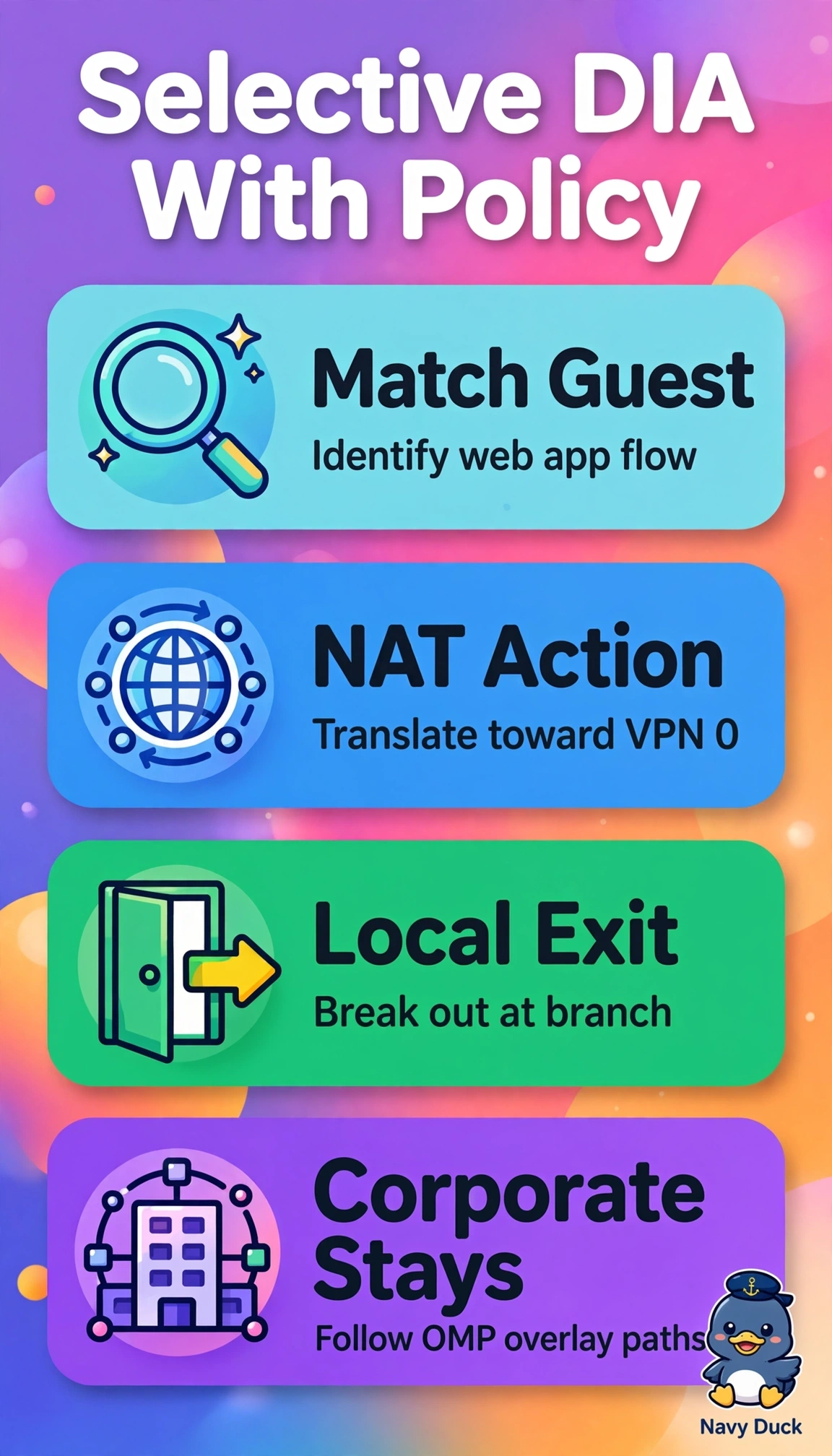
Selective means steering only what you want. A data policy with NAT action breaks out guest web while corporate stays on overlay.
Full Explanation
Selective DIA requires flow-level steering plus source translation, which a centralized data policy provides by matching application or prefix and invoking a NAT action with VPN 0 as the egress toward the local Internet transport, leaving other traffic on OMP paths, which is why the data policy with NAT action is correct; a static default NAT route is blanket routing that would send corporate traffic locally in violation of the constraint, a control policy TLOC action manipulates OMP route advertisement rather than performing data-plane NAT and cannot translate guest sources, and a static route without NAT leaves private sources untranslated so return traffic fails. For the exam remember data policy equals selective DIA while static NAT route equals blanket DIA, and operationally verify with policy counters and show ip nat translations on the branch Edge. The SD-WAN Manager was formerly called vManage.