
A service provider outgrows a single SD-WAN Manager handling 800 devices, with statistics lagging and configuration commits queuing. The plan adds two nodes for scale and resiliency without splitting the overlay. Which cluster design should the architect deploy to distribute Manager load?
Select an answer to reveal the explanation.
Short Explanation
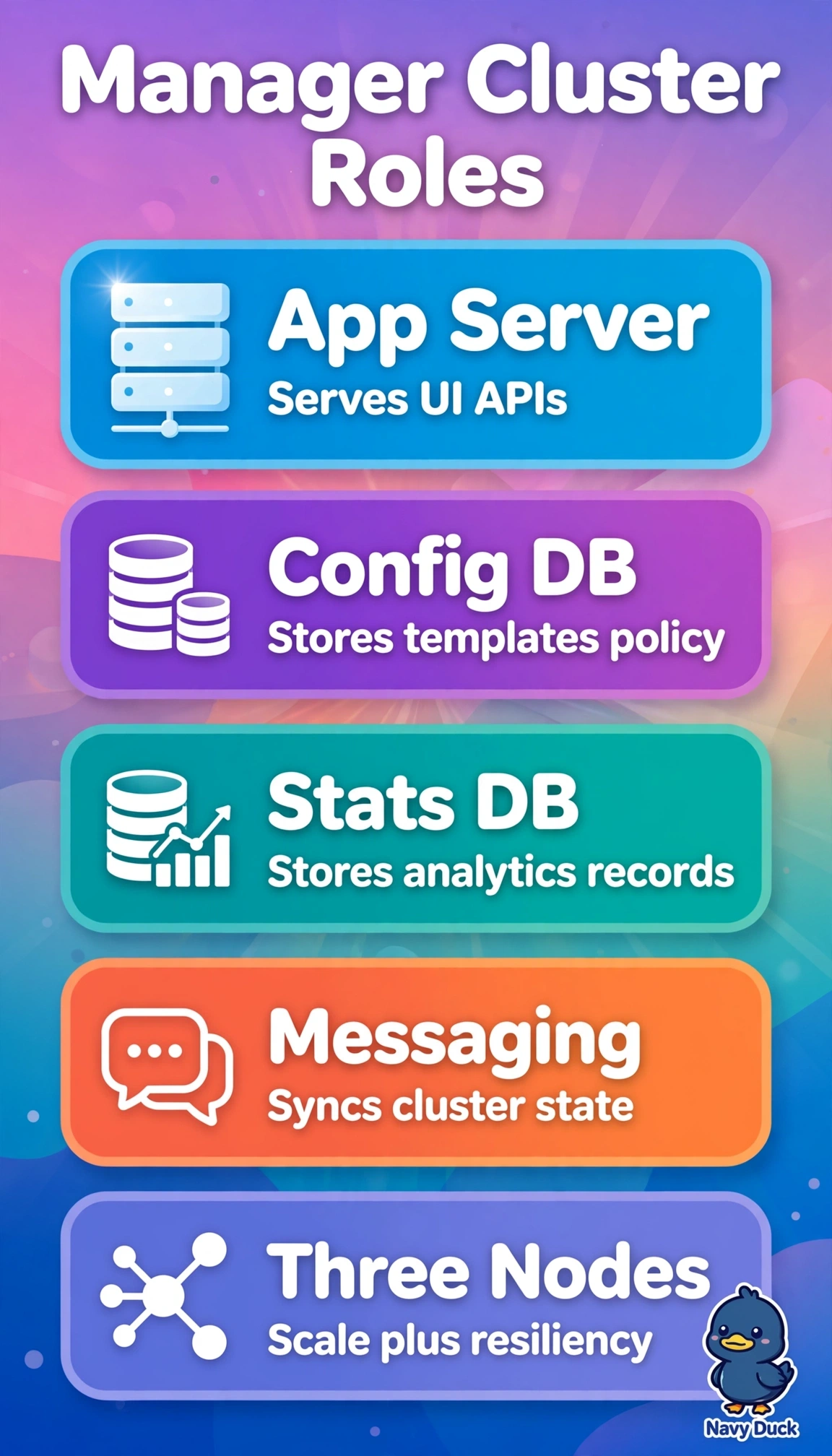
You're turning one overloaded desk into a team with clear jobs. Cluster services split UI, config and stats so each node pulls its weight.
Full Explanation
SD-WAN Manager clustering (formerly vManage clustering) scales through NMS application server, configuration database, statistics database, and messaging services distributed across three or more nodes with replication, allowing device load, sessions and analytics to balance while retaining a single logical manager and single pane of glass. A three-node cluster with balanced application, config-DB and stats-DB roles relieves commit queuing and stats lag without fragmenting management. Three standalone managers create split-brain domains with separate databases and no state sharing, breaking centralized policy. A single larger disk does not add compute or service redundancy and leaves a single point of failure. Validators (formerly vBond) handle orchestration and NAT traversal, not statistics collection or template storage, so adding them cannot offload Manager load. For the exam, remember cluster nodes share services and require inter-node reachability and version parity; check Cluster Management in Administration to confirm service distribution and replication status.