
A logistics company adds LTE and MPLS at 50 branches and sees tunnels forming unpredictably, with some branches preferring the wrong transport despite policy. The architect must explain how endpoint identity steers IPsec tunnel formation. Which TLOC structure description correctly links system IP, color, and encapsulation to how TLOCs drive tunnel formation?
Select an answer to reveal the explanation.
Short Explanation
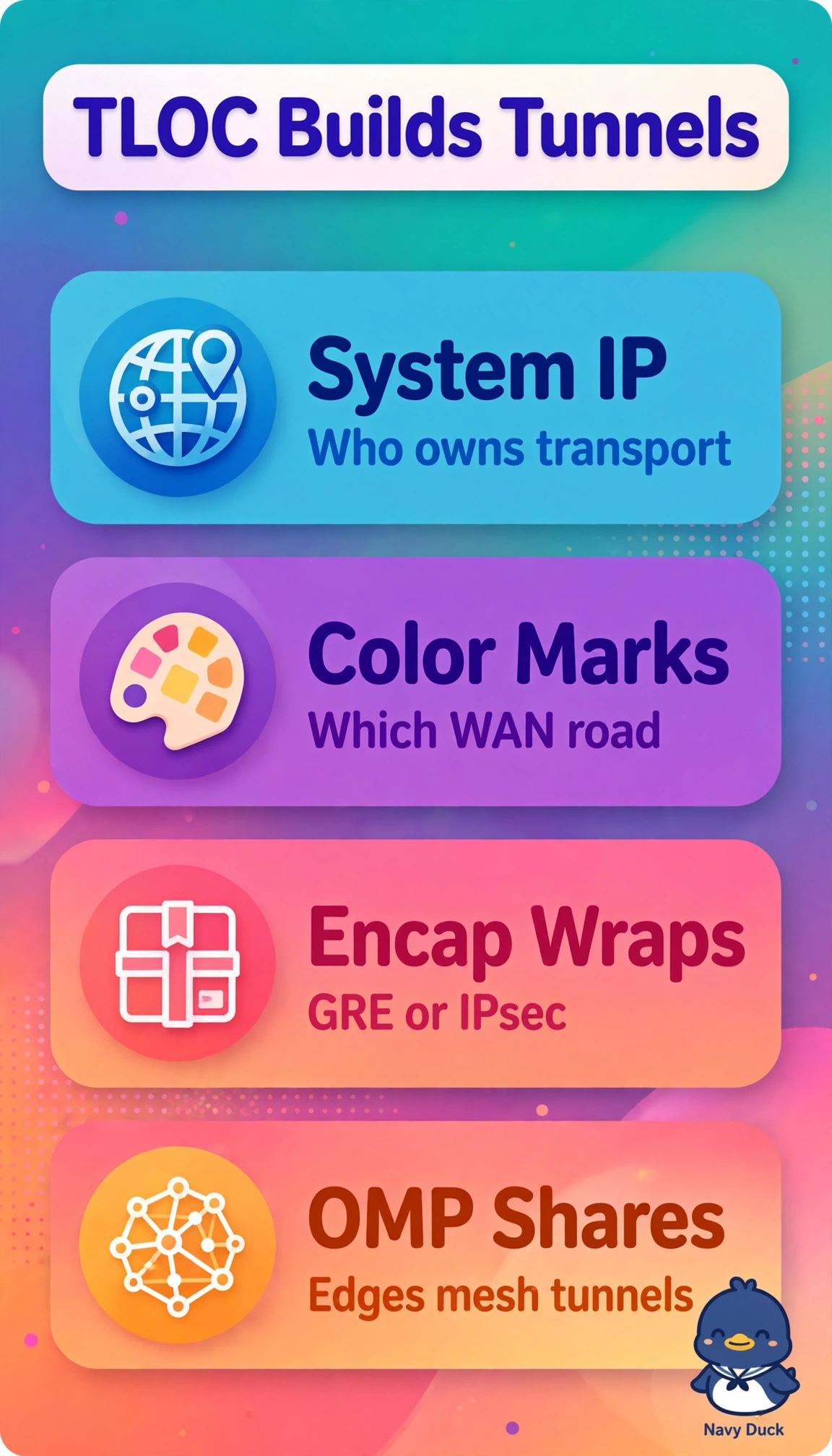
Nailing the three-part address stops mystery tunnels. You label who, which road, and how wrapped — like a parcel-label for every path.
Full Explanation
The correct description is accurate because each transport attachment is advertised as a TLOC identified by system IP for unique device identity, color for transport type such as MPLS versus LTE, and encapsulation for IPsec versus GRE capability, and edges exchange those TLOC routes over OMP then build IPsec tunnels between local and remote TLOC pairs, which explains unpredictable peering when colors are misassigned and why policy must match color to prefer the intended path. The description using system IP plus color plus OMP preference fails by concept because preference is a route-selection attribute applied after TLOCs are advertised, not part of TLOC identity, so it cannot explain encapsulation mismatch or tunnel instantiation and it confuses tunnel creation with best-path choice. The description using system IP plus encapsulation plus NAT port fails by concept because public ports and NAT bindings affect reachability of an already defined TLOC but do not replace color as the transport distinguisher, so without color the architect cannot separate LTE from MPLS or correct wrong-transport preference. The description using site ID plus color plus encapsulation fails by concept because site ID identifies a location shared by devices for template and policy scope, while only system IP gives globally unique endpoint identity for TLOC advertisement and tunnel destination lookup, so multi-router branches would remain ambiguous. As an exam caveat, distinguish TLOC identity that drives tunnel formation from centralized data policy and OMP preference that only steer traffic after tunnels exist. As a practical check, compare show omp tlocs with show ipsec tunnels on both peers to confirm every expected system IP, color, and encapsulation tuple is present and meshed before adjusting policy.