
A healthcare group is sizing 25 new clinics where each WAN Edge must run on-box firewall, IPS, URL filtering and continuous application QoE monitoring for telehealth, with room for throughput growth. Procurement wants the lowest cost that still meets services. Which sizing consideration should the architect prioritize to support security and app-QoE services?
Select an answer to reveal the explanation.
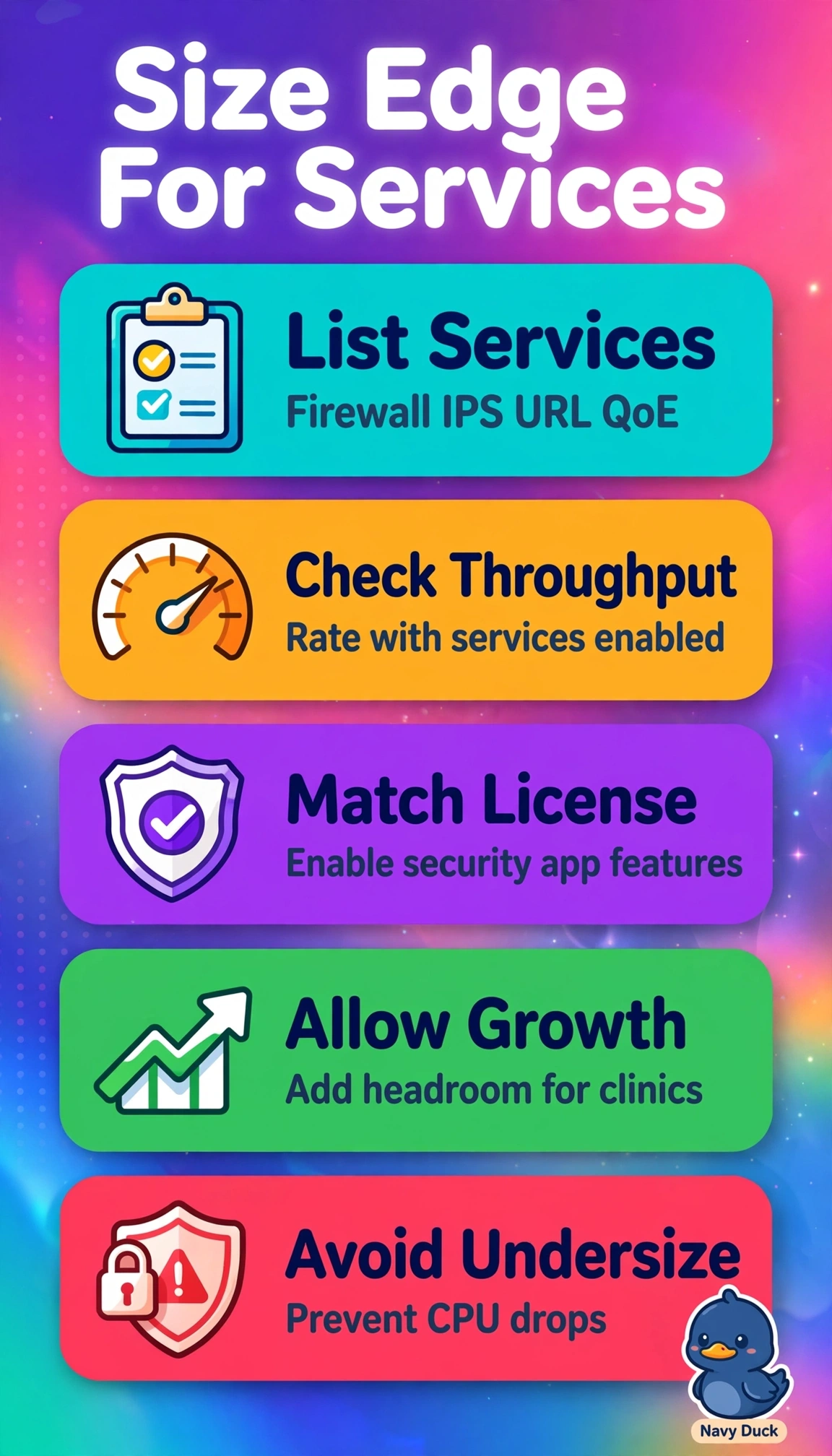
Short Explanation
You spotted that features have a hardware cost. Enabling inspection is like towing a trailer that needs a bigger engine, so prioritize sizing with services on.
Full Explanation
The correct approach validates platform and license capacity with firewall, IPS, URL filtering and continuous QoE all enabled because each service consumes forwarding CPU, memory and subscription throughput that raw IMIX numbers hide, preserving telehealth quality while still allowing lowest-cost procurement with growth headroom. Sizing with on-box threat prevention plus aggregated flow visibility reflects standard capacity planning but fails continuous application monitoring, since aggregated telemetry lacks per-session loss, latency, jitter and voice-video scoring required to detect and troubleshoot telehealth degradation. Relying on cloud-delivered threat prevention with continuous QoE is a proven hub or SSE pattern to reduce branch load, but it breaks the explicit on-box requirement for every clinic and adds dependence on uplink bandwidth, encryption and external availability for functions that must stay local. Validating an economical platform only at current peak telehealth load with full services active saves cost now but omits growth headroom, inviting CPU saturation and forced upgrades as sessions and encrypted traffic rise. Exam caveat: separate firewall throughput from full-stack throughput with IPS, URL filtering and QoE enabled when comparing datasheets. Practical check: pilot the candidate tier with production traffic mix, all services on, and confirm headroom at peak plus projected growth before purchase.