
A multinational reports that branch prefixes appear in SD-WAN Manager but internet exits and firewall services are not advertised correctly, and engineers debate which OMP advertisements carry what. The fabric uses SD-WAN Controller for route reflection with service-side and transport attachments. Which OMP route type mapping correctly describes OMP routes, TLOC routes, and service routes and what each carries?
Select an answer to reveal the explanation.
Short Explanation
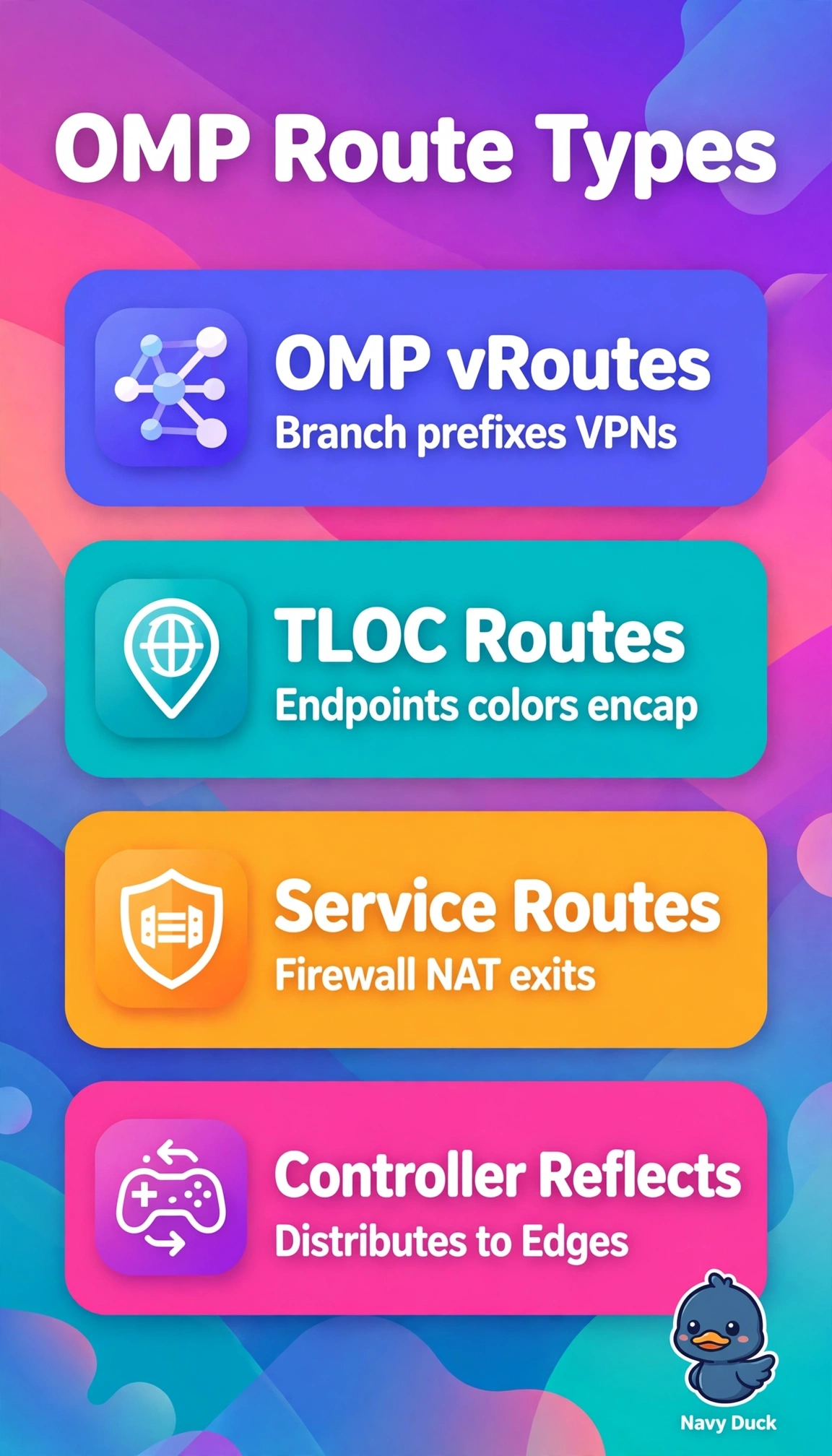
You'll clear this up fast when you give every advertisement its own job on your road trip. Your vRoutes list the branch neighborhoods, TLOCs are the highways you'll ride, and service routes are the pit stops for firewall or NAT help.
Full Explanation
OMP, originated and reflected by SD-WAN Controller formerly vSmart, advertises vRoutes or OMP routes carrying VPN prefixes, attributes and VPN topology for site reachability, TLOC routes carrying transport locators with color, encapsulation and reachability for tunnel endpoints, and service routes carrying service VPN labels and addresses for shared services such as firewall, IDS, NAT or cloud exit. Swapping their payloads fails by concept because TLOC routes cannot carry prefix topology and vRoutes cannot carry underlay next-hop construction, just as assigning authentication or system IP allocation to OMP routes confuses control-plane identity bootstrapping with learned reachability. Assigning key exchange or DTLS setup to these routes also fails because encryption and session establishment use DTLS/TLS and IKE, not route advertisements. Exam caveat is to check VPN-ID, origin and label fields when troubleshooting missing prefixes versus missing tunnels, and practical check is to compare OMP routes and TLOCs on Controller and Edge with show omp routes commands.