
A seaport logistics hub runs voice dispatch, a warehouse management system, and nightly database replication over MPLS and broadband. Dispatch voice marked EF freezes when replication bursts, and managers need voice protected without blocking replication. Which centralized data-policy sequence match uses source, destination, application, and DSCP?
Select an answer to reveal the explanation.
Short Explanation
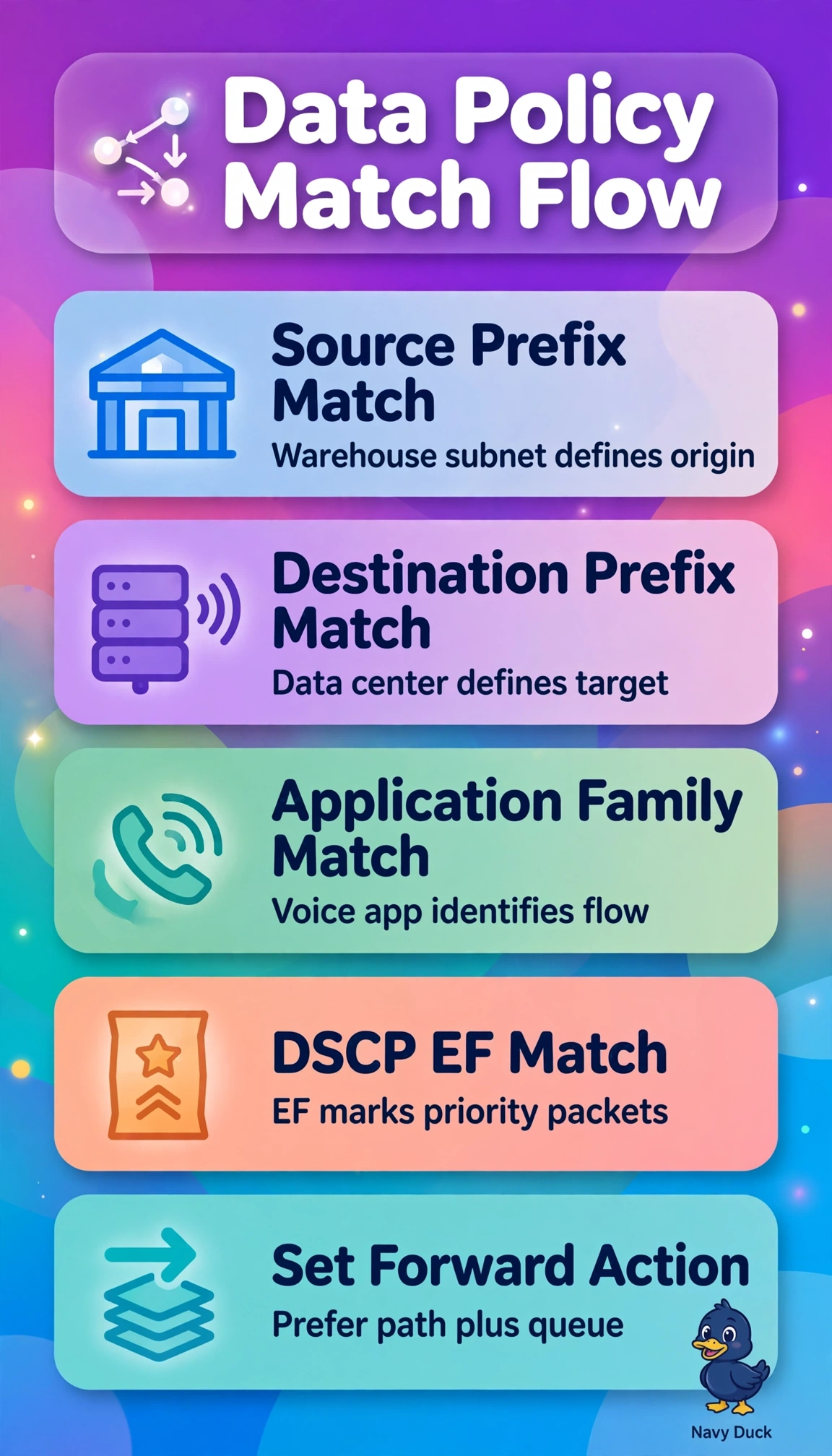
Sorting this crowd is easier with four name tags at once. Your winning sequence checks where traffic starts, where it's headed, what app it is, and its DSCP-marking before giving voice the fast lane. Route tags and hardware facts can't see packets that way.
Full Explanation
The correct sequence is right because centralized data policy can isolate dispatch voice across MPLS and broadband by combining prefix scope with application awareness and marking trust, where source warehouse and destination data-center prefixes limit scope to the affected flow, voice family identification handles dynamic ports that port ACLs miss, DSCP EF verifies expedited forwarding is honored, and setting preferred transports with queuing gives voice strict priority while leaving replication to use remaining capacity. The AF41 video variant fails on marking concept because AF41 requests assured forwarding for video with different per-hop behavior and thresholds, so EF-marked voice misses the entry and still freezes when replication bursts. The replication application variant fails on classification concept because it elevates bulk database traffic with EF queuing, which protects throughput but inverts the business intent and starves real-time dispatch. The internet destination variant fails on scope concept because an internet prefix never matches warehouse to data-center internal traffic, so the policy never triggers on the congested path despite correct source, application and DSCP. Exam caveat is to separate centralized data policy from application-aware routing, control policy and localized QoS, and to check direction, site lists and sequence order. Practical check is to verify DPI classification and EF preservation, then validate with policy counters, queue drops and voice jitter during a replication burst.