
A 40-user branch has one MPLS transport and one Internet transport with NAT enabled on its interface in VPN 0. Users in service VPN 10 need direct Internet access for all traffic while MPLS stays preferred for corporate prefixes. Which branch DIA design provides full local Internet breakout?
Select an answer to reveal the explanation.
Short Explanation
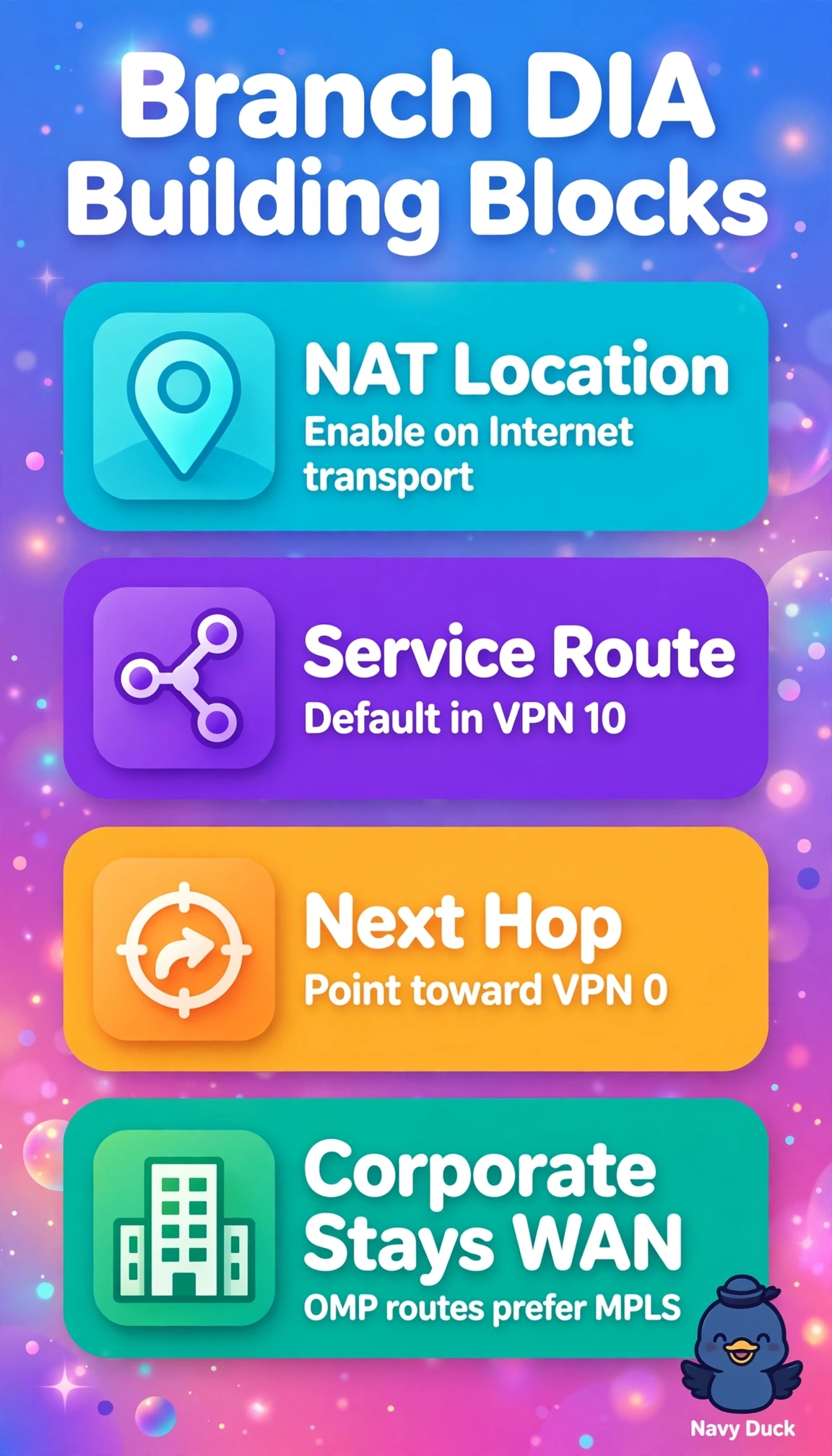
Local breakout clicks when your service VPN knows where to exit. That VPN 0 next hop plus interface NAT sends branch users straight to the Internet.
Full Explanation
Direct Internet access at a branch relies on interface NAT in VPN 0 to translate private service-VPN source addresses to the public transport address, combined with a service-VPN default route with a next-hop toward VPN 0 so local Internet-bound traffic exits locally instead of following OMP, which is why NAT on the Internet transport plus a VPN 10 default to VPN 0 is correct and preserves MPLS for corporate OMP routes; NAT on the MPLS transport would break out through the private transport that likely drops or misroutes Internet traffic, NAT on the service-VPN interface misunderstands where translation occurs because translation must happen on the VPN 0 transport interface, and originating the default only into OMP centrally would steer remote or inbound behavior rather than installing the required local exit route. The SD-WAN Controller, formerly vSmart, still distributes corporate prefixes over MPLS while the local default remains local. For the exam remember DIA needs both NAT and local routing, and operationally verify with show ip nat translations and show ip route vrf 10.