
A retail company is refreshing 80 branches that each carry about 300 Mbps of mixed MPLS and Internet traffic, need on-box intrusion prevention with TLS inspection, and must run application-aware routing with active SLA probes while keeping headroom for bursts. Which platform sizing principle ensures the WAN Edge sustains security and app-QoE services?
Select an answer to reveal the explanation.
Short Explanation
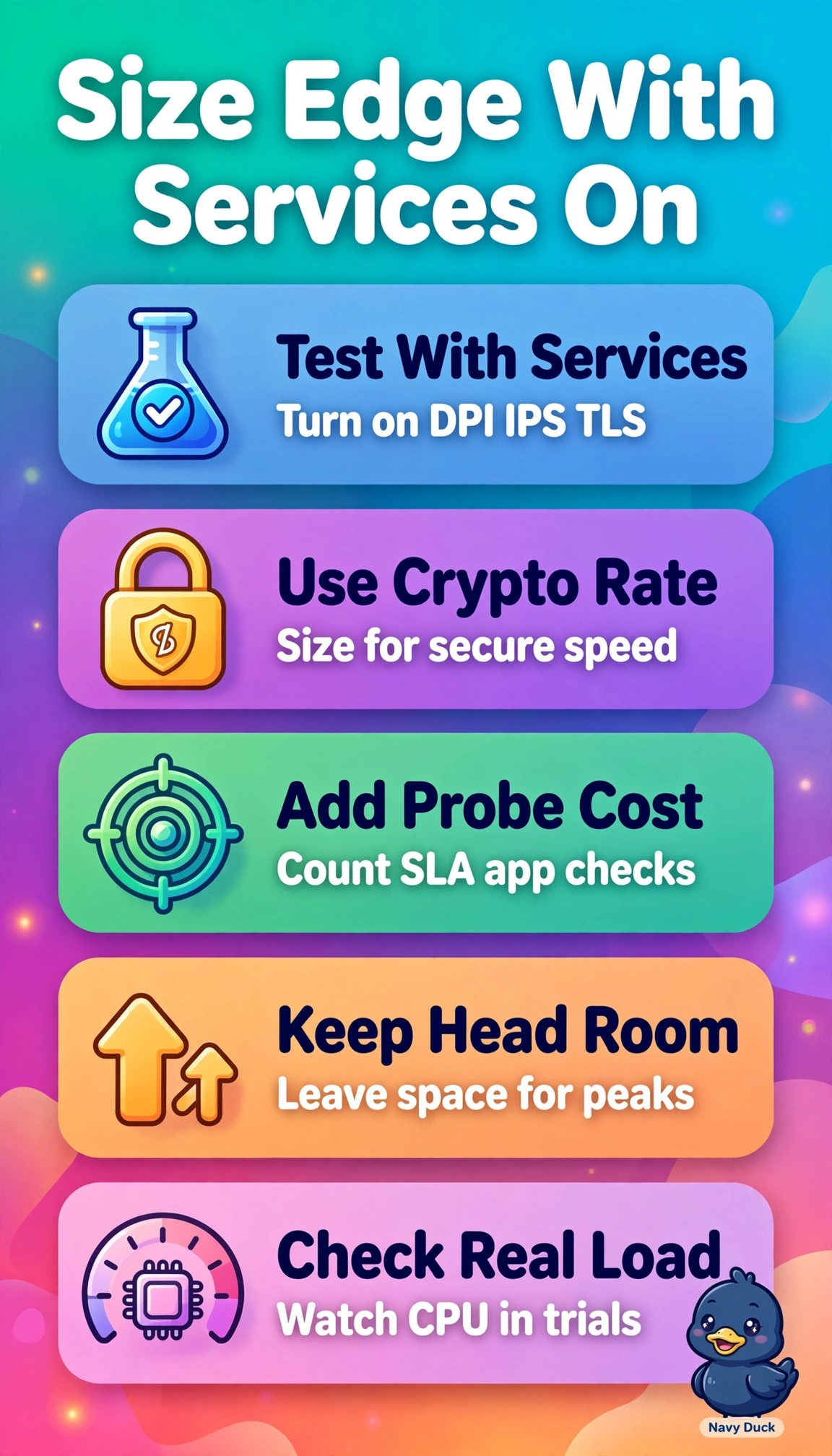
You need to measure the workload with the security and routing services you’ll actually run, not rely on a clean forwarding-rate figure. Testing with DPI, IPS, TLS inspection, and SLA monitoring enabled shows the real capacity to sustain traffic; keep burst headroom as well.
Full Explanation
Sizing from encrypted throughput with DPI, IPS, TLS inspection, and SLA monitoring enabled best reflects the resources each branch needs to sustain its mixed MPLS and Internet traffic while providing application-aware routing. DPI classification, decryption, intrusion prevention, and continuous SLA probes all consume resources, so the measured figure should include their combined overhead. The average-load measurement without burst headroom is inadequate because traffic peaks and encryption bursts can cause latency or drops even when average demand fits. Assuming DPI classification cost is minor is also unsafe: application-aware routing depends on classification, which adds processing and state overhead beyond IPS and TLS inspection. Using burst headroom based on forwarding rates alone misses the cost of active SLA monitoring, so performance measured that way may not hold once probes are enabled. A useful exam distinction is between clean interface or datasheet forwarding rates and encrypted throughput with the required services active; don’t treat them as interchangeable. The correct measurement condition includes SLA overhead, while capacity planning should also preserve headroom for bursts. In a lab or pilot, test representative encrypted traffic with DPI, IPS, TLS policies, and SLA probes enabled, then drive about 300 Mbps plus 30–50% burst headroom and check CPU, session levels, and probe loss.