
A retailer connects 40 stores to two data centers over MPLS and internet. Stores must learn LAN prefixes with their VPN IDs, edge routers must learn which WAN next-hops are reachable, and two hubs must advertise firewall service insertion. Which OMP route type should the engineer check for the firewall advertisement?
Select an answer to reveal the explanation.
Short Explanation
You’ve got this: prefixes, tunnel reachability, and service insertion each have their own route type. Service routes advertise firewall insertion with the VPN, TLOC, and service type.
Full Explanation
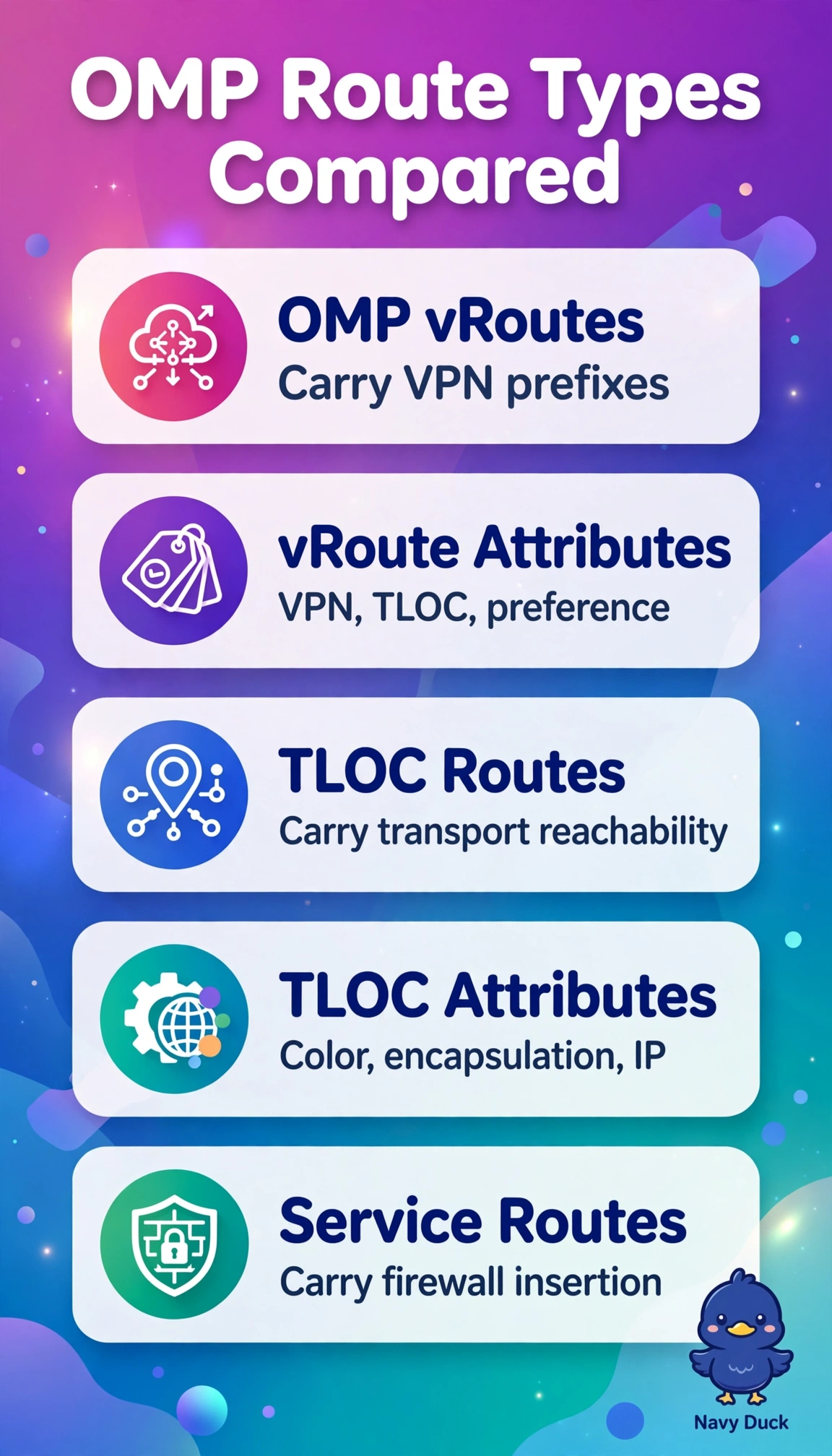
Cisco SD-WAN OMP separates route information by purpose, so the firewall advertisement belongs in service routes. Service routes advertise service insertion, such as a firewall, with the VPN, service type, and originating TLOC; this identifies the service and where it is attached. TLOC routes carry WAN transport reachability and attributes such as color and encapsulation, which help establish tunnels, but they do not advertise firewall insertion. OMP routes, also called vRoutes, carry VPN-side prefixes and their attributes; they are not the route type for tunnel liveliness, which depends on TLOC reachability. Nor do OMP routes advertise firewall state with encryption keys and uptime: those are not the attributes described for OMP routes, and firewall insertion is represented by a service route. Exam caveat: keep VPN-prefix advertisement, WAN next-hop reachability, and service insertion distinct, even though all are exchanged through OMP. For a practical check, inspect the service route advertisement and confirm its VPN, service type, and originating TLOC identify the intended firewall service.