
A manufacturer must steer file transfers and backup traffic to a central WAN optimization farm without hairpinning branch routers, with automatic load sharing across two optimizers and health-aware bypass on failure. Branches run SD-WAN with limited CPU. Which App-QoE service-steering design meets load sharing and bypass needs?
Select an answer to reveal the explanation.
Short Explanation
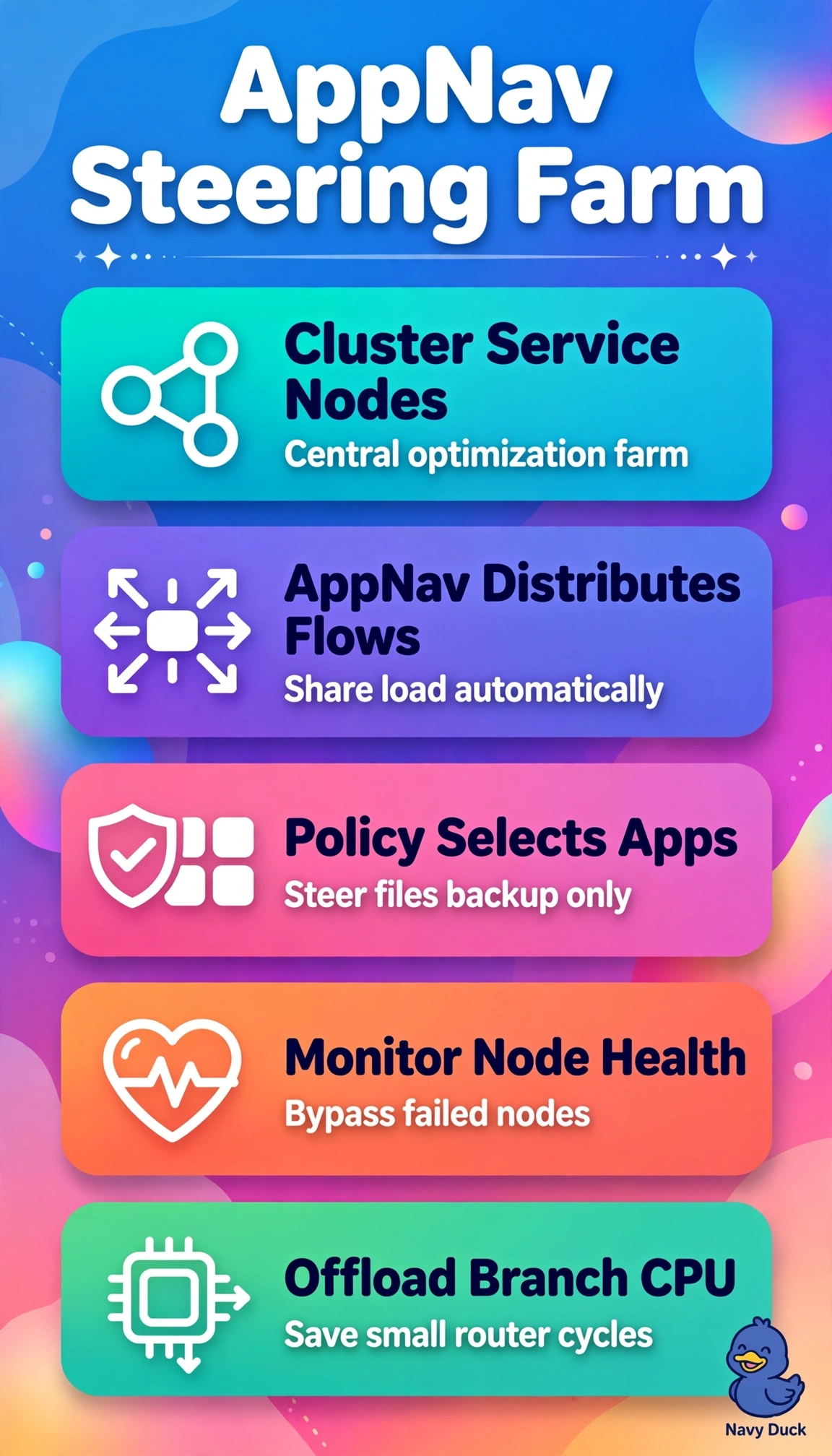
You can keep branch CPU free while sending only file and backup traffic to the central farm. AppNav shares flows across healthy service nodes and bypasses optimization if a node fails.
Full Explanation
AppNav with data-center service nodes is the right design because App-QoE policy can selectively steer file-transfer and backup flows to the central farm, while AppNav distributes flows across both optimizers for actual load sharing. Health monitoring can remove a degraded node from service and let traffic bypass optimization, avoiding a black hole; central steering also avoids placing interception work on branches with limited CPU. Steering through preferred-order affinity provides consistency, but its primary-first preference does not share load across both optimizers during normal operation; the second is mainly a failover destination. A service group with health monitoring used only for alerting also fails the bypass requirement: steering can continue toward a failed optimizer because monitoring does not change forwarding behavior. Paired optimizers at large branches can provide local load sharing and health monitoring, but move processing and management to the edge, contrary to the central-farm design and the branches’ CPU constraint. Exam caveat: health visibility is not the same as health-aware bypass; confirm that failure changes forwarding. Practical check: in a lab, stop one service node and verify new flows use the survivor, traffic bypasses optimization without drops, and branch CPU remains flat.