
A trading firm needs voice to fail over in seconds when WAN quality degrades, but the default application-aware routing feels slow to react. Which BFD and app-route polling adjustment accelerates SLA detection and convergence for this requirement?
Select an answer to reveal the explanation.
Short Explanation
You're tuning for speed where milliseconds matter — polling frequency drives reaction. Like checking the weather radar more often, shorter polls catch storms early.
Full Explanation
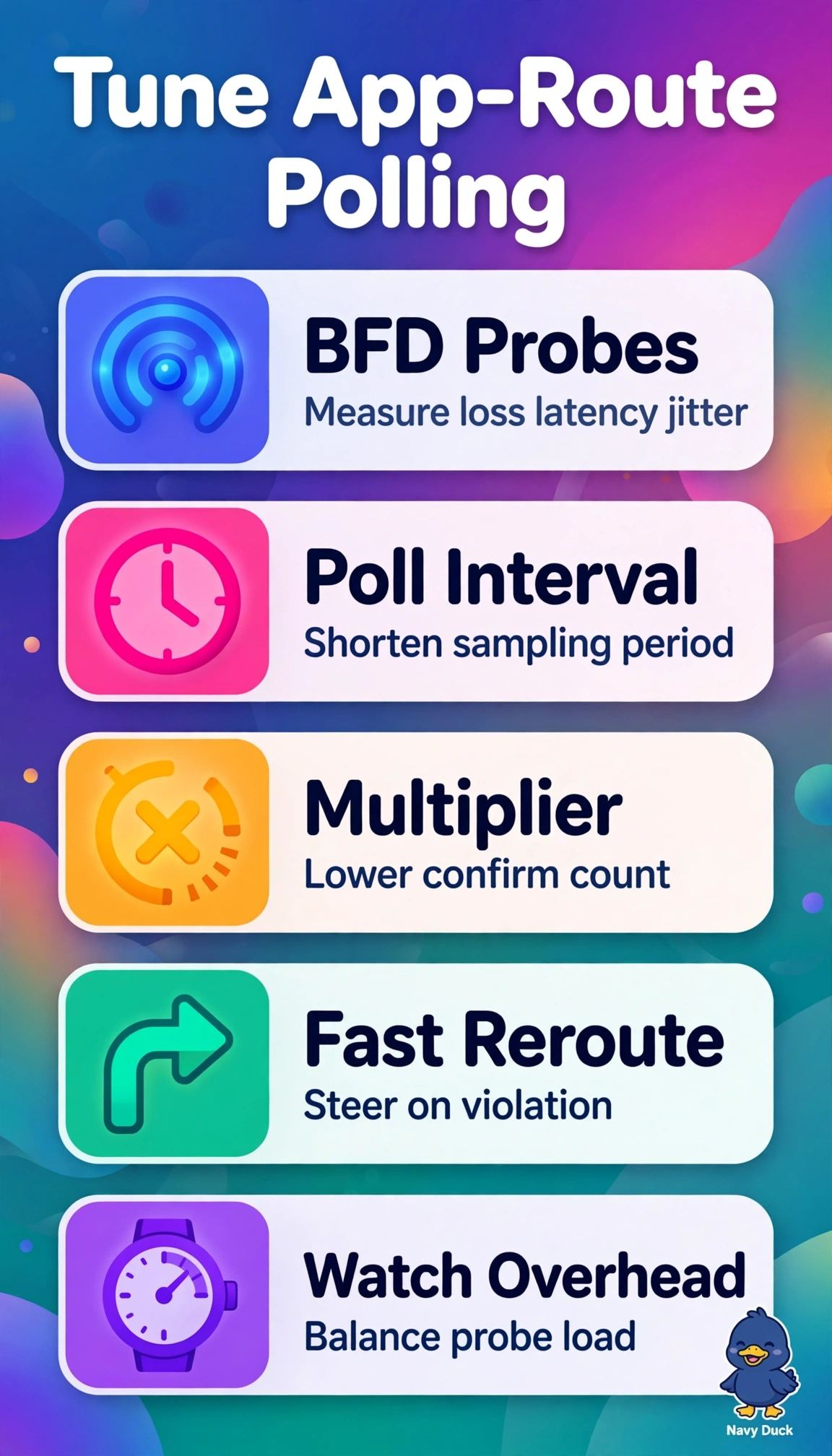
The correct adjustment works because voice failover on degraded quality depends on application-aware routing SLA evaluation rather than tunnel liveness alone, so a shorter poll interval generates loss, latency and jitter samples more often and a lower multiplier requires fewer consecutive violating polls to declare failure, together collapsing detection from default minutes to seconds and driving faster reroute. The BFD-only tightening approach is valid for rapid detection of hard tunnel drops but fails this requirement conceptually because BFD declares down neighbor or path state while degraded-but-up voice quality needs SLA violation detection, so unchanged polling leaves quality-based convergence slow. Shortening polling while raising the confirmation count is a respected anti-flap design for unstable links but misses the speed mandate because demanding more consecutive violations offsets frequent sampling and delays action. Retargeting aggressive timers to data SLAs while leaving voice at defaults is common for staged tuning or bulk-traffic protection but misses the stated fact that voice is the priority, so voice still converges slowly. For exams, distinguish liveness from SLA policy and remember lower timers mean faster but noisier decisions while higher values mean stable but slower reactions. Practically, verify with live SLA statistics and controlled degradation tests while watching CPU and false reroutes, since overly aggressive polling and BFD at scale increase overhead.