
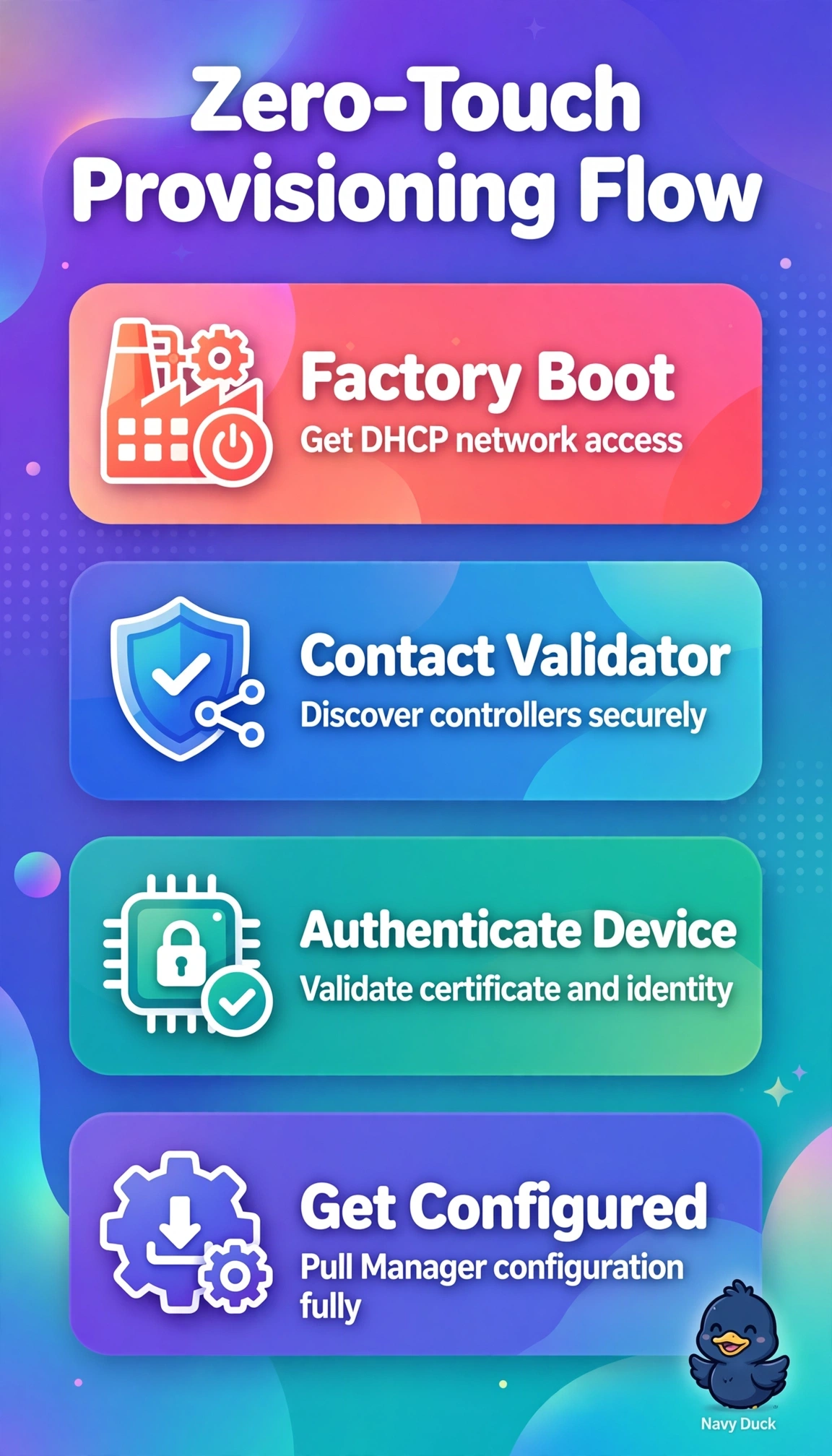
A healthcare group shipped 25 unconfigured WAN Edge routers to clinics with only internet access and DHCP, requiring plug-and-play onboarding with no console access and full Manager control afterward. Certificates must be validated and configuration delivered automatically. Which sequence describes the zero-touch provisioning flow from device boot to a fully managed WAN Edge?
Select an answer to reveal the explanation.
Short Explanation
When you're shipping routers with no console access, you'll let them boot clean and call home like new phones activating themselves. They check in with the Validator to prove they're legit, then grab your Manager config and get to work.
Full Explanation
Zero-touch provisioning starts from factory defaults where the edge obtains local network access through DHCP, is redirected through Cisco Plug and Play Connect to the SD-WAN Validator, formerly vBond, for orchestrated authentication and Controller and Manager discovery, then validates certificates and pulls full configuration from Manager to form managed control connections. Booting from USB and manually configuring OMP neighbors describes manual staging and misplaces OMP, which runs to the Controller rather than manual peers, so it violates the no-console requirement. Booting into ROM monitor to pull policies from the Controller reverses the order because the Controller is learned via the Validator and Manager provides configuration, while portal licensing is separate from bootstrapping. Booting with staging config to form peer links and sync OSPF describes branch routing adjacency, not the orchestrated cloud-first discovery and authentication chain. For the exam, remember that the Validator orchestrates discovery first; in practice confirm the device serial is claimed and the Validator is reachable on the internet.