
A logistics firm redesigns its network with data center hubs in Frankfurt and Chicago plus 120 spokes. It needs deterministic spoke-to-spoke paths via hubs, no spoke transit, and survival if one hub or its WAN links fail. Which hub deployment design meets the resiliency and path-control requirement?
Select an answer to reveal the explanation.
Short Explanation
You balanced control with survival perfectly. Two hubs plus policy gives spokes a clear primary and backup, like having two dispatchers on call.
Full Explanation
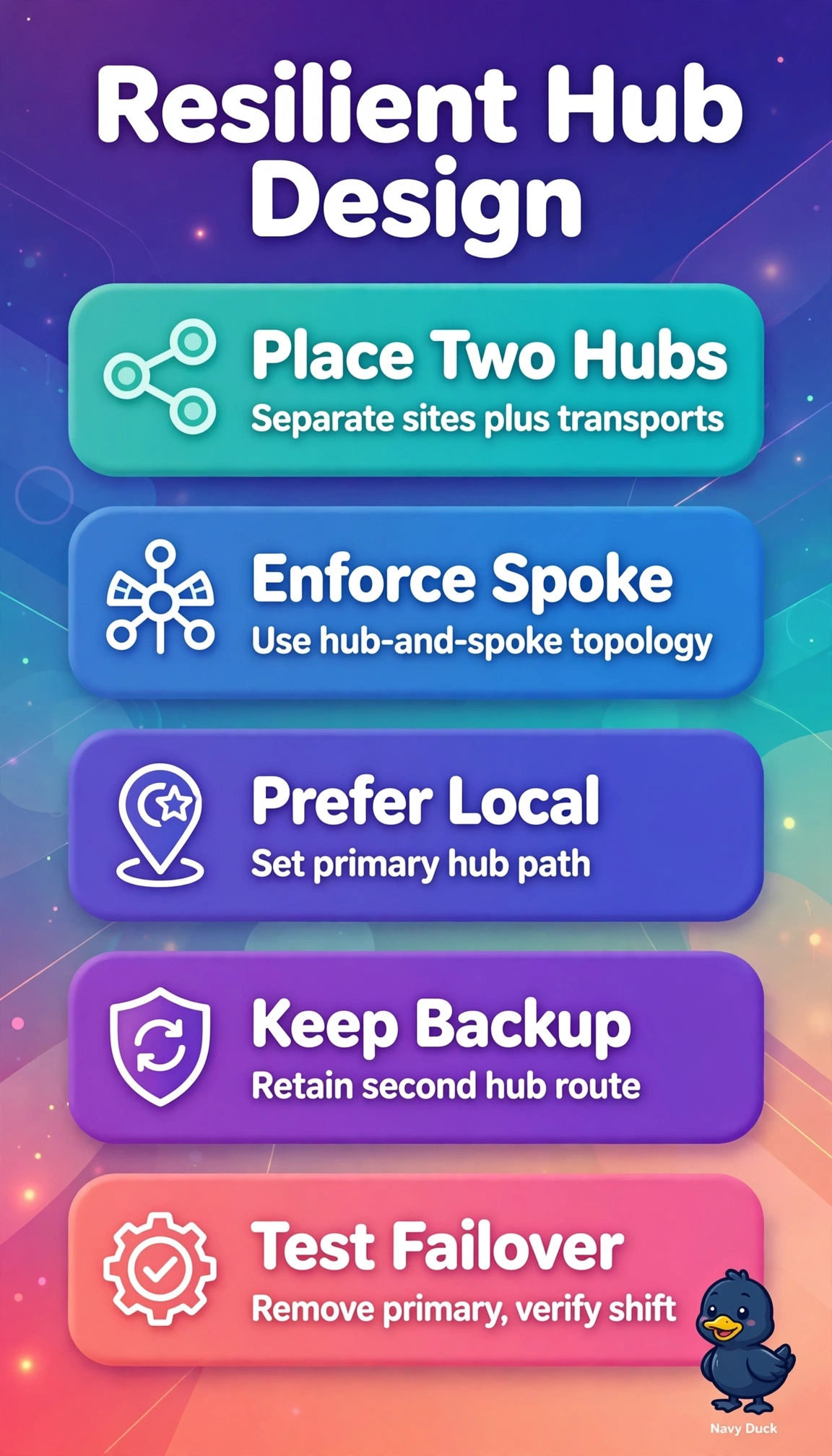
The correct design succeeds because two diverse hubs with a hub-and-spoke control policy enforces hierarchy while preserving determinism; spokes peer only to hubs, spoke-to-spoke traffic is forced via a hub, local-hub preference keeps latency predictable, and automatic failover reroutes spokes to the surviving hub if a hub or its WAN links fail, satisfying path control and one-failure survival without spoke transit. The pinned-affinity design fails on resiliency because strict nearest-hub pinning without failover creates fate-sharing with one hub and its transports, so loss of Frankfurt or Chicago strands its spokes despite a second hub being deployed. The direct-tunnel optimization fails on path control because permitting spoke-to-spoke tunnels bypasses mandated via-hub inspection and determinism, trading governance for latency even though dual hubs provide redundancy. The spoke-as-transit backup fails on topology constraint because using spokes for backup transit violates the explicit no-spoke-transit requirement and risks underpowered branches and asymmetric routing across 120 sites. Exam caveat: distinguish deployed redundancy from policy-enabled failover, as dual hubs alone do not guarantee survival unless policies actually allow failover. Practical check: shut one hub in lab and confirm spokes reconverge via the survivor with paths still via hub.