
A university streams commencement over IPv4 multicast from the data center to 30 campuses. Campuses run PIM on their LANs, WAN links are mixed internet and MPLS, and the design must carry multicast across the overlay without native multicast on transports. Which multicast support combination should the engineer describe to meet all three facts?
Select an answer to reveal the explanation.
Short Explanation
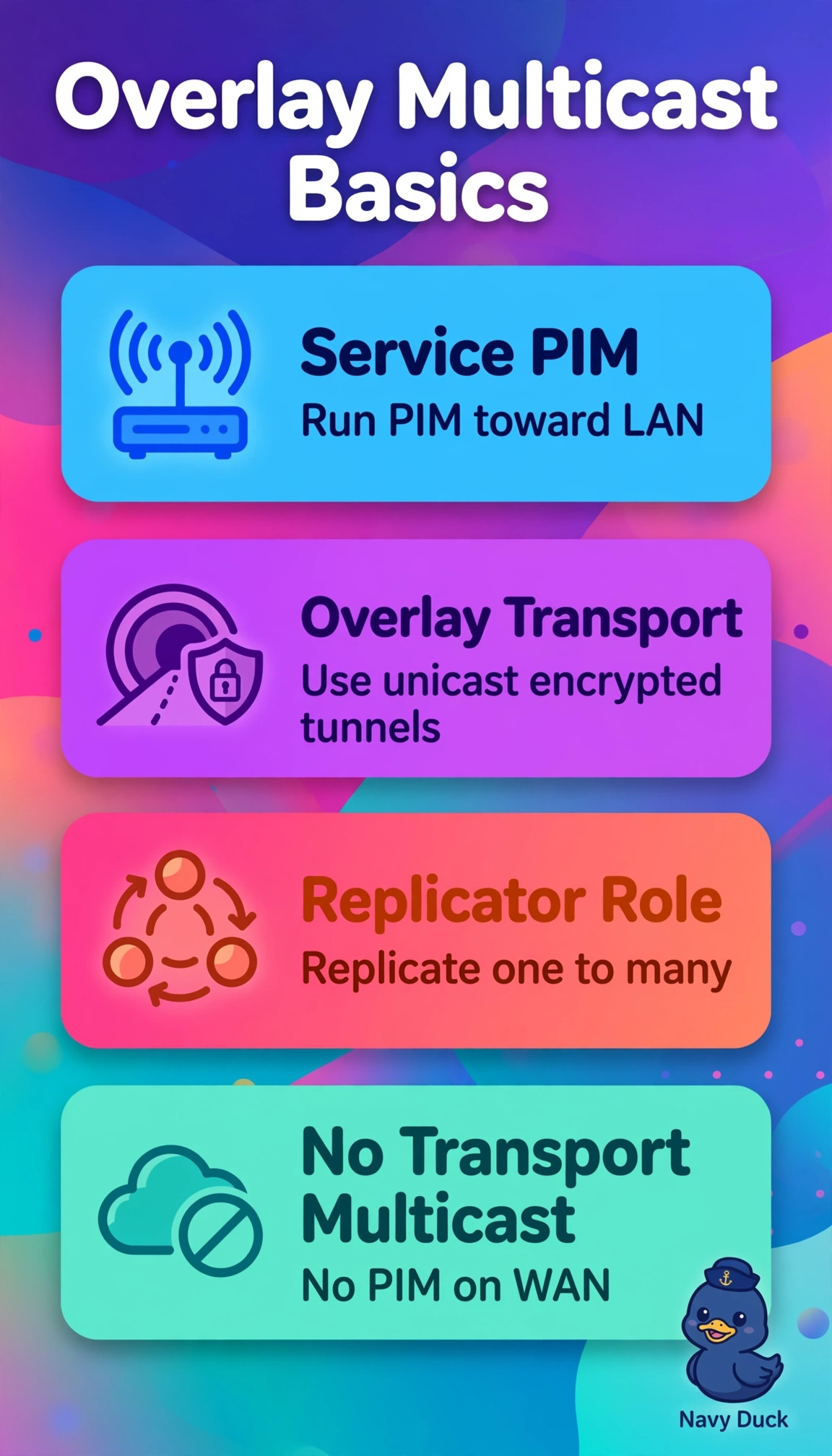
Your LAN stays classic while the WAN stays clever here. You keep PIM on the service side and let replicators fan traffic across plain unicast tunnels.
Full Explanation
Cisco SD-WAN supports PIM on the service side in the service VPN while the overlay carries that traffic using overlay multicast where designated replicators receive one copy and replicates it over IPsec unicast tunnels, which satisfies PIM LANs plus no transport multicast. PIM on transport VPNs fails because the transport VPN carries control and encrypted tunnels, not the LAN multicast state, so enabling PIM there does not join campus receivers. Native multicast across internet transports fails because internet and most MPLS underlays do not provide inter-site native multicast, so PIM joins cannot transit the transports. Validators forwarding over multicast tunnels fails by role because the Validator (formerly vBond) performs orchestration and discovery, not data-plane replication, and overlay tunnels remain unicast. Exam caveat is that overlay multicast still requires PIM configuration toward receivers on the service VPN, and practical check is to confirm Rendezvous Point reachability in the service VPN and replicator election status.