
A hospital runs voice over two transports with an application-aware routing policy requiring low loss and latency, but during a fiber brownout both tunnels violate the SLA class. Which fallback behavior keeps critical voice flowing when no tunnel meets the SLA class?
Select an answer to reveal the explanation.
Short Explanation
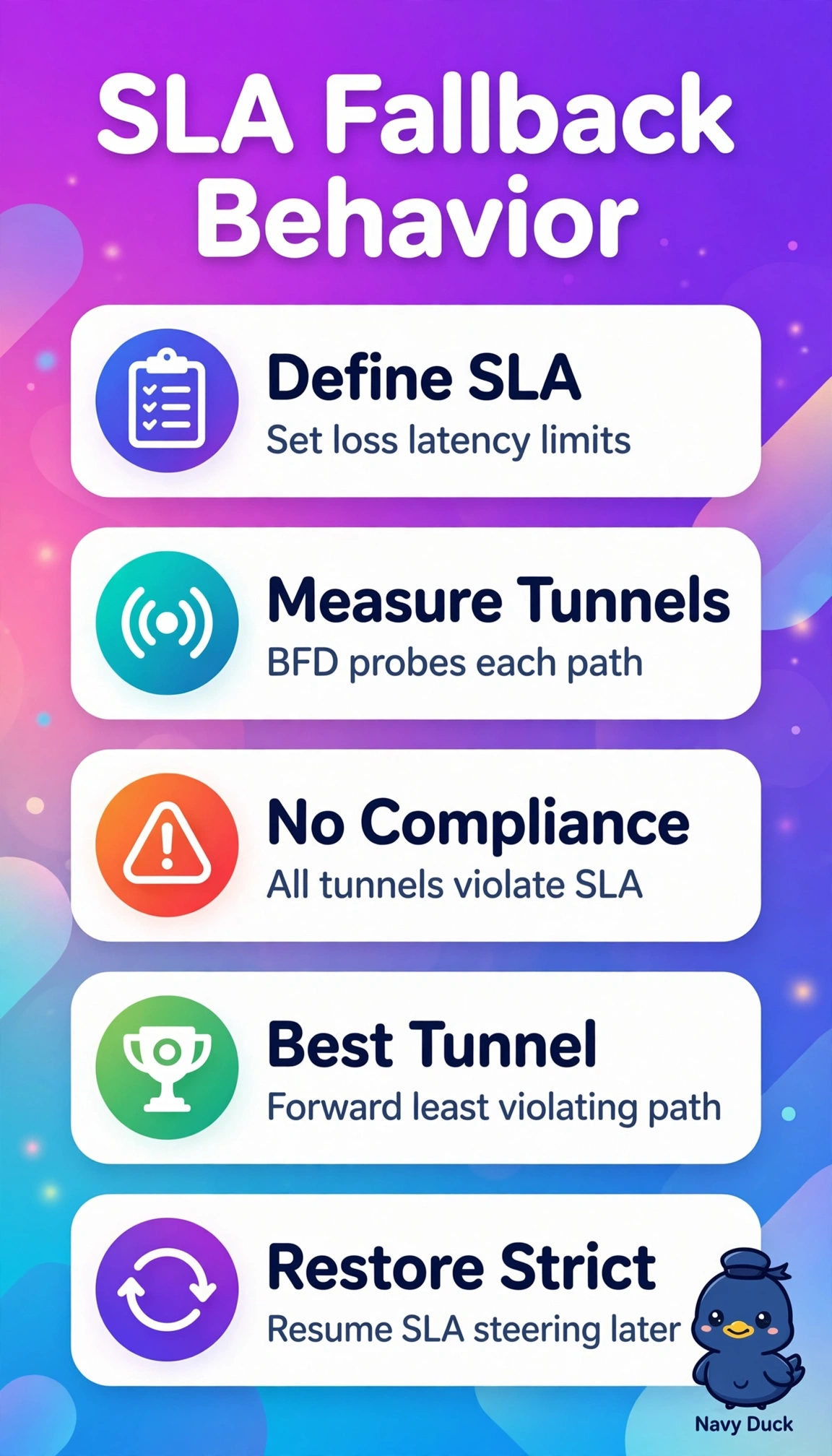
You're protecting the call when perfection isn't possible — fallback keeps voice alive. Like picking the clearest bad phone line, best-tunnel still beats silence.
Full Explanation
Application-aware routing with an SLA class normally pins voice to tunnels meeting loss and latency thresholds, but when a brownout leaves no compliant path the desired behavior is best-effort continuity for critical voice using the least-violating measurement rather than a blackout. Enabling fallback preserves call signaling and media over the better degraded tunnel, which matches hospital continuity needs where degraded voice is preferable to no voice. Replicating packets across both degraded tunnels is a sound resilience technique for mitigation of random loss, yet it doubles utilization on already browned-out links and still does not select a preferred compliant-or-best path when the SLA class is unmet. Holding voice until a hard-down before using LTE backup is common for cost control and stability, yet it confuses reachability with quality and would strand voice on violating tunnels during a soft brownout that never triggers down detection. Steering on lowest latency while ignoring loss is widely used for interactive performance tuning, yet voice quality depends on both metrics and ignoring loss violates the stated low-loss and latency policy and can select a low-delay but lossy path with choppy audio. On exams, distinguish soft SLA violation from hard tunnel down and choose continuity with best-path logic only when the stem explicitly states no tunnel meets the class. In practice, verify fallback is scoped to the voice application, log SLA violations during fallback, and validate MOS and loss after recovery to confirm return to compliant steering.