
A 60-user branch needs 500 Mbps encrypted throughput with PoE switching and Wi-Fi, a regional hub needs 5 Gbps aggregation for 30 branches with deep crypto scale, and a data center needs 20 Gbps core with redundancy. Budget is tight and only SD-WAN Edge models may be proposed. Which platform mapping best aligns throughput and feature needs to site roles?
Select an answer to reveal the explanation.
Short Explanation
You'll save headaches by matching muscle to the workload, not buying a race car for groceries. Right-sizing puts PoE access where users sit and heavy crypto where tunnels concentrate.
Full Explanation
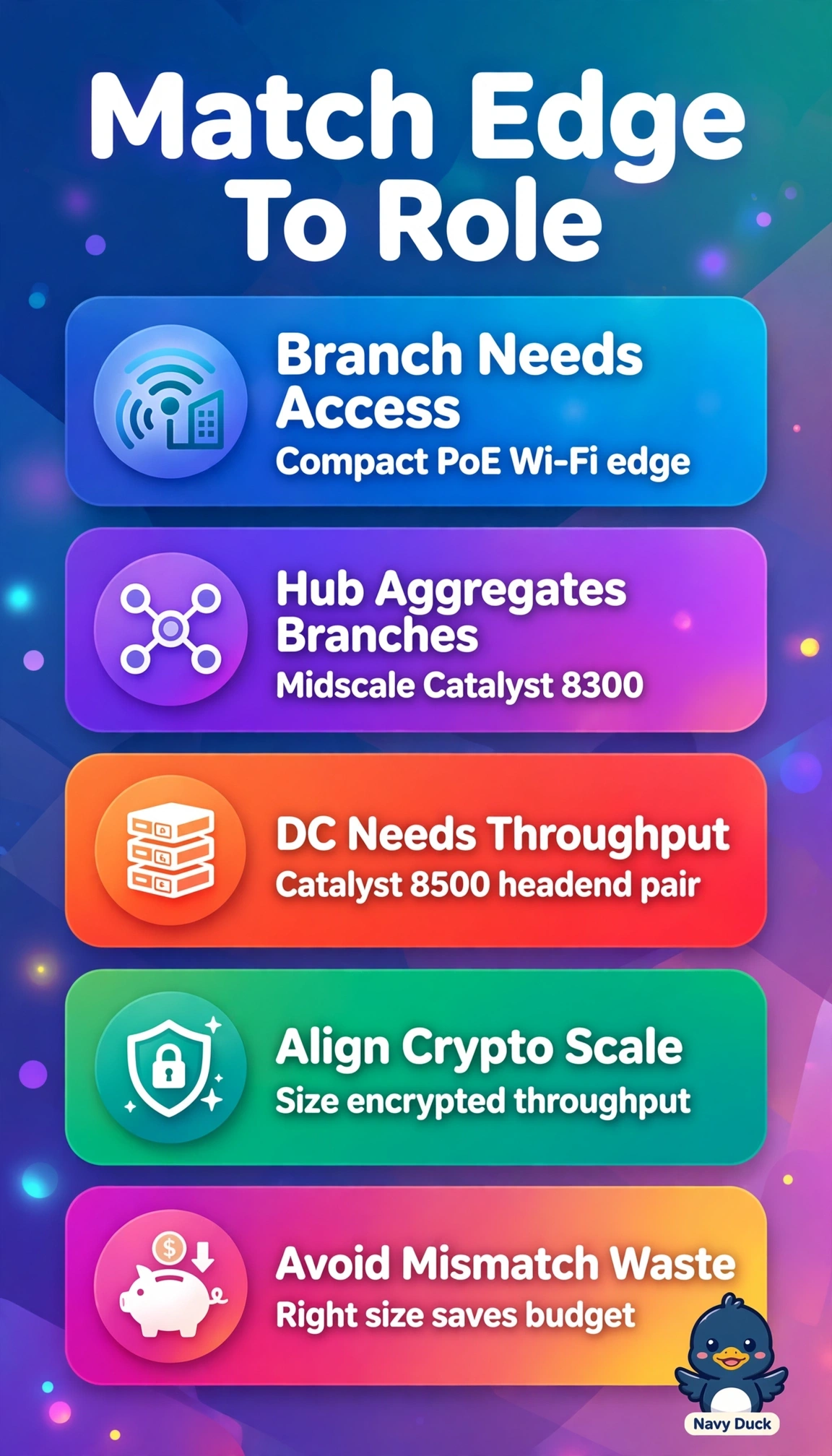
The tiered mapping succeeds because it aligns forwarding and crypto headroom to site role while respecting budget and portfolio limits, with the compact ISR-class edge delivering around 500 Mbps encrypted throughput in an economical form factor with integrated PoE switching and Wi-Fi for the 60-user branch, the midscale Catalyst 8300-class edge providing multigigabit aggregation and deeper IPsec tunnel scale to support 30 branches at 5 Gbps for the regional hub, and the high-throughput Catalyst 8500-class edge deployed redundantly to deliver 20 Gbps core capacity with hardware resiliency for the data center. The single-chassis data center variant fails on resiliency because one high-performance node still represents a single point of failure for power, software upgrade and hardware fault, directly violating the stated redundancy requirement despite sufficient throughput. The uniform midscale branch variant fails on financial right-sizing because placing 8300-class performance at every 60-user site technically forwards traffic but overprovisions small sites and breaks the tight-budget constraint that the compact edge was chosen to satisfy. The redundant midscale core variant fails on performance scalability because pairing two 8300-class nodes improves availability but does not raise the platform crypto ceiling to 20 Gbps, confusing high availability with additive throughput. As an exam caveat, always compare encrypted IPsec throughput with services enabled rather than plaintext fabric numbers and verify PoE budget, wireless support and licensing separately from chassis throughput. As a practical check, validate datasheets for sustained VPN throughput, confirm branch PoE power and access-point support, and design the data center pair with diverse uplinks, dual power and tested stateful failover.