
A mining site uses LTE with 8% bursty loss for voice and SCADA, with ample spare bandwidth but strict latency targets and limited router CPU. Voice needs immediate repair for single-packet loss while bulk telemetry tolerates delay. Which App-QoE loss-mitigation choice best fits these stated loss and latency needs?
Select an answer to reveal the explanation.
Short Explanation
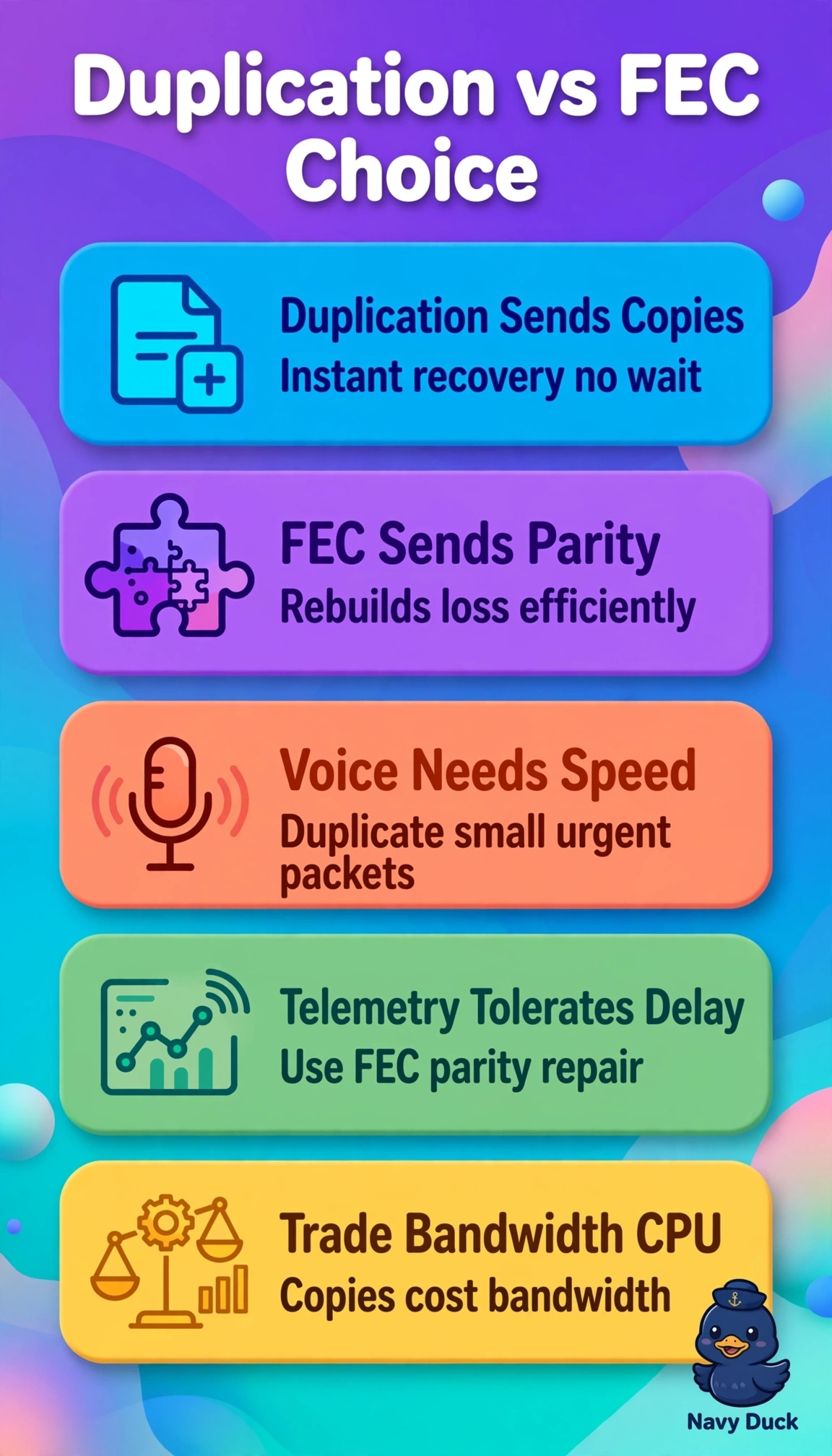
You've got two different appetites here, so feed them differently with a split menu. Packet duplication shines for tiny, urgent voice because a twin arrives instantly without waiting to do math.
Full Explanation
App-QoE provides packet duplication that replicates original packets over an alternate tunnel for instant recovery, which suits real-time voice on bursty lossy links because no decode wait is added, while forward error correction adds parity packets so the receiver can reconstruct lost packets without retransmission, which suits less urgent flows where bandwidth overhead and some encode overhead are acceptable. Using forward error correction for voice reverses the trade-off because it adds latency and CPU to rebuild while saving bandwidth you already have spare, TCP optimization does not repair UDP voice loss with duplication semantics and misapplies acceleration to real-time traffic, and duplicating everything wastes ample but not infinite bandwidth and increases CPU for telemetry that could have used efficient parity. For the exam remember duplication equals low-latency redundancy at cost of bandwidth and FEC equals bandwidth-efficient repair at cost of delay and compute, and verify with SD-WAN Manager (formerly vManage) App-QoE statistics showing duplicated versus reconstructed packets on the lossy tunnel.