
A retailer has dual-transport branches with MPLS and internet TLOCs and a central policy must keep guest Wi-Fi off MPLS during normal operation while allowing failover if internet is down. Centralized data policy already matches guest traffic. Which control in the policy action steers guest traffic to specific transports?
Select an answer to reveal the explanation.
Short Explanation
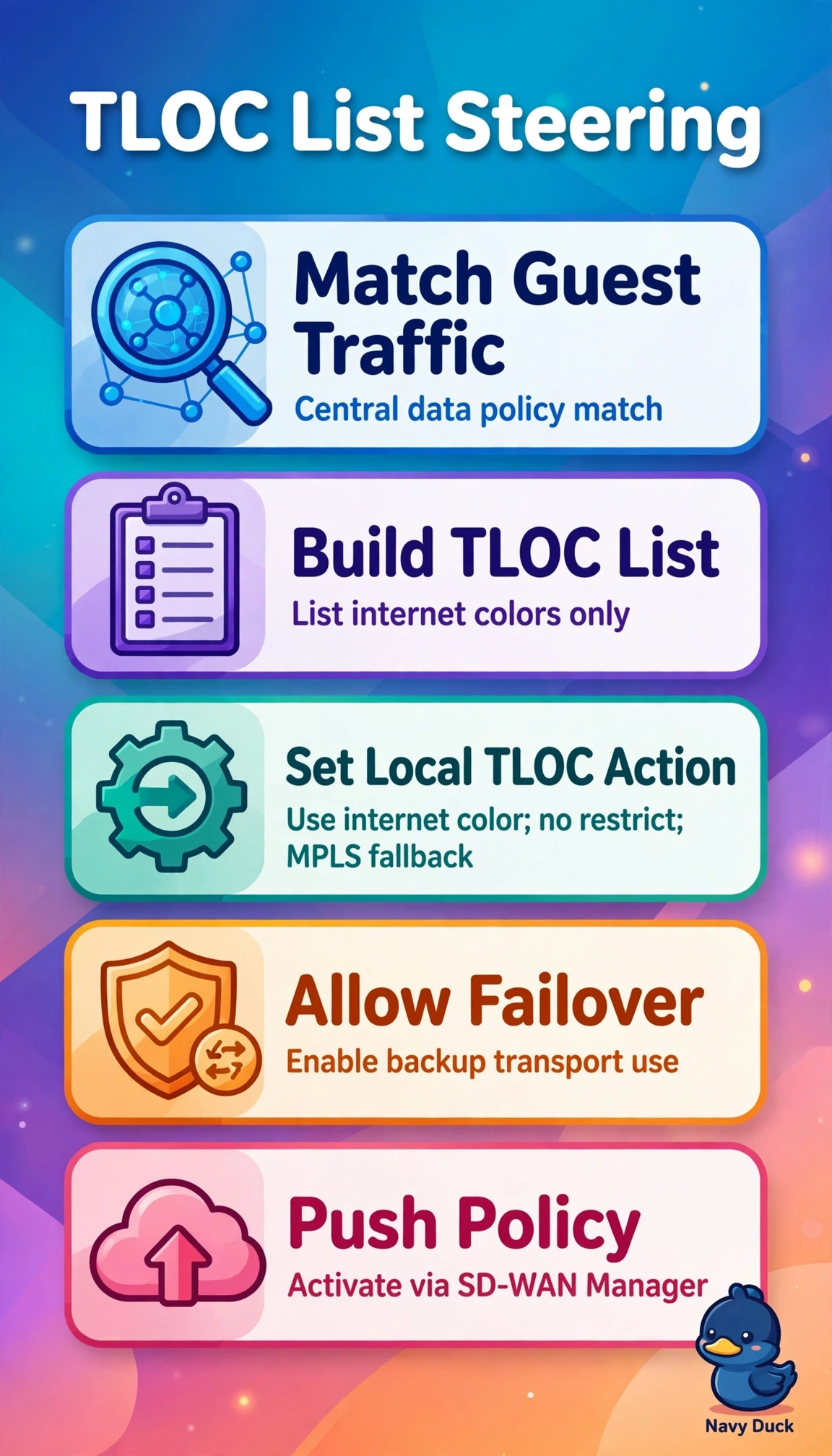
You've got this: you're pinning guest traffic to the cheap path without breaking it. A local TLOC preference for internet, with no restrict option, acts like a VIP lane sign that still opens the other lane when needed.
Full Explanation
Centralized data policy uses set actions such as local TLOC to steer matching application or prefix traffic to specific WAN transports defined by color, and the restrict option controls failover: by default, if the preferred TLOC is unavailable, traffic uses an alternate TLOC, while restrict drops it. The correct approach works because SD-WAN Manager defines the policy, the SD-WAN Controller distributes it, and edges prefer the internet color while retaining MPLS as backup, satisfying both steering and resilience requirements. Setting MPLS TLOCs fails by concept because it steers toward the transport to be avoided and policing only rate-limits rather than selecting egress. Redirect DNS fails by concept because it controls DNS response handling, not data-plane next-hop TLOC selection for general traffic. Service chaining fails by concept because it redirects to a service node such as firewall or IPS, not to a transport TLOC for native forwarding. Exam caveat is to distinguish local TLOC steering in centralized data policy from local data policy or app-route preferred colors, and practical check is to preview the policy and verify active TLOCs per site in SD-WAN Manager.