
A university streams commencement video from a source behind its data-center WAN Edge to receivers at 12 campus WAN Edge sites over the SD-WAN overlay. The transport providers do not carry multicast and several campuses sit behind NAT. Which overlay multicast design delivers the stream to all campus receivers?
Select an answer to reveal the explanation.
Short Explanation
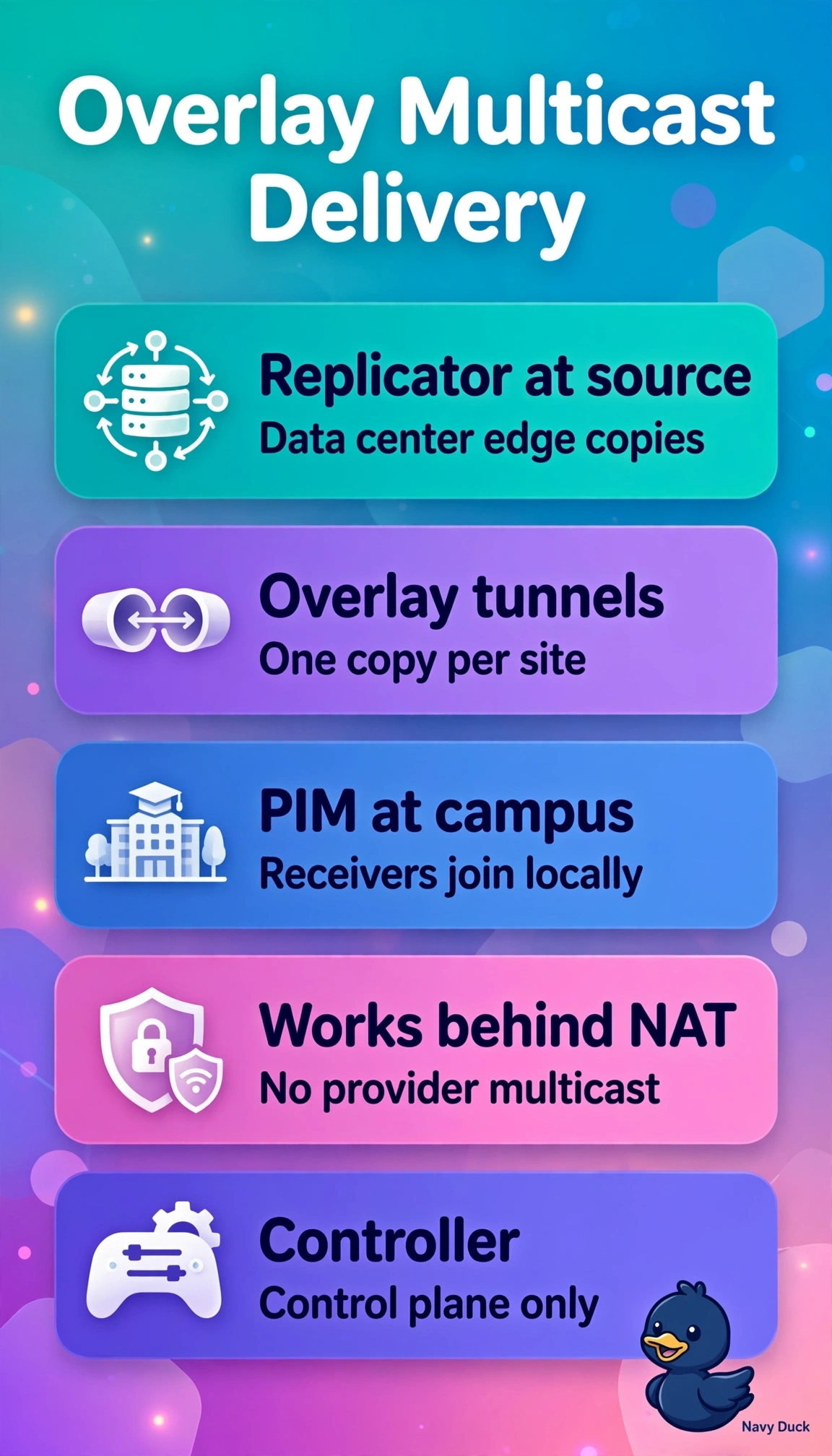
Think of the replicator as the copy shop at the source: it makes one copy per interested site and sends each over the overlay tunnels. You just turn on PIM at the campuses so their receivers can ask for the stream.
Full Explanation
Catalyst SD-WAN overlay multicast relies on a WAN Edge configured as a multicast replicator, placed near the source, which receives the stream and sends a copy to each remote edge that has interested receivers, using the existing IPsec overlay tunnels. Receiver sites need PIM enabled in the service VPN so local joins are signaled through OMP, and because traffic rides the tunnels it works behind NAT and without provider multicast support. Making every campus edge a replicator adds configuration without delivering anything new, because replication is needed where the source is, not at each receiver site. Native PIM in the transport VPN depends on the providers carrying multicast, which the scenario rules out, and NAT would break it anyway. The SD-WAN Controller handles control-plane OMP information only and never forwards data traffic, so it cannot replicate the stream. For the exam, remember the split: the replicator copies data on the edge, while OMP and the Controller carry join state. As a check, confirm the replicator with show sdwan multicast replicator and verify campus joins with show sdwan multicast topology.