
A logistics firm must upgrade two SD-WAN Controllers overnight while 300 WAN Edges keep forwarding voice traffic without drops. OMP peering will flap during the upgrade and the team needs forwarding to continue on stale routes briefly. Which OMP graceful-restart and timer configuration preserves forwarding during controller maintenance?
Select an answer to reveal the explanation.
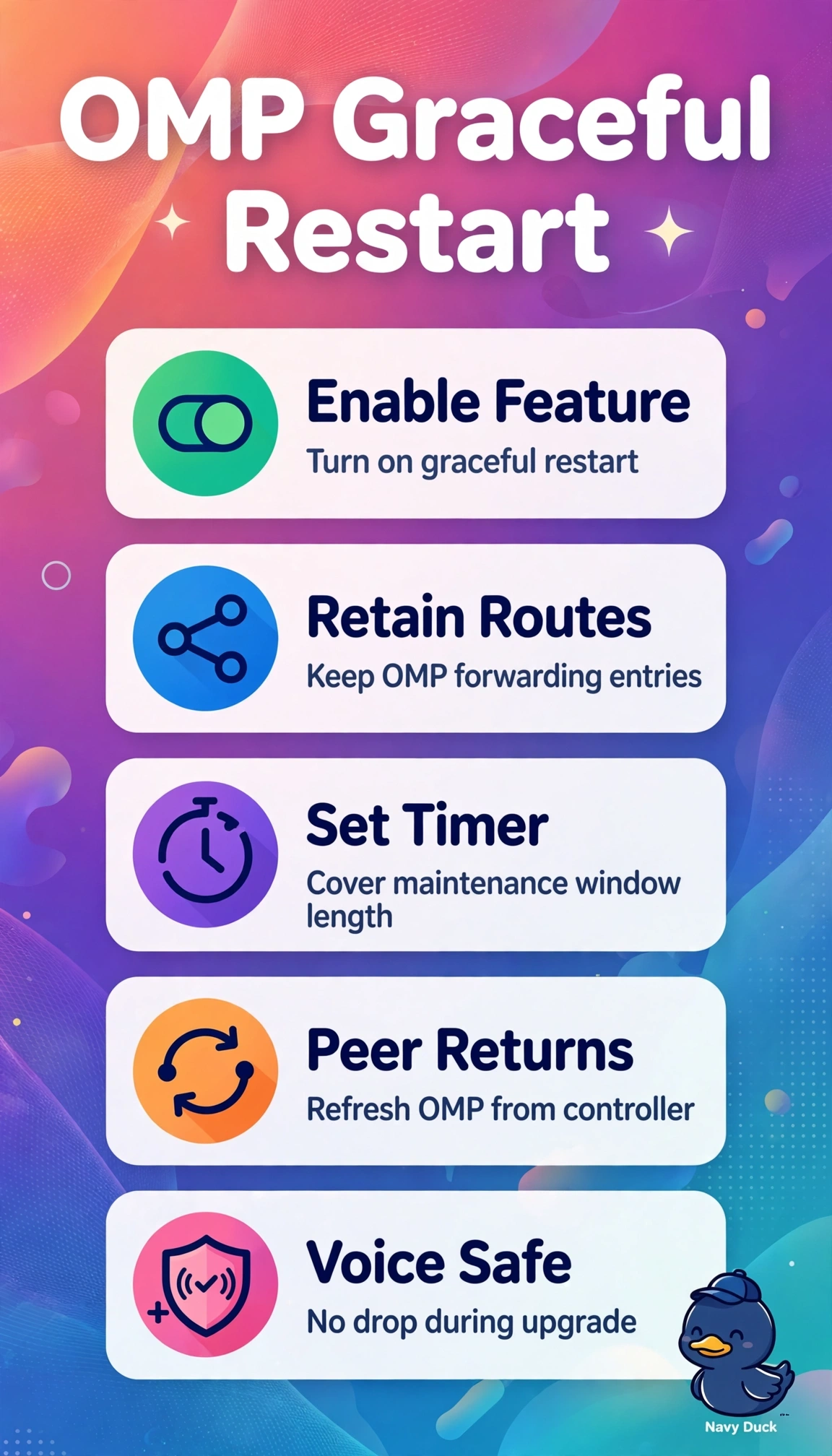
Short Explanation
Overnight upgrades get scary when voice is on the line, but you have the right safety net. Graceful restart lets edges keep using known paths while controllers reboot, with the timer covering the gap.
Full Explanation
OMP graceful restart allows a WAN Edge to retain OMP routes in its forwarding table when its SD-WAN Controller peering drops, and the graceful-restart timer defines how long those stale routes remain usable while controllers return, which preserves data-plane forwarding during planned outages. Disabling graceful restart with a lower hold timer fails by concept because faster failure detection actively withdraws routes sooner and guarantees the traffic interruption the scenario must avoid. Enabling graceful restart but tuning hello interval fails by concept because hello timing only affects liveness detection speed and does not authorize retention of forwarding state after peering loss. Disabling graceful restart and raising update timer fails by concept because update pacing affects advertisement frequency during stable peering, not route preservation after peering loss. Exam caveat is to link graceful restart to forwarding preservation and hold and hello timers to detection speed, since questions often swap those roles. Practical check is to confirm graceful-restart status and timer values with show OMP operational commands before controller maintenance begins.