
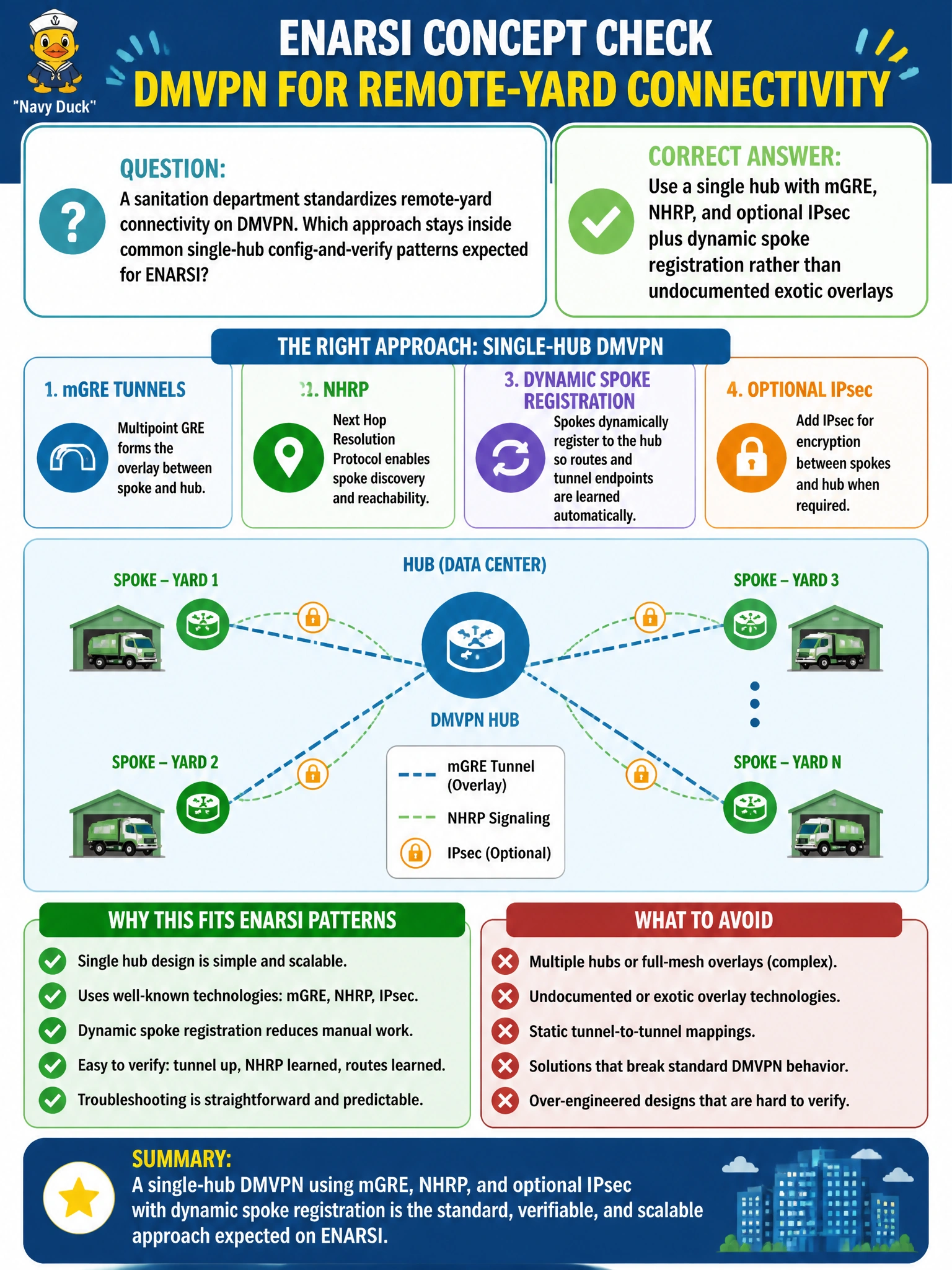
A sanitation department standardizes remote-yard connectivity on DMVPN. Which approach stays inside common single-hub config-and-verify patterns expected for ENARSI?
Select an answer to reveal the explanation.
Short Explanation
Stick to the recipe on the box: one hub, mGRE, NHRP, IPsec if you need it, dynamic spokes—not exotic dual-hub science projects.
Full Explanation
A sanitation department standardizing remote-yard connectivity should stay inside common single-hub config-and-verify patterns: one hub, mGRE, NHRP, optional IPsec, and dynamic spoke registration. That matches ENARSI VPN Technologies expectations and keeps civic operations on a documented, supportable overlay rather than exotic meshes for garbage-truck yards and transfer stations that operations staff cannot maintain.
Deploying dual-hub Phase-3 meshes with per-spoke TE tunnels as the default ENARSI answer exceeds the usual single-hub exam depth and mixes in MPLS-TE themes the stem does not require. Replacing DMVPN with SD-WAN OMP policies from ENSDWI shifts to a different exam’s concentration and distracts from Domain 2.3 DMVPN skills. Running only static crypto maps to every sanitation truck without NHRP or mGRE abandons DMVPN’s dynamic mapping model and recreates per-peer provisioning pain.
Exam caveat: pick the blueprint pattern—single-hub DMVPN building blocks—not adjacent technologies. Operational check: validate hub mGRE, NHRP, and crypto; onboard a yard spoke dynamically; and verify with show dmvpn, NHRP, and IPsec counters rather than inventing TE or SD-WAN as the ENARSI answer.