
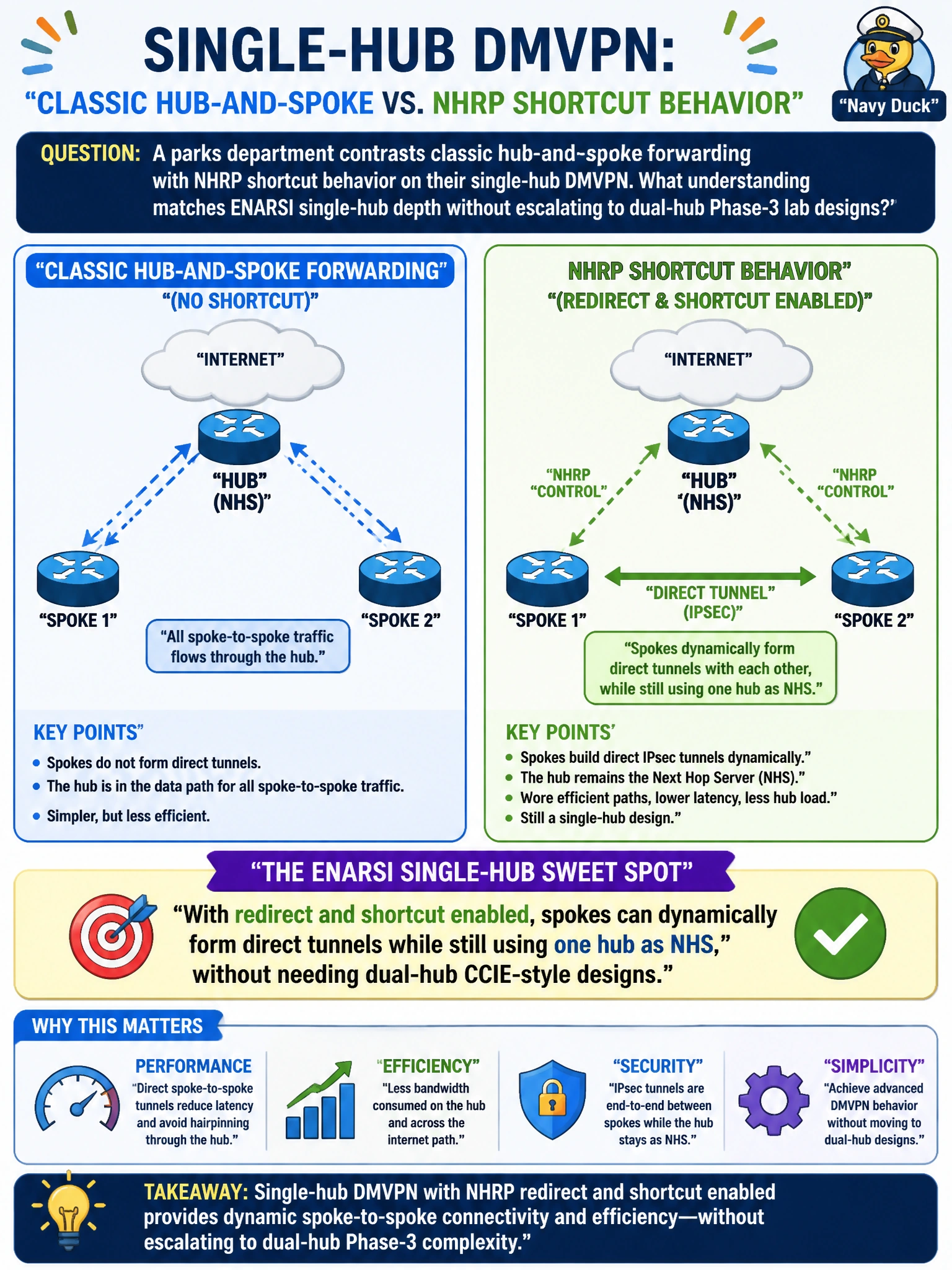
A parks department contrasts classic hub-and-spoke forwarding with NHRP shortcut behavior on their single-hub DMVPN. What understanding matches ENARSI single-hub depth without escalating to dual-hub Phase-3 lab designs?
Select an answer to reveal the explanation.
Short Explanation
One hub can still hand out directions—redirect and shortcut let parks spokes meet in the middle without building a dual-hub CCIE playground.
Full Explanation
At ENARSI single-hub depth, parks-department engineers should understand that with NHRP redirect and shortcut enabled, spokes can dynamically form direct tunnels while still using one hub as NHS. Dual-hub CCIE-style designs are not required to explain that behavior on the exam blueprint’s single-hub focus. Picnic-site and ranger-station routers can still shortcut after hub-assisted discovery without building a dual-NHS lab topology.
Saying shortcuts require dual hubs and dual NHS clusters before any spoke can resolve a peer overstates prerequisites for basic spoke-to-spoke operation. Claiming spoke-to-spoke shortcuts are impossible on single-hub DMVPN and exist only in FlexVPN is false for ENARSI DMVPN content. Asserting NHRP shortcuts always delete the hub from the topology permanently after the first packet misstates residual NHS and control roles—the hub remains part of the design for registration and fallback paths.
Exam caveat: stay inside single-hub redirect and shortcut theory; do not escalate answers into dual-hub Phase-3 lab designs unless the stem asks. Operational check: on a single hub with redirect and shortcut, verify spoke-to-spoke mappings form between parks sites, confirm the hub still shows as NHS, and ensure traffic fails over sensibly if a direct tunnel drops.