
A municipal 911 PSAP studies penultimate-hop popping on the provider path into its PE. What does PHP mean at ENARSI describe depth?
Select an answer to reveal the explanation.
Short Explanation
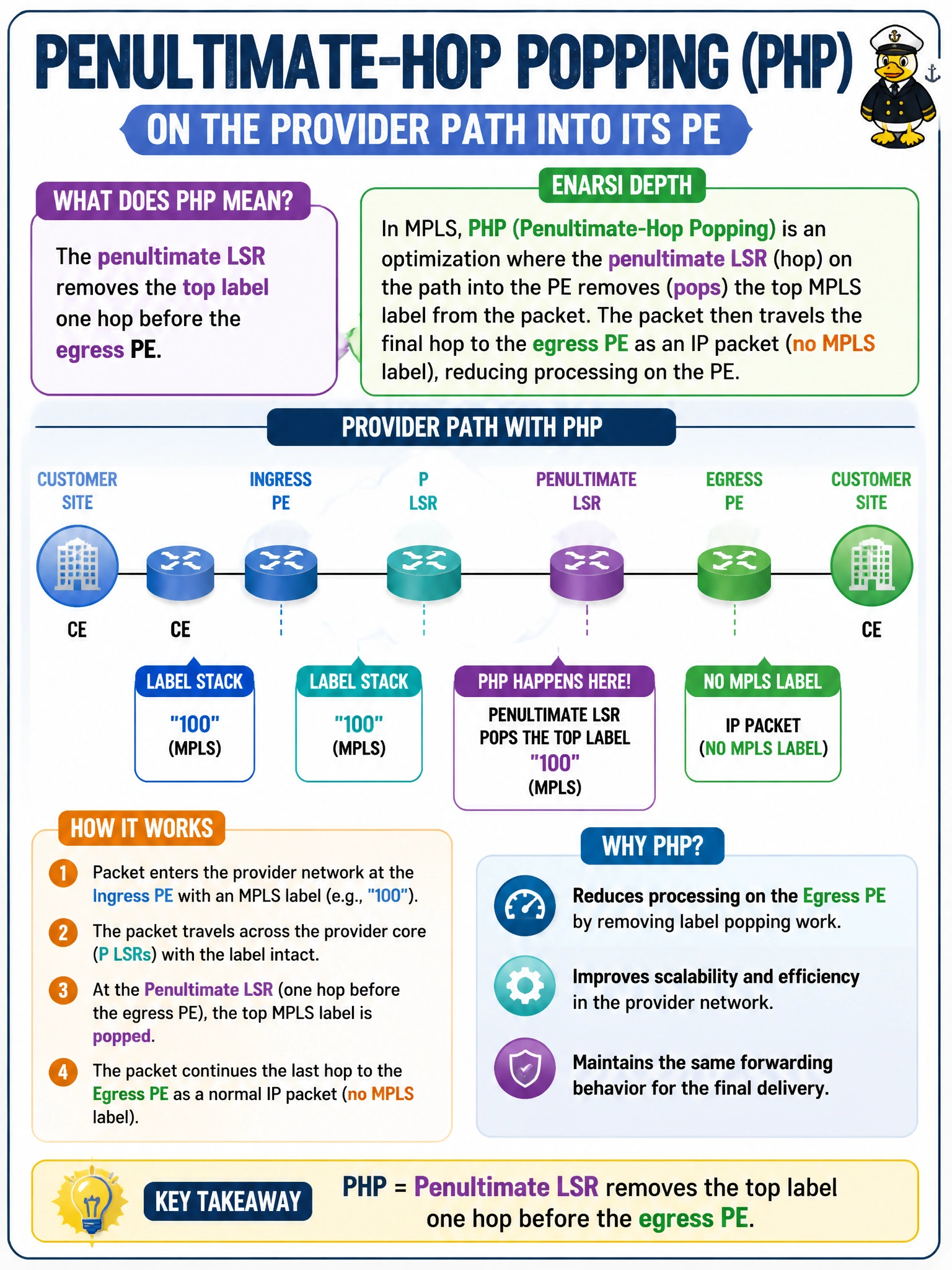
You can think of PHP as the “almost there” pop: the router just before the egress PE removes the top label one hop early, so the PE avoids an extra lookup for that label. It’s a handy MPLS optimization, not a CE function.
Full Explanation
For a municipal 911 PSAP studying penultimate-hop popping on the provider path into its PE, PHP means the penultimate LSR—the hop immediately before the egress PE—removes the top, typically transport, label one hop early. The egress PE therefore avoids an extra lookup for that outer label, simplifying egress forwarding. PHP is an MPLS optimization along the LSP, not a CE function or a mid-path removal of every label. Having the CE pop all VPN labels before sending packets into the PE attachment circuit misplaces PHP at the customer edge; in classic designs the CE sends unlabeled IP to the PE, while VPN label handling occurs on the provider PE/P path. Having every LSR pop both VPN and IGP labels at mid-path contradicts label switching: PHP pops only the top label at the penultimate hop, while transit nodes otherwise swap labels. Disabling LDP so only RSVP-TE can build LSPs is unrelated; PHP is a pop behavior for an existing LSP, does not turn off LDP, and does not mandate RSVP-TE. Exam caveat: a platform may advertise implicit-null for PHP or explicit-null to preserve QoS EXP information to the egress. After PHP, the egress PE may still process an inner VPN label in L3VPN; do not confuse PHP with encryption, CE LDP, or a TE-only core. Practical check: on the penultimate LSR, the mpls forwarding-table entry toward the egress FEC should show pop (implicit-null), rather than a swap to a real label. On the egress PE, confirm the expected disposition of any remaining VPN label and unlabeled delivery to the PSAP CE; MPLS traceroute can reveal the early pop one hop before egress.