
A county elections office expects MPLS LSPs for civic prefixes to track the same forwarding path the IGP prefers. What describe-level relationship supports that expectation?
Select an answer to reveal the explanation.
Short Explanation
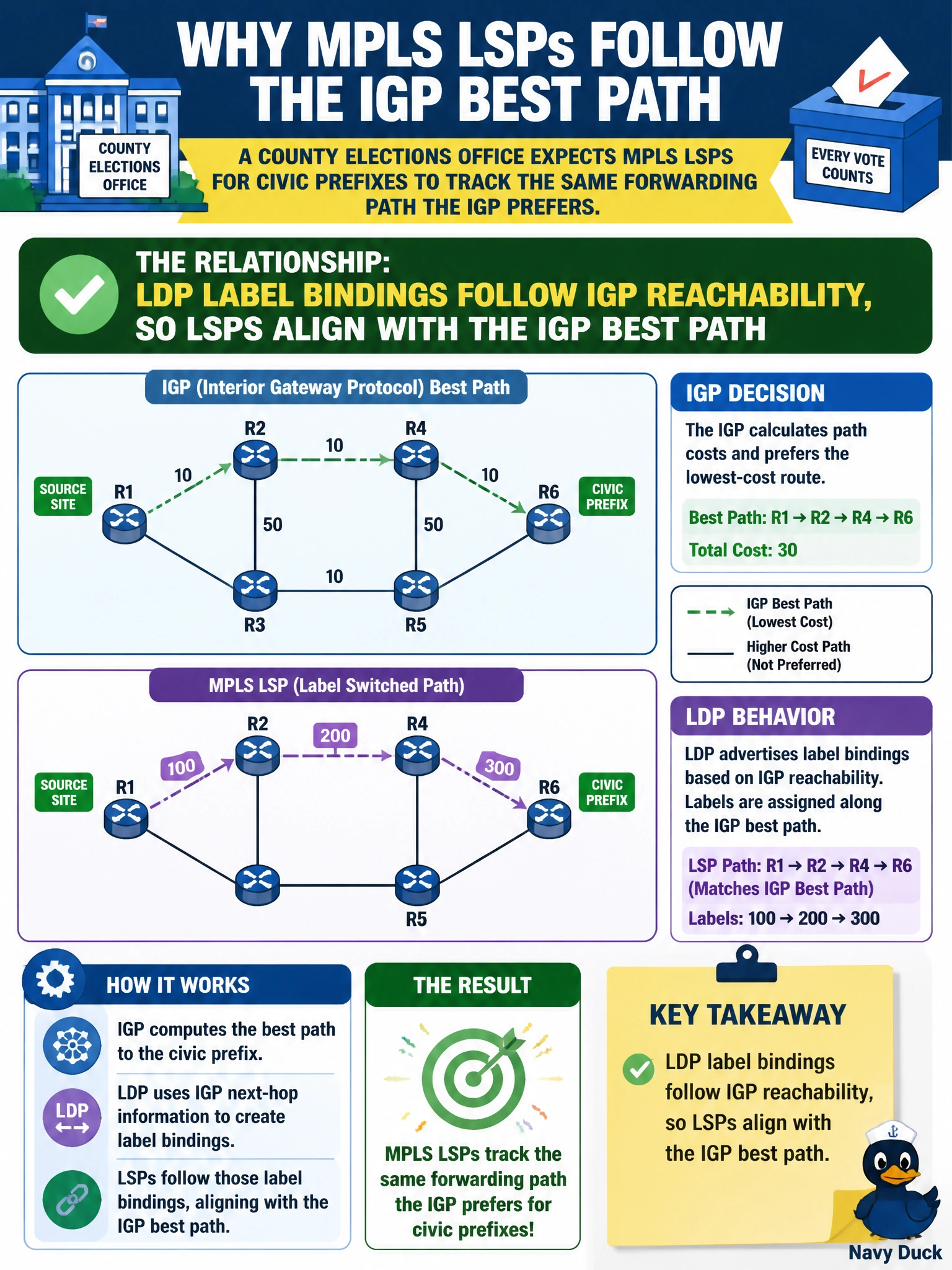
LDP does not invent its own treasure map—it labels the paths the IGP already likes. When the IGP best path shifts, the labeled freeway tends to shift with it.
Full Explanation
A county elections office that expects MPLS LSPs for civic prefixes to track the IGP's preferred forwarding path is relying on the classic LDP-plus-IGP relationship. LDP distributes label bindings for FECs that align with IGP-learned prefixes, and the labeled forwarding path follows the same next hops the IGP selects. When the IGP best path shifts (link metric change, failure, reconvergence), LDP bindings and the LFIB track that new IGP topology so LSPs realign with the IGP best path at describe depth.
LDP ignoring the IGP and always building LSPs over the highest-latency link is false. LDP does not independently optimize for latency that way; it labels along IGP reachability/next hops.
NHRP overriding OSPF metrics so label paths prefer spoke-to-spoke shortcuts only describes DMVPN shortcut behavior, not the default LDP/IGP alignment in an MPLS provider or enterprise labeled core for elections traffic.
BGP communities alone installing MPLS labels without any IGP underneath skips the underlay. Communities are BGP policy attributes; label switching still needs a labeled path layer (LDP/RSVP-TE) and an underlying IGP (or TE database) for hop reachability.
Exam caveat: traffic engineering (RSVP-TE) can deliberately diverge from pure IGP shortest path; the stem's expectation that LSPs track IGP preference points to LDP's IGP-aligned model. Also remember LDP sync features exist so traffic is not pushed onto a link before labels are ready.
Operational check: compare show ip route next hop for a civic prefix FEC with show mpls forwarding-table outgoing interface/next hop; they should agree. Flap or change an IGP metric in a lab and confirm the LSP next hop follows. If IP and MPLS diverge, check static overrides, TE tunnels, or LDP sync.