
A wastewater treatment plant identifies which device removes MPLS labels before delivering traffic to a township CE. Which role performs that egress disposition?
Select an answer to reveal the explanation.
Short Explanation
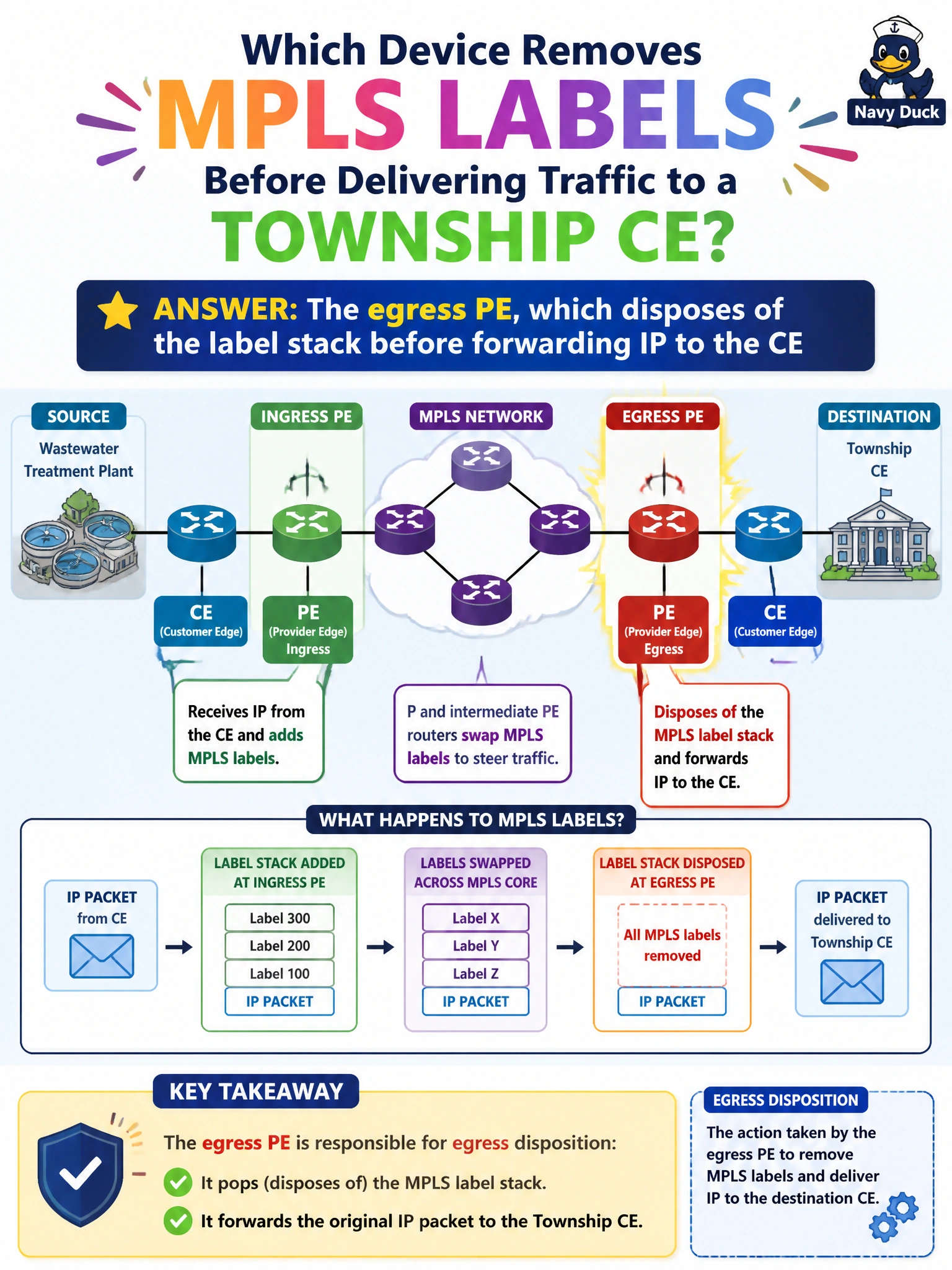
At the far edge, the egress PE peels the MPLS stickers off and hands clean IP to the township CE. The core P routers are not supposed to strip everything at every hop.
Full Explanation
At a wastewater treatment plant path toward a township CE, egress label disposition is performed by the egress PE. After the labeled packet traverses the provider LSP, the egress PE removes remaining MPLS label context associated with that flow and forwards native IP to the CE on the attachment circuit. Transit P routers are not supposed to strip the entire stack at every hop; their job is swap (with PHP optionally popping only the top transport label one hop early).
Every P router removing all labels so the next hop always sees native IP would destroy end-to-end label switching and force IP lookups through the core—opposite of MPLS transit design.
The CE running LDP with the PE solely to strip labels on arrival is not the standard PE-CE model for IP attachment. The CE typically receives unlabeled IP from the PE; the PE performs disposition before delivery.
The ingress PE only, which never allows labeled packets past the first hop, contradicts the whole LSP model. Ingress imposes so packets can travel labeled across the core to the far PE.
Exam caveat: with PHP, the penultimate LSR pops the outer transport label, so the egress PE may see a packet with only the VPN label (L3VPN) or unlabeled IP (IGP LSP). Disposition responsibility still sits at the egress edge of the MPLS service, not on the township CE.
Operational check: confirm the PE-CE link carries IP without MPLS headers; on the egress PE, verify pop/disposition entries toward the CE interface; on penultimate P, check for PHP pop of the transport label. Unexpected labels on the CE link indicate disposition misconfiguration.