
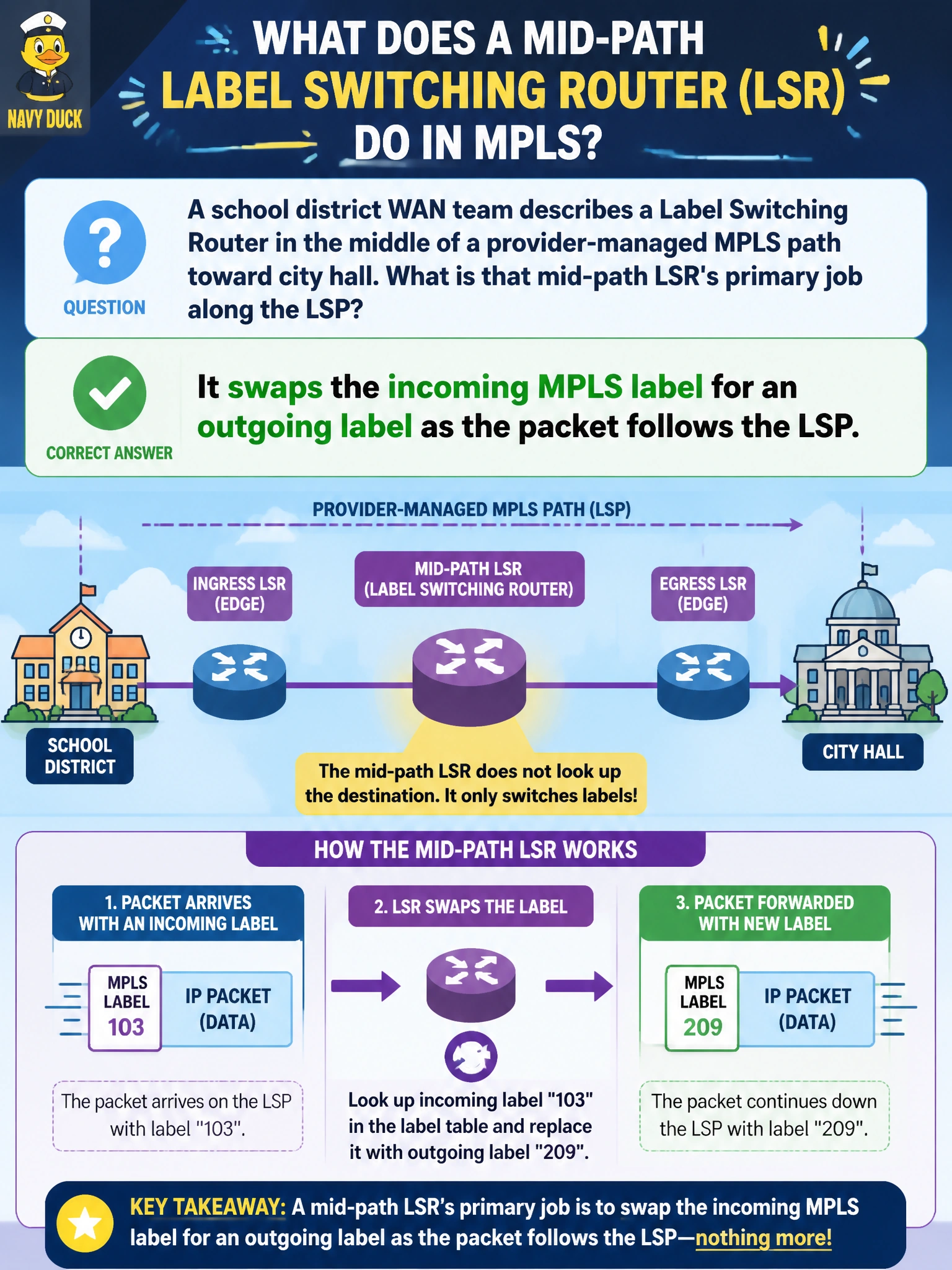
A school district WAN team describes a Label Switching Router in the middle of a provider-managed MPLS path toward city hall. What is that mid-path LSR's primary job along the LSP?
Select an answer to reveal the explanation.
Short Explanation
Mid-path LSRs are the relay runners of MPLS: take the baton (label) you were handed, swap it for the next one, and keep the packet on the labeled path. They are not reinventing the whole IP lookup at every hop.
Full Explanation
On a school-district WAN path through a provider-managed MPLS cloud toward city hall, a Label Switching Router in the middle of the LSP is a transit LSR. Its primary job is label swap: it receives a labeled packet, looks up the incoming label in the LFIB, replaces it with the outgoing label bound toward the next hop, and forwards the frame along the Label Switched Path. That hop-by-hop swap keeps civic traffic on the labeled forwarding path without requiring each mid-path router to reinvent a full customer IP longest-match decision for every packet.
Originating all customer VRF routes into MP-BGP on behalf of every CE is a PE control-plane role in MPLS L3VPN, not the primary data-plane job of a mid-path LSR. Transit P routers typically do not carry customer VRFs or originate VPNv4 routes.
Terminating IPsec for every labeled packet before an IP longest-match lookup is not classic MPLS transit behavior. Mid-path LSRs switch on labels; they do not decrypt IPsec as their MPLS role, and MPLS itself is not IPsec.
Removing every label at every hop so the next router always routes purely on IP contradicts label switching. Only disposition (and PHP of the top label) occurs at specific points; transit hops swap, they do not strip the stack at every LSR.
Exam caveat: know imposition at ingress PE, swap at P/transit, disposition at egress PE, and that PHP may pop the top label one hop early. Do not assign PE VPN route origination or IPsec termination to a generic mid-path LSR on ENARSI describe questions.
Operational check: traceroute mpls / show mpls forwarding-table on transit nodes should show swap operations (incoming label to outgoing label/next hop). Confirm LDP (or RSVP-TE) bindings exist toward the FEC; if the mid LSR shows untagged or unexpected pops mid-path, investigate PHP versus broken LSP design.