
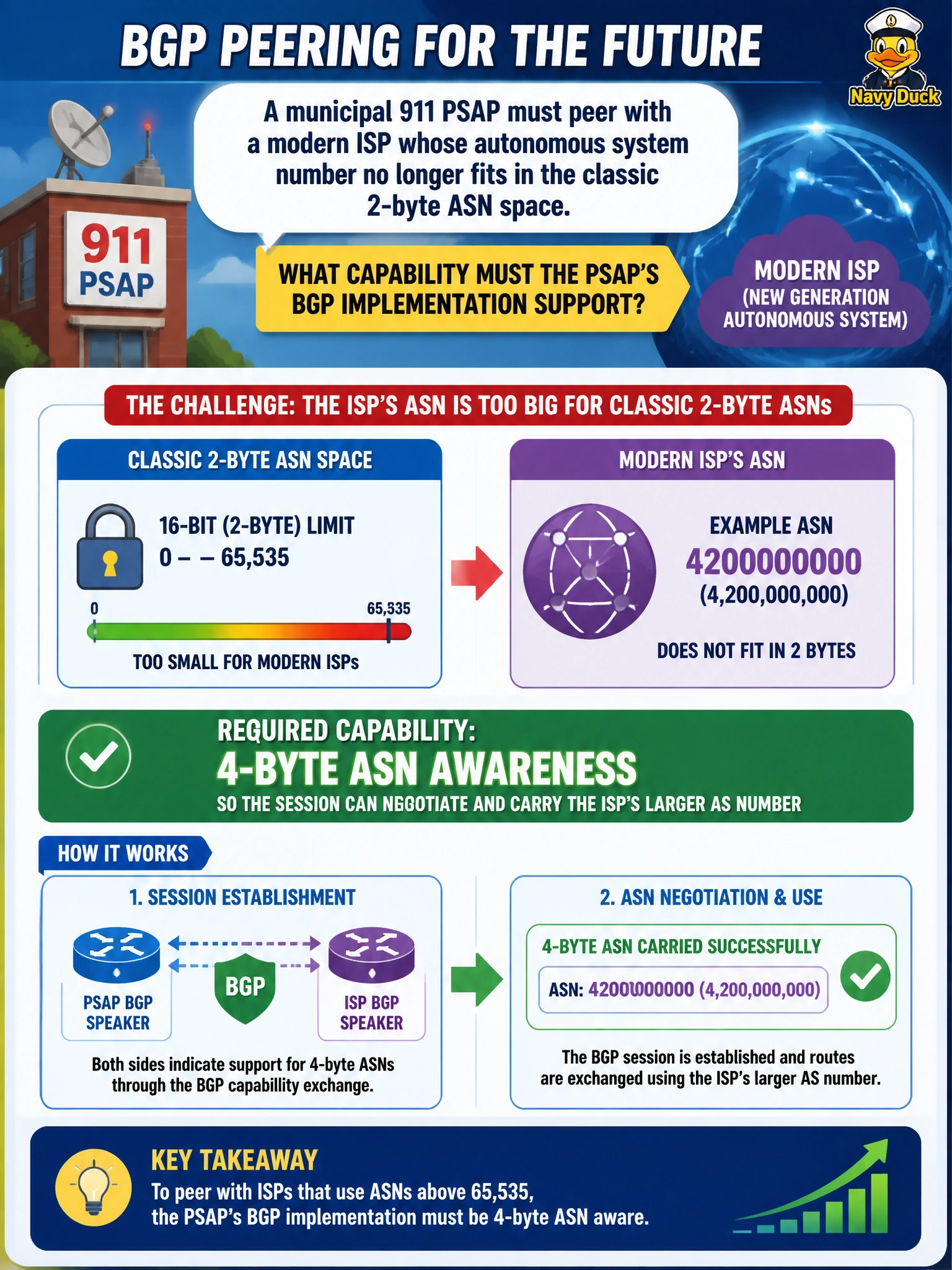
A municipal 911 PSAP must peer with a modern ISP whose autonomous system number no longer fits in the classic 2-byte ASN space. What capability must the PSAP's BGP implementation support?
Select an answer to reveal the explanation.
Short Explanation
ASNs outgrew the old 16-bit coat rack. If the ISP shows up with a big 4-byte number, your BGP stack has to speak that dialect—plain 2-byte-only gear will not shake hands cleanly.
Full Explanation
A municipal 911 PSAP peering with a modern ISP whose ASN no longer fits in the classic 0–65535 (2-byte) space must run BGP that is 4-byte (32-bit) ASN aware. The implementation must negotiate capability correctly in OPEN, encode the peer's large AS number, and represent that ASN properly in AS_PATH (including transitional AS_TRANS handling when mixed with old speakers). Without 4-byte ASN support, session establishment or path encoding for that ISP fails or becomes unreliable—exactly the capability the stem asks for.
Claiming that only confederations work because 4-byte ASNs cannot appear in standard eBGP OPEN messages is false. Confederations subdivide an AS for iBGP scaling; they are not a substitute for 4-byte ASN capability, and modern BGP does carry large ASNs in standard sessions when both sides support the extension.
Mandatory route-reflector clients on every PE before any 4-byte AS peer can establish confuses iBGP topology with ASN encoding. Route reflectors scale iBGP; they are not a prerequisite for eBGP sessions to a 4-byte ASN ISP.
IPsec tunnel protection because MPLS labels cannot encode AS numbers above 65535 mixes unrelated planes. ASN size is a BGP protocol field issue, not an MPLS label-encoding or IPsec requirement for peering with a large ASN.
Exam caveat: distinguish local AS configuration (asplain vs asdot notation on some platforms), capability negotiation failures in debugs, and that private ASN ranges also expanded with 4-byte space. Do not confuse 4-byte ASN support with confederations, RRs, or encryption.
Operational check: show bgp neighbors should show the ISP's full ASN and established capability; verify AS_PATH displays the real 4-byte value (not stuck at 23456 AS_TRANS toward old tools unless expected); confirm routing policy matches the correct ASN in filters; lab a 4-byte peer before cutover on the PSAP border.