
A fire-district IT team needs to explain how neighboring LSRs learn which MPLS labels to use for IGP-reachable prefixes. Which protocol fulfills that label-distribution role in classic MPLS operations?
Select an answer to reveal the explanation.
Short Explanation
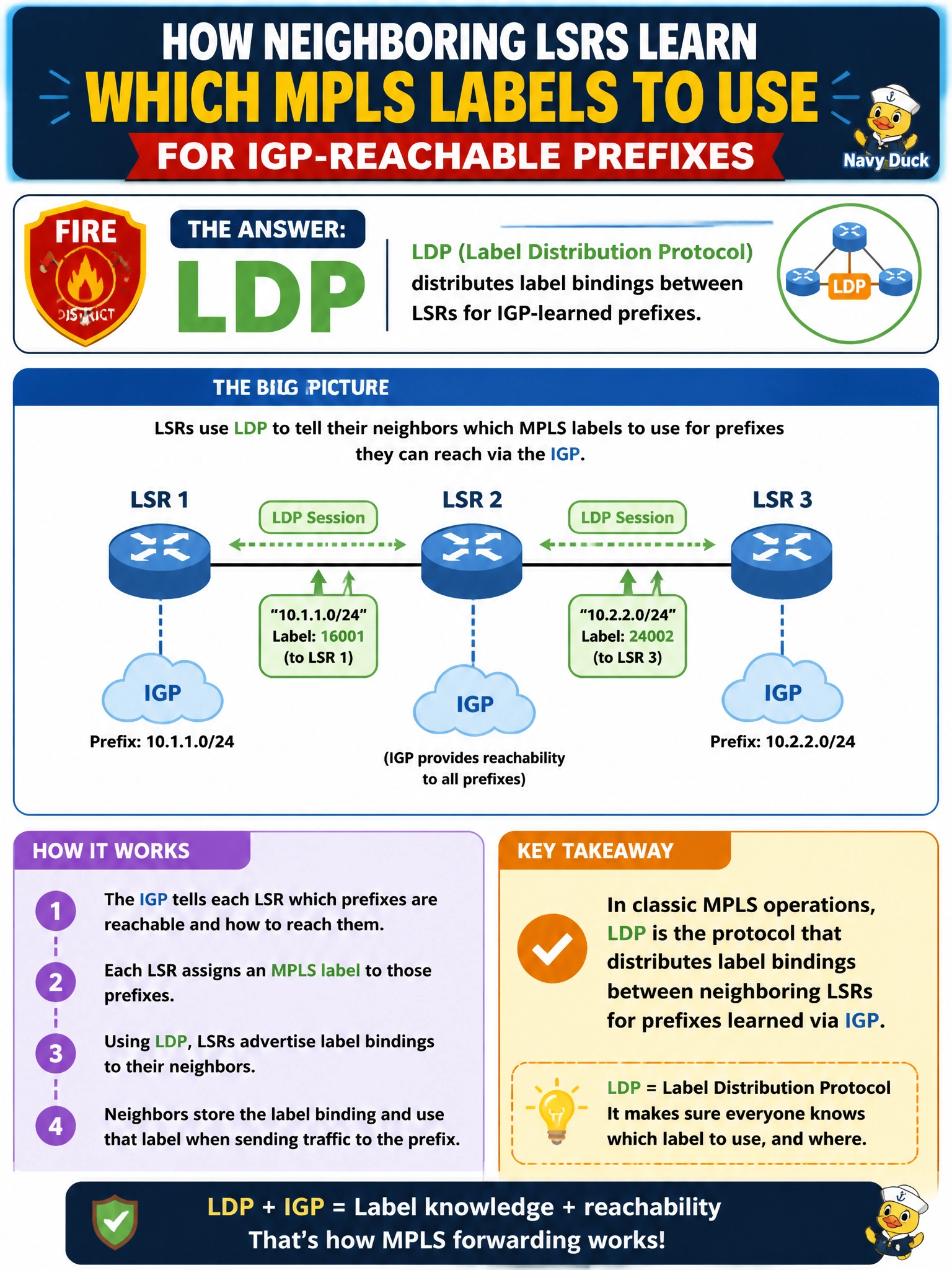
You can think of the IGP as finding the roads and LDP as assigning the labels that let routers forward along them. That is the classic MPLS label-distribution role for IGP-reachable prefixes.
Full Explanation
In classic MPLS operations, LDP distributes label bindings between neighboring LSRs for prefixes learned through the IGP. The IGP advertises IP reachability and selects best paths; LDP associates labels with those forwarding equivalence classes so each LSR can program push, swap, or pop actions in its LFIB. Together, IGP and LDP build hop-by-hop LSPs that follow the IGP topology. NHRP resolves NBMA overlay addresses in DMVPN and similar designs so spokes can build dynamic tunnels; it does not distribute IGP-prefix label bindings between LSRs. IKEv2 exchanges IPsec keying material and establishes security associations, not MPLS label values for IGP prefixes. BFD quickly detects forwarding-path failures, but it does not distribute label bindings when a path changes; failure detection is not label distribution. Exam caveat: the wording “classic MPLS” and “IGP-reachable prefixes” is important: it points to LDP rather than another label-distribution approach. Operational check: verify that show mpls ldp neighbor reports operational LSR relationships and that show mpls ldp bindings or show mpls forwarding-table lists labels for IGP prefixes. If IGP is up but bindings are missing, check LDP session authentication, transport-address reachability, and whether mpls ip is enabled on the relevant interfaces.