
A wastewater treatment plant shares one edge router among multiple agencies and needs separate BGP routing contexts without provider MPLS. Which enterprise pattern fits that requirement at ENARSI depth?
Select an answer to reveal the explanation.
Short Explanation
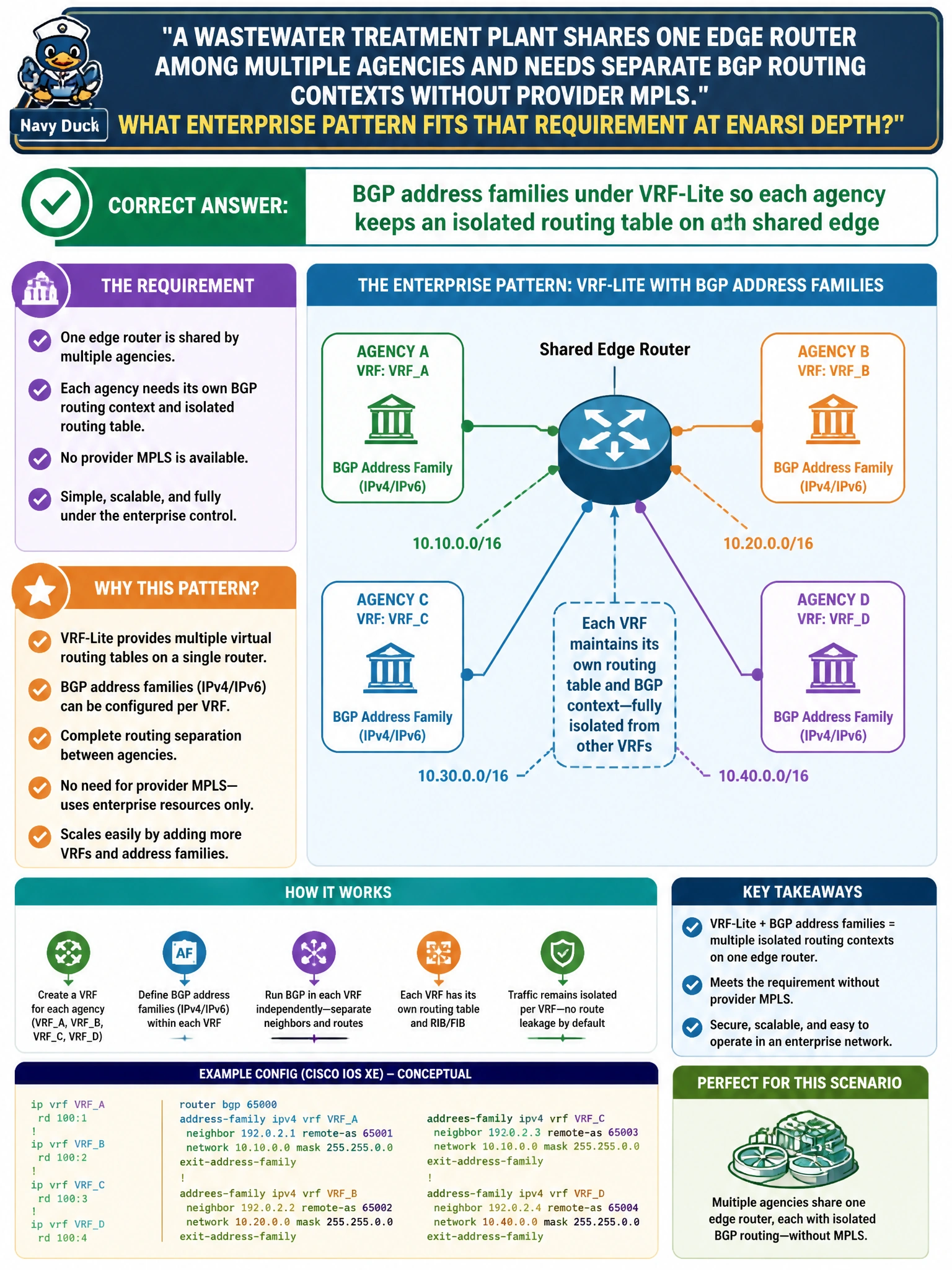
VRF-Lite is like separate filing cabinets in the same city hall building—one router, many isolated tables. Pair BGP per VRF (address families) and each agency keeps its own routes without needing a provider L3VPN.
Full Explanation
A wastewater treatment plant that shares one edge router among multiple agencies and needs separate BGP routing contexts without buying provider MPLS is describing VRF-Lite. VRF-Lite instantiates multiple VRFs on the enterprise edge so each agency keeps an isolated routing table, interfaces, and policies on the same physical router. BGP participates per VRF through address families (or VRF-aware BGP configuration), allowing each agency's prefixes and peers to remain separate even when address spaces overlap. No provider MPLS core is required for that local separation pattern at ENARSI depth.
A single global BGP process with one shared RIB forces all agencies into identical routing context and cannot isolate overlapping or policy-separated agency spaces; that is the opposite of the requirement.
DMVPN Phase 3 dual-hub is an overlay WAN design for dynamic spoke-to-spoke tunnels and NHRP shortcuts. It is not the only—or the ENARSI-primary—pattern for separating agency BGP contexts on a shared edge without provider MPLS, and it does not replace VRF-Lite table isolation on that edge router.
Disabling VRF entirely and relying on CoPP alone fails by concept. Control-Plane Policing protects the route processor's CPU from excessive punt traffic; it does not create separate routing tables or isolate overlapping agency prefixes in the data-plane RIB/FIB.
Exam caveat: VRF-Lite separates tables locally but does not by itself provide labeled transport across a provider core—that is full MPLS VPN. Know that overlapping RFC1918 is a common driver, that PE-CE style BGP per VRF appears in both Lite and MPLS designs, and that leaking between VRFs requires explicit route-targets or import policies if used.
Operational check: show vrf detail / show ip route vrf <agency> should list only that agency's routes; confirm interfaces are bound to the correct VRF; verify BGP address-family ipv4 vrf sessions are Established per agency; ensure no accidental global-table leakage unless intentionally designed.