
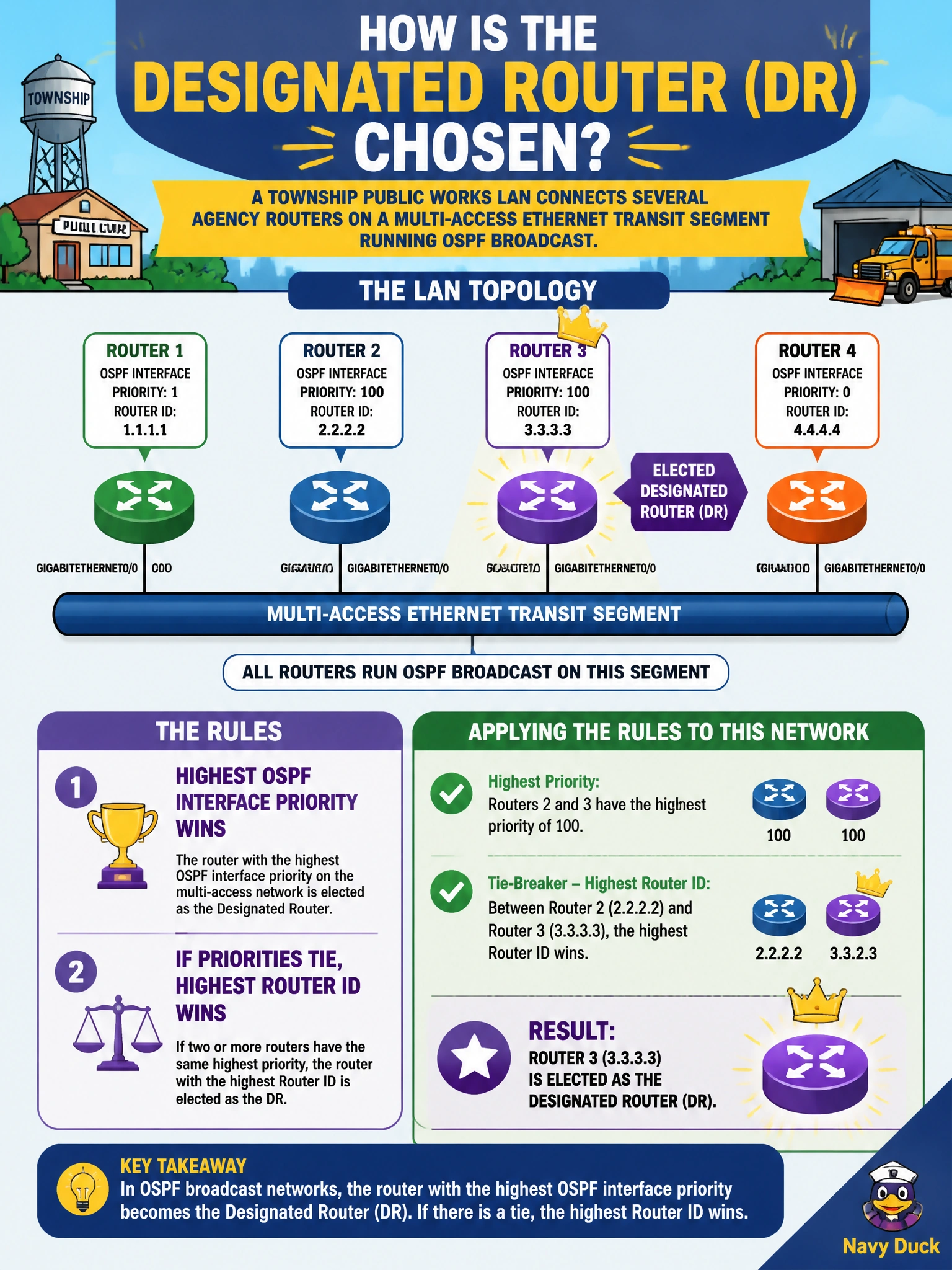
A township public works LAN connects several agency routers on a multi-access Ethernet transit segment running OSPF broadcast. How is the Designated Router chosen?
Select an answer to reveal the explanation.
Short Explanation
On a busy multi-access LAN, OSPF picks a DR like electing a meeting chair: highest priority gets the gavel. If everybody set the same priority, highest router ID breaks the tie. Cost and who booted first are not what wins that vote.
Full Explanation
On a township public works multi-access Ethernet transit segment running OSPF broadcast, the Designated Router is chosen by interface priority first: the router with the highest OSPF interface priority wins. If priorities are equal, the highest OSPF router ID breaks the tie. That deterministic election reduces adjacency scale on multi-access media by having non-DR routers form adjacencies primarily with DR/BDR. Understanding priority-then-RID selection is why the correct answer matches how the DR is chosen on the agency LAN. Lowest OSPF cost on any uplink does not elect the DR; cost influences SPF path selection, not DR election. The first router to boot does not permanently remain DR regardless of priority—preemption and priority/RID rules apply when elections run (with the practical nuance that a stable DR is not always immediately displaced, but “first forever” is not the rule). DR election does not use BGP MED values copied into hellos; MED is a BGP attribute unrelated to OSPF hello election fields. Exam caveat: set priority 0 on routers that must never be DR; remember RID tie-break is the highest RID, often influenced by loopbacks—duplicate RIDs break more than election. Operational check: review show ip ospf interface for Priority, DR, and BDR; intentionally set hub/transit priorities; after changes, bounce the segment or clear OSPF carefully in a maintenance window and reconfirm DR identity before relying on flooding assumptions.