
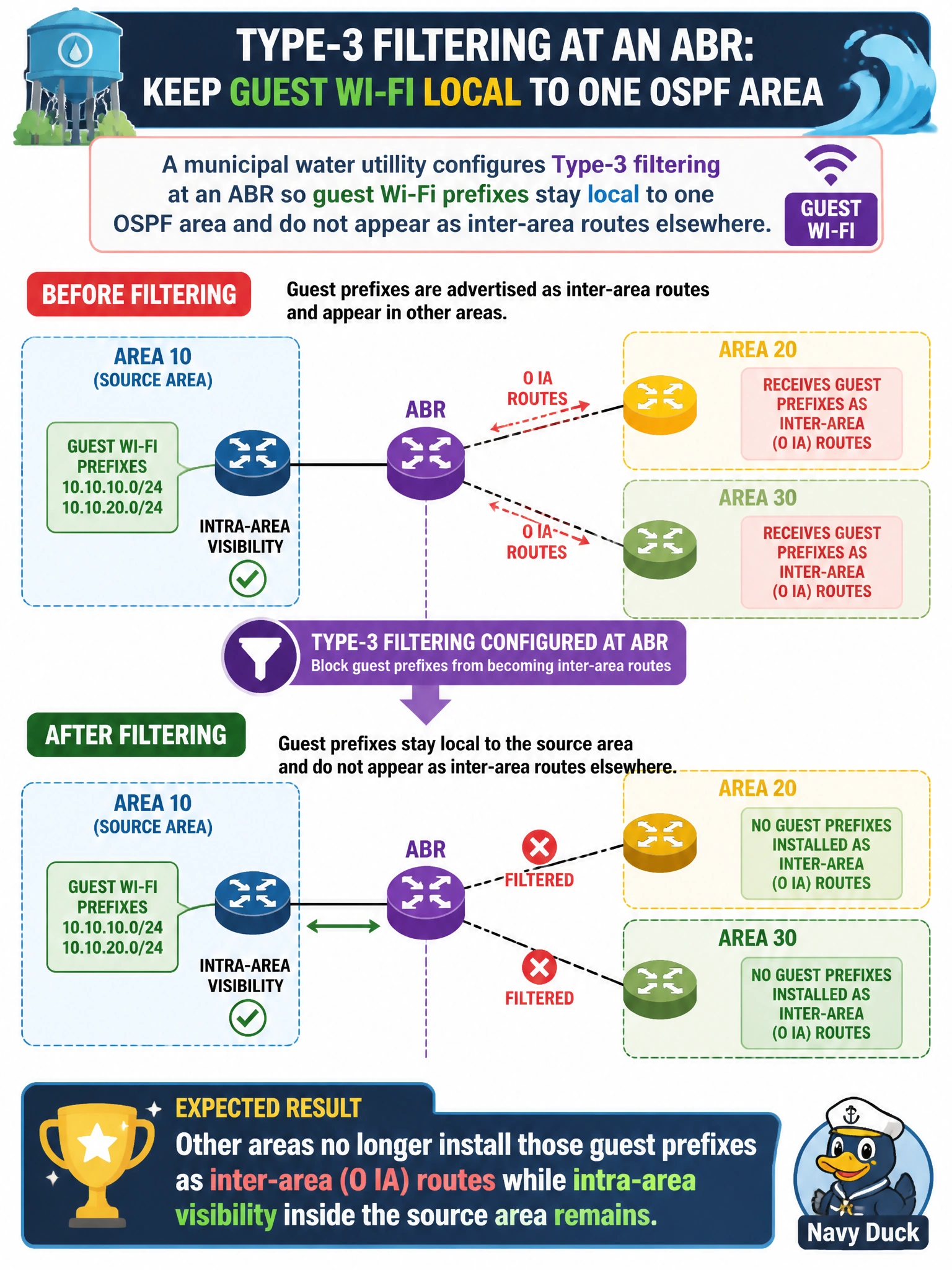
A municipal water utility configures Type-3 filtering at an ABR so guest Wi-Fi prefixes stay local to one OSPF area and do not appear as inter-area routes elsewhere. What is the expected result?
Select an answer to reveal the explanation.
Short Explanation
The ABR is the customs desk between areas. If it filters a Type-3 summary for guest Wi-Fi, other neighborhoods never get that inter-area route—but folks still see it inside the home area.
Full Explanation
When a municipal water utility configures Type-3 filtering at an ABR so guest Wi-Fi prefixes stay local to one OSPF area, the ABR stops advertising those prefixes as inter-area Type-3 summary LSAs into other areas. Consequently, other areas no longer install those guest prefixes as O IA routes, while routers inside the source area still see them as intra-area routes. Filtering at the ABR is the correct control point for inter-area visibility because Type-3 LSAs are generated by ABRs—hence the expected result in the correct option. Guest prefixes flooding as Type-5 externals into every stub area automatically is unrelated to Type-3 ABR filtering and misstates both LSA type and stub behavior. Claiming filtering at the ABR has no effect because Type-3 LSAs bypass ABRs is false; ABRs create and can filter Type-3s. Intra-area routers in other areas still seeing the guest prefixes as O routes is wrong because O (intra-area) visibility does not cross area boundaries—other areas would have seen them as O IA only if Type-3s were advertised. Exam caveat: Type-3 filtering hides inter-area reachability but does not remove the prefixes from the source area’s LSDB; also distinguish from Type-5 filtering and summarization. Operational check: apply the Type-3 filter on the ABR toward the destination areas; verify with show ip ospf database summary and show ip route on a remote-area router that guest prefixes are gone as O IA while source-area routers still show them as O.