
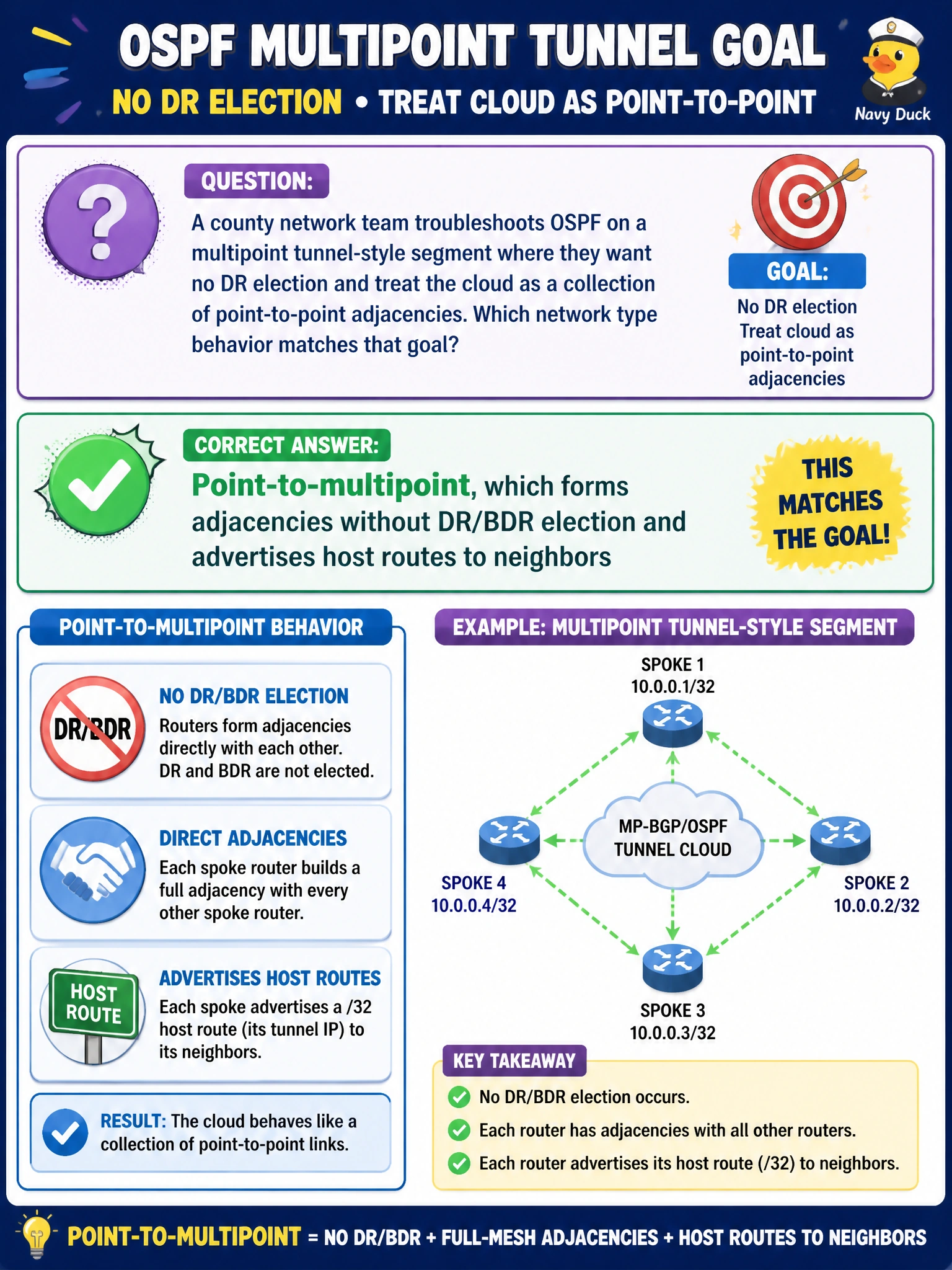
A county network team troubleshoots OSPF on a multipoint tunnel-style segment where they want no DR election and treat the cloud as a collection of point-to-point adjacencies. Which network type behavior matches that goal?
Select an answer to reveal the explanation.
Short Explanation
Point-to-multipoint is the "many point-to-point roads sharing one cloud" model—no DR beauty contest. Neighbors form without electing a DR/BDR, and the router advertises host routes toward each peer. That fits multipoint tunnel-style county designs better than pretending the cloud is a LAN.
Full Explanation
A county network team on a multipoint tunnel-style segment that wants no DR election and wants the cloud treated as a collection of point-to-point adjacencies should use OSPF point-to-multipoint. Point-to-multipoint forms adjacencies without Designated Router or Backup Designated Router election and advertises host (/32) routes to neighbors, which matches a multipoint tunnel or similar nonbroadcast cloud where electing a DR is undesirable. That behavioral model—no DR/BDR, host routes to peers—is why the correct choice fits the troubleshooting goal. Broadcast fails because it elects a DR and expects LAN-like multicast behavior to every spoke, which is what the team is trying to avoid. Loopback network type electing two DRs per tunnel key invents a nonexistent OSPF network-type behavior. Nonbroadcast with priority 255 on every spoke so all spokes become DRs fights itself: NBMA still elects a DR, and making every spoke priority 255 creates contention rather than eliminating DR election. Exam caveat: contrast point-to-multipoint (no DR, host routes) with NBMA (static neighbors, DR/BDR still applies) and with point-to-multipoint nonbroadcast variants; exam wording often hinges on DR presence. Operational check: set ip ospf network point-to-multipoint on the tunnel interfaces; confirm show ip ospf interface shows no DR/BDR; verify neighbor Full states and /32 host routes to peers in the routing table.