
A regional planning commission converts a remote fire-district OSPF area to totally stubby so the LSDB stays tiny. What routes should routers in that area keep after the ABR is configured correctly?
Select an answer to reveal the explanation.
Short Explanation
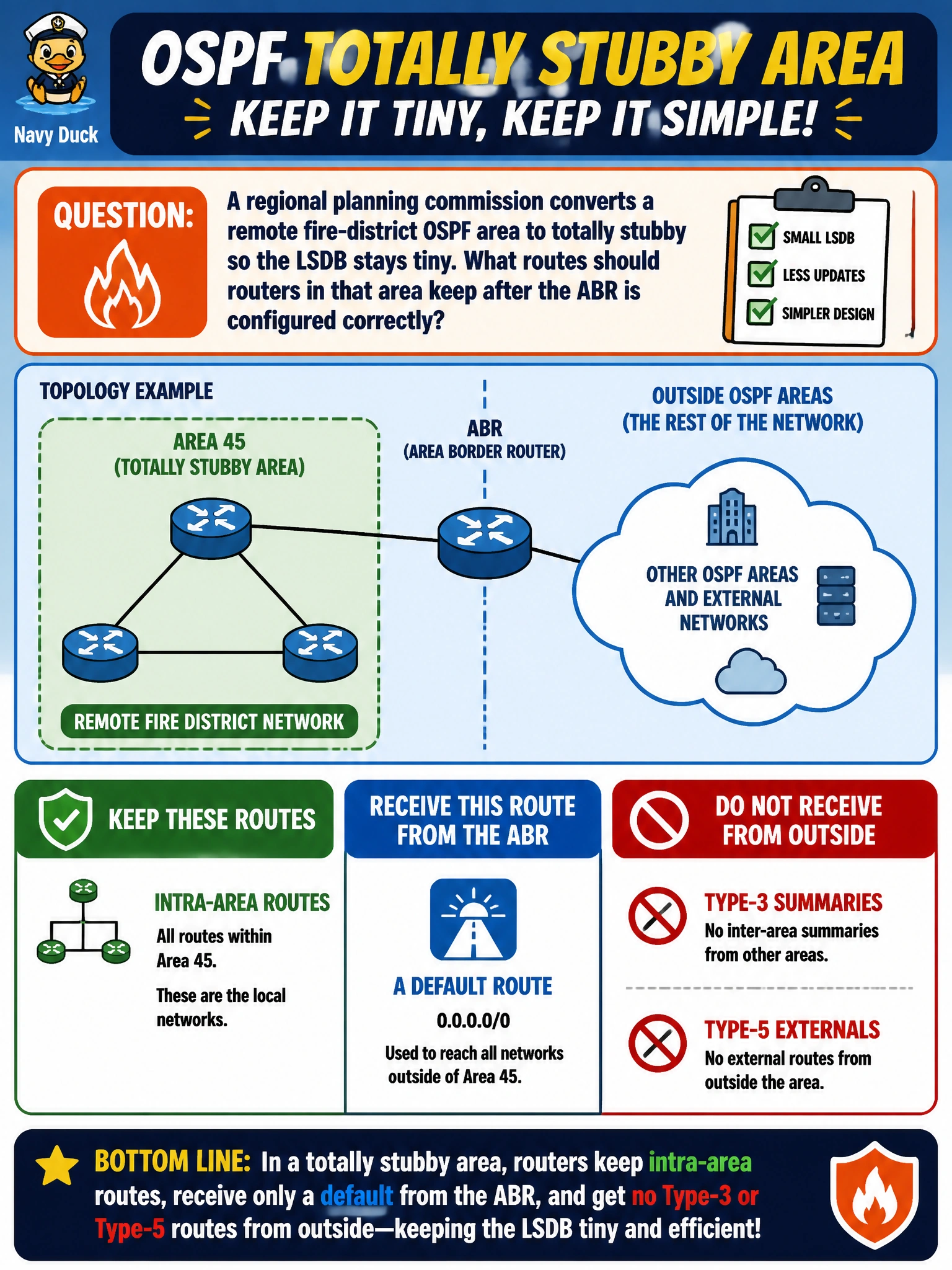
Totally stubby is the "bring only a default and your own streets" map for a quiet fire district. The ABR hangs a default, blocks outside Type-3 summaries and Type-5 externals, and leaves local intra-area routes alone.
Full Explanation
A regional planning commission converting a remote fire-district area to totally stubby intentionally minimizes that area’s LSDB. With the ABR correctly configured as totally stubby, routers inside the fire district keep intra-area (O) routes for local topology and install a default route originated by the ABR for everything outside the area. Totally stubby areas do not receive inter-area Type-3 summaries from other cities and do not receive Type-5 externals; the default replaces both classes of outside detail. That is why the correct outcome is intra-area routes plus a default, without Type-3 summaries or Type-5 externals from outside the area. Keeping full Type-5 external tables plus every inter-area Type-3 summary contradicts totally stubby filtering and leaves the LSDB large. Allowing only redistributed EIGRP Type-7 LSAs with no default confuses totally stubby with NSSA behavior and denies the default that totally stubby areas rely on for exit. Installing every Type-4 ASBR summary plus full Internet BGP tables inside the fire district is the opposite of stub minimization and mixes BGP Internet scale with OSPF area design incorrectly. Exam caveat: stub still allows Type-3 summaries (plus default, no Type-5); totally stubby removes those Type-3 summaries as well—ENARSI stems often test whether you remember the extra filter. Operational check: after ABR totally-stubby configuration, on a fire-district internal router run show ip route ospf and show ip ospf database; confirm a default from the ABR, local O routes only for in-area prefixes, and no O IA summaries or E1/E2 externals from outside.