
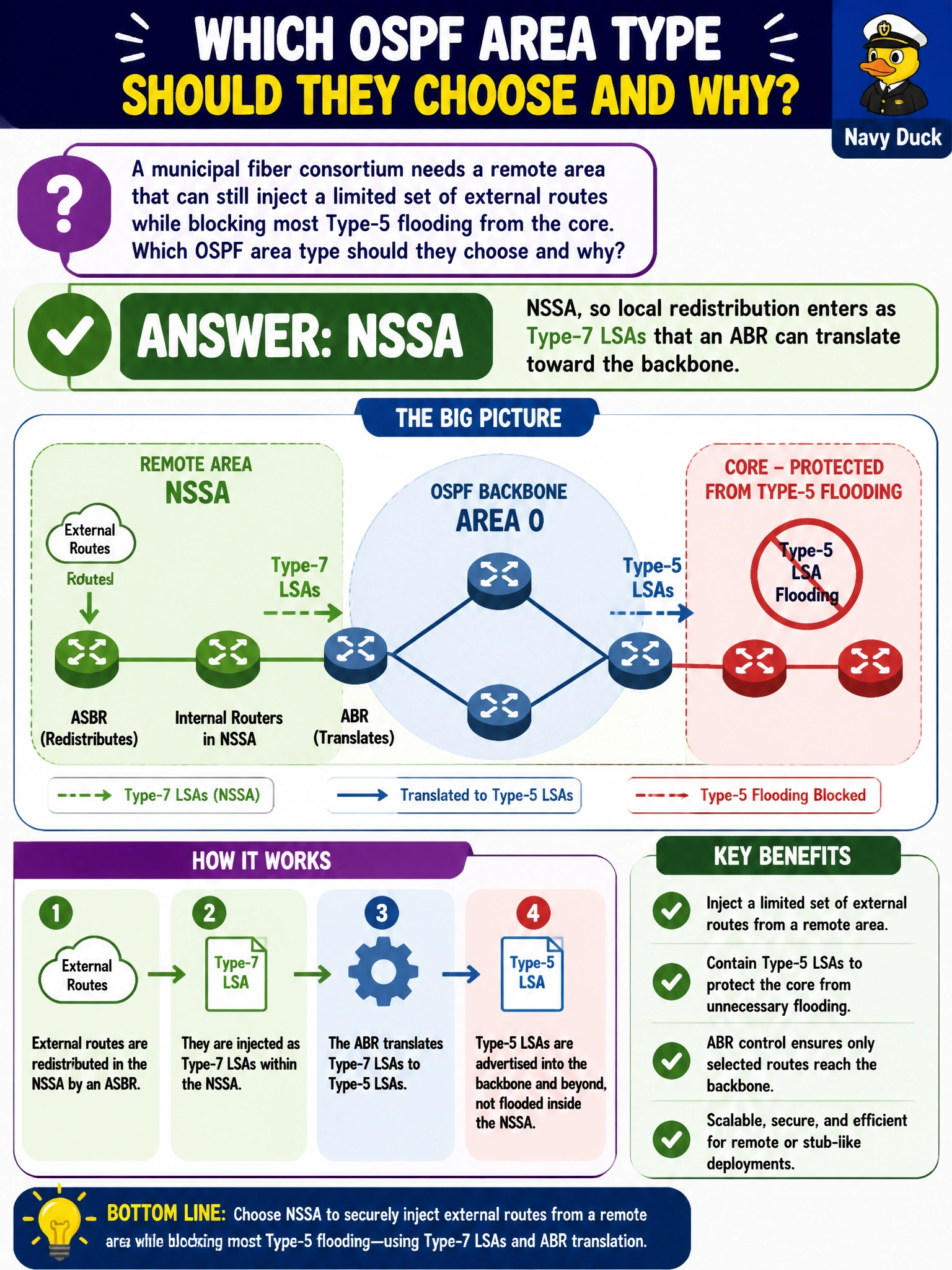
A municipal fiber consortium needs a remote area that can still inject a limited set of external routes while blocking most Type-5 flooding from the core. Which OSPF area type should they choose and why?
Select an answer to reveal the explanation.
Short Explanation
Choose an NSSA when you want your remote area to inject a few outside routes without taking in a full Type-5 flood. You get local Type-7 injection, and the ABR translates routes that should reach the backbone.
Full Explanation
A municipal fiber consortium that needs a remote area to inject a limited set of external routes while blocking most core Type-5 flooding should choose an NSSA (Not-So-Stubby Area). Local redistribution in an NSSA creates Type-7 LSAs rather than Type-5 LSAs. An ABR can translate selected Type-7 LSAs into Type-5 LSAs toward the backbone, letting the remote site advertise needed external routes without importing a full Type-5 flood from elsewhere. That inject-and-translate behavior makes an NSSA suitable for controlled local external injection while limiting external flooding into the area. The totally stubby description fails because totally stubby areas are designed to block outside Type-3 summaries and Type-5 externals; they do not freely flood Type-5s from every ASBR. The backbone-only claim is incorrect because Type-7 LSAs exist in NSSAs, not only in area 0. A normal area with no ABR is not a viable remote OSPF area attached to the domain, and removing the ABR does not eliminate the need for proper ASBR and ABR roles in external-route handling. Exam caveat: distinguish an NSSA from a stub or totally stubby area; remember Type-7 originates in the NSSA and an ABR translates it to Type-5 for the backbone, while totally stubby NSSA variants further limit Type-3 summaries. Practical check: verify NSSA configuration on internal and ABR routers, inspect local Type-7 LSAs with show ip ospf database nssa-external, and confirm beyond the ABR that only intended prefixes appear as translated Type-5 LSAs.