
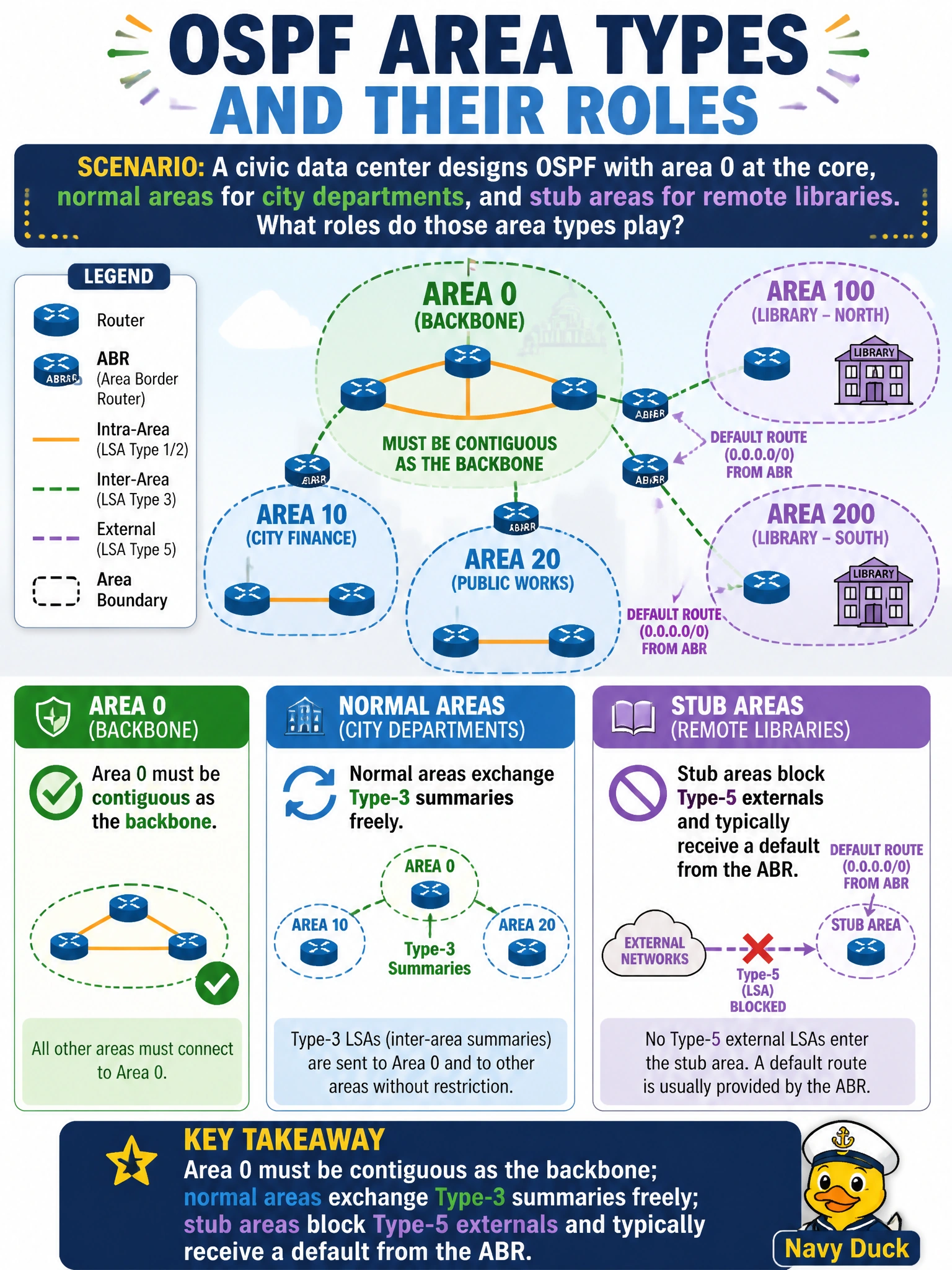
A civic data center designs OSPF with area 0 at the core, normal areas for city departments, and stub areas for remote libraries. What roles do those area types play?
Select an answer to reveal the explanation.
Short Explanation
Think of area 0 as the downtown transit plaza every bus route must touch. Regular department areas still see inter-area summaries, but remote library stubs keep the map simple—no Type-5 external flood—just a default from the ABR.
Full Explanation
Civic OSPF designs commonly place area 0 at the core as the contiguous backbone, use normal areas for city departments that still need inter-area Type-3 summaries, and use stub areas for remote libraries that should not carry a full external Type-5 flood. Area 0’s contiguity requirement exists so every non-backbone area can reach the backbone through an ABR path without partitioning; without a contiguous backbone, inter-area reachability breaks or needs temporary virtual links. Normal areas exchange Type-3 summaries freely so department routers learn other areas’ prefixes as O IA routes. Stub areas block Type-5 externals and typically receive a default from the ABR, shrinking the remote LSDB while still providing exit reachability—exactly the role remote libraries need when they do not require every external detail. Making stub areas the only legal backbone fails because the backbone is area 0; stubs cannot replace it or be required to contain every ASBR. Claiming normal areas refuse all Type-3 LSAs while area 0 floods only Type-5s reverses OSPF area behavior and invents illegal flooding rules. Forcing remote library stubs to peer eBGP directly into area 0 without an ABR confuses exterior BGP peering with OSPF area attachment; stub libraries still attach through an ABR and do not need eBGP into the backbone for basic OSPF area roles. Exam caveat: distinguish stub (no Type-5, usually default) from totally stubby (also no Type-3 summaries) and NSSA (Type-7 local externals); the stem here is classic stub versus normal versus backbone roles. Operational check: confirm area 0 contiguity and ABR attachments with show ip ospf and show ip ospf border-routers; in a library stub, verify absence of Type-5 LSAs and presence of a default from the ABR in the routing table.