
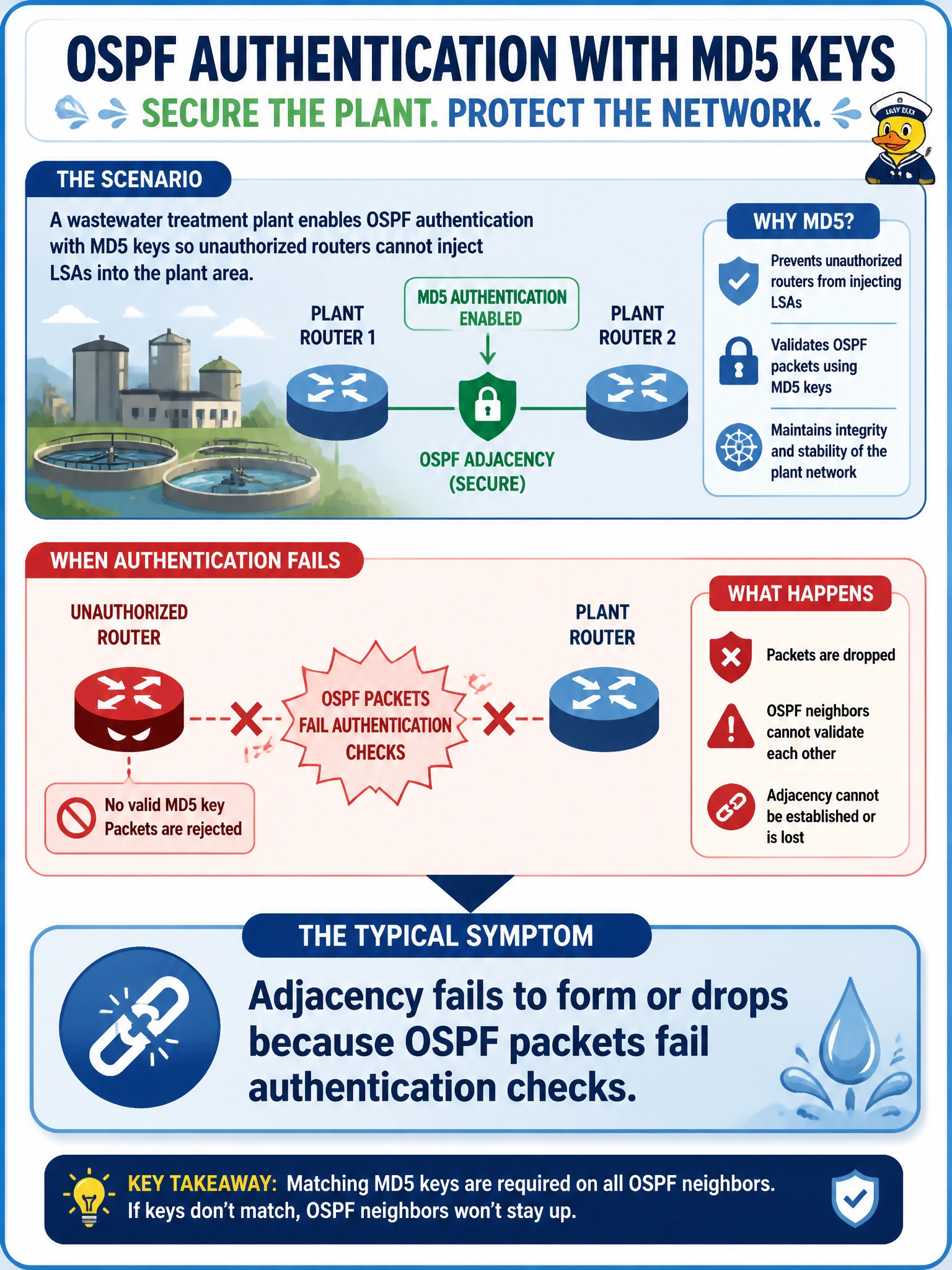
A wastewater treatment plant enables OSPF authentication with MD5 keys so unauthorized routers cannot inject LSAs into the plant area. What is the typical symptom when authentication fails?
Select an answer to reveal the explanation.
Short Explanation
Bad or missing OSPF keys mean the wastewater routers will not become neighbors—no trust, no LSA exchange. That is the feature working: a random box on the plant LAN cannot inject routes.
Full Explanation
OSPF interface or area authentication (plaintext or MD5/key-chain styles depending on platform) validates OSPF packets. When authentication fails at a wastewater treatment plant, adjacency fails to form or an existing neighbor drops because packets fail authentication checks. That is the desired outcome when unauthorized routers must not inject LSAs into the plant area: without matching keys, there is no trusted neighbor and no LSA exchange.
Claiming neighbors reach FULL but all Type-5 LSAs are silently dropped fails by concept: auth failure blocks adjacency, not a selective Type-5 filter after FULL. Claiming OSPF continues adjacency and only blocks SNMP polls from unauthenticated peers confuses routing authentication with device management access control. Claiming DR election succeeds while BDR election is skipped until keys match invents a partial-election symptom that is not the typical auth-failure outcome.
Exam caveat: authentication type and key must match on the link/area scope in use; mismatched type (MD5 vs null) fails as surely as a wrong key. Operational check: align OSPF auth configuration on plant peers, verify adjacency reaches FULL only with correct keys, and confirm a test device with wrong keys cannot join the area or inject LSAs.