
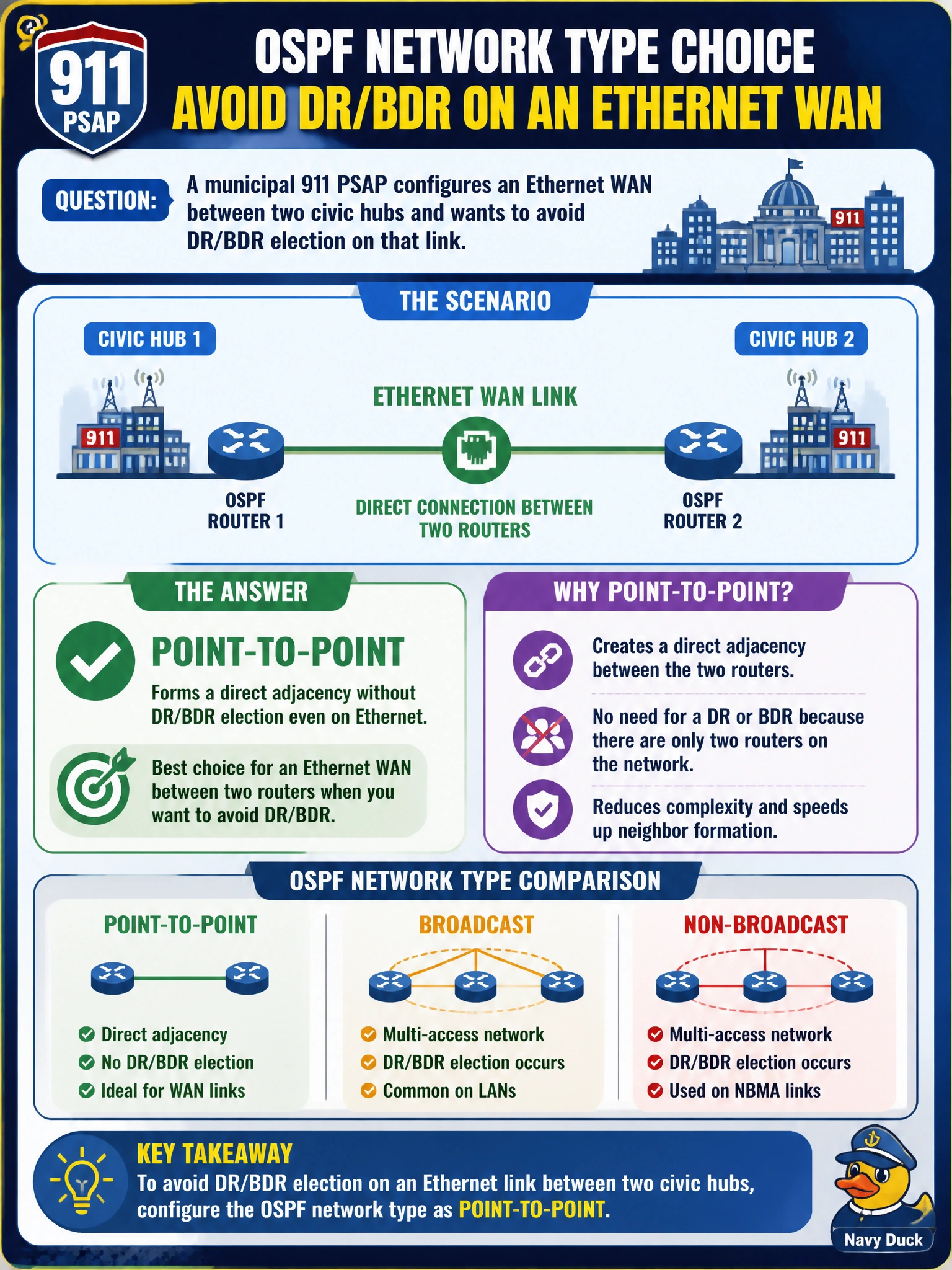
A municipal 911 PSAP configures an Ethernet WAN between two civic hubs and wants to avoid DR/BDR election on that link. Which OSPF network type choice achieves that?
Select an answer to reveal the explanation.
Short Explanation
Ethernet defaults to broadcast and holds a DR election like a town meeting. Point-to-point tells OSPF "this is just two hubs talking"—no election, simpler adjacency for the PSAP WAN. Pick point-to-point when only two routers share that Ethernet handoff.
Full Explanation
OSPF point-to-point network type forms a direct adjacency without DR/BDR election, even when the underlying interface is Ethernet. For a municipal 911 PSAP Ethernet WAN that is logically two civic hubs only, point-to-point avoids unnecessary DR/BDR election overhead and simplifies adjacency to a single FULL neighbor relationship. Matching network types on both ends remains mandatory. Broadcast on Ethernet would elect DR/BDR; that election is unneeded when only two routers share the handoff.
Broadcast always electing DR/BDR is why it is the wrong choice when the goal is to avoid election—not a solution. Nonbroadcast still involves DR behavior on NBMA-style multiaccess designs and is not the clean “no election” answer for a two-router Ethernet WAN. Loopback network type is for loopback interfaces advertising a host route, not a valid multiaccess WAN Ethernet handoff type for this purpose.
Exam caveat: changing network type changes next-hop and adjacency expectations—set both PSAP hubs consistently and clear OSPF process carefully in a window if rewriting types on a live link. Operational check: configure ip ospf network point-to-point (or OSPFv3 equivalent) on both civic hubs’ Ethernet WAN interfaces, verify no DR/BDR election, confirm a single FULL adjacency, and re-check 911-related prefix installation.