
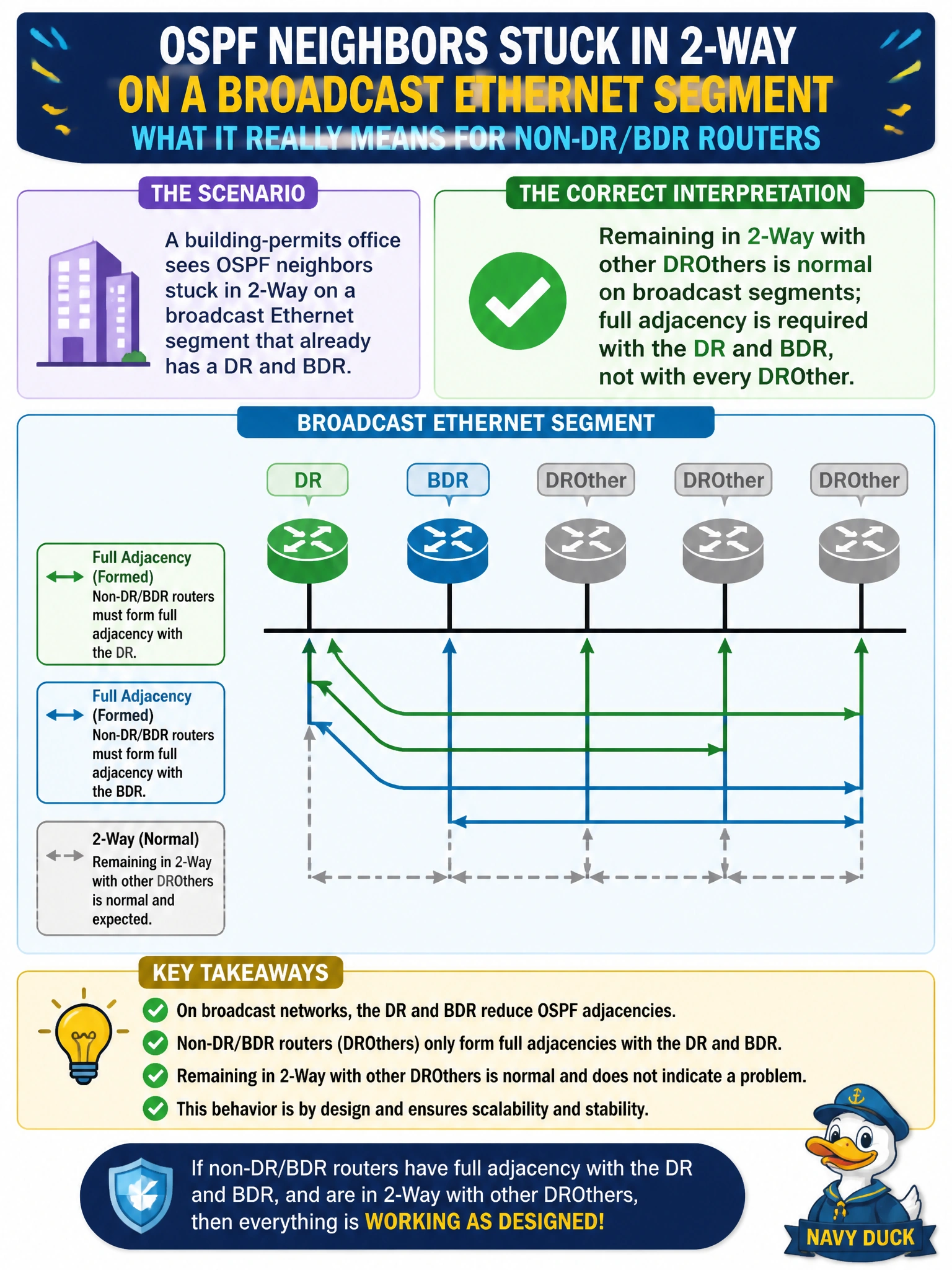
A building-permits office sees OSPF neighbors stuck in 2-Way on a broadcast Ethernet segment that already has a DR and BDR. What is the correct interpretation for non-DR/BDR routers?
Select an answer to reveal the explanation.
Short Explanation
On a busy Ethernet floor, not everyone needs a full conversation with everyone—only with the designated lead and backup (DR/BDR). Two building-permit routers both stuck at 2-Way with each other as DROthers is often healthy, not broken.
Full Explanation
On OSPF broadcast network types, DROthers form full adjacencies with the DR and BDR but remain in 2-Way with other DROthers. That reduced adjacency mesh is normal and expected on a multiaccess Ethernet segment that already has a DR and BDR. Building-permits office routers that are both DROthers showing 2-Way to each other are often healthy; FULL is required toward the DR/BDR, not toward every other DROther on the segment.
Claiming any 2-Way state always means Hello/Dead timer mismatch fails by concept: 2-Way among DROthers is steady-state on broadcast, whereas timer mismatch typically prevents progressing toward a stable adjacency with the DR/BDR as well. Claiming 2-Way means the area was set to NSSA incorrectly fails—area type is unrelated to this DROther behavior. Claiming all routers on a broadcast segment must reach FULL with every other router fails; that full mesh is exactly what DR election avoids.
Exam caveat: 2-Way to the DR or BDR (or stuck below 2-Way) is abnormal—contextualize who the peer is before troubleshooting. Operational check: identify DR/BDR on the permits Ethernet segment, confirm each DROther is FULL with DR and BDR, accept 2-Way between DROthers, and only chase timers/MTU/auth if FULL to DR/BDR is missing.