
An assessor’s office enables OSPFv3 for IPv6 campus edges while continuing OSPFv2 for IPv4. Which statement correctly describes their roles?
Select an answer to reveal the explanation.
Short Explanation
Think two map departments: OSPFv2 draws the IPv4 streets, OSPFv3 draws the IPv6 streets. The assessor’s dual-stack edges keep both maps current instead of hoping one protocol magically drafts both.
Full Explanation
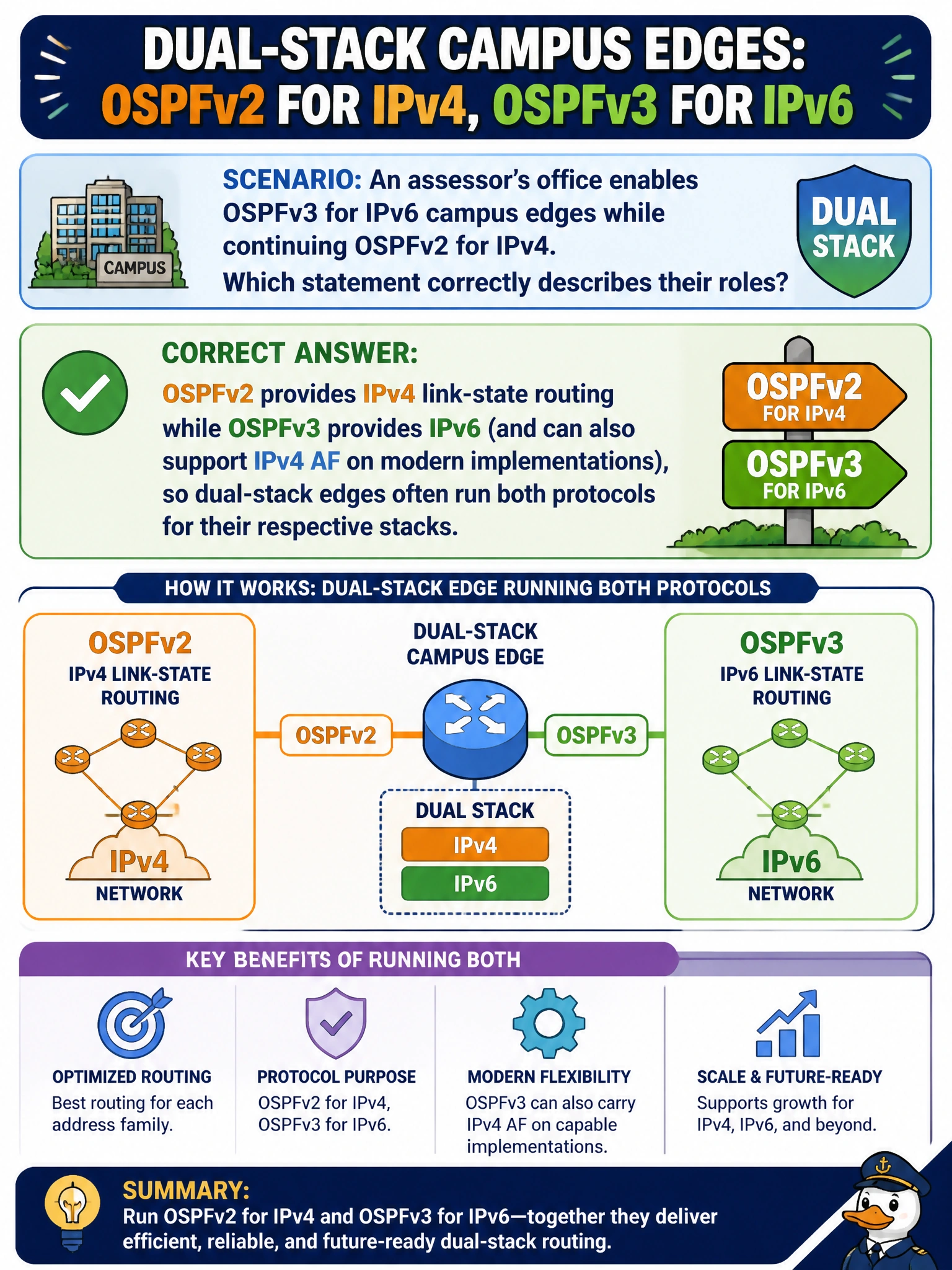
OSPFv2 provides IPv4 link-state routing; OSPFv3 was designed for IPv6 and, on modern implementations, can also support IPv4 address families. An assessor’s office dual-stack campus therefore commonly runs OSPFv2 for IPv4 alongside OSPFv3 for IPv6 rather than expecting one protocol to silently replace the other for both stacks. Enabling OSPFv3 for IPv6 campus edges does not automatically retire OSPFv2’s role for IPv4.
Claiming OSPFv3 replaces OSPFv2 for both IPv4 and IPv6 automatically once any IPv6 interface is added fails by concept: the protocols coexist unless you deliberately migrate IPv4 into OSPFv3 AF and remove OSPFv2. Claiming OSPFv2 carries IPv6 natively when areas are numbered above 0 fails—OSPFv2 does not carry IPv6 prefixes. Claiming OSPFv3 is only an authentication wrapper that still depends on OSPFv2 LSAs for IPv6 fails; OSPFv3 is a full IPv6 (and optional IPv4 AF) link-state protocol with its own LSAs.
Exam caveat: “OSPFv3 can do IPv4 AF” on modern IOS-XE is true but separate from the common dual-process dual-stack pattern; read the stem for which stacks are in play. Operational check at the assessor campus: verify OSPFv2 neighbors/routes for IPv4, OSPFv3 neighbors/routes for IPv6, confirm no unintended redistribution loops between them, and document which protocol owns each stack.