
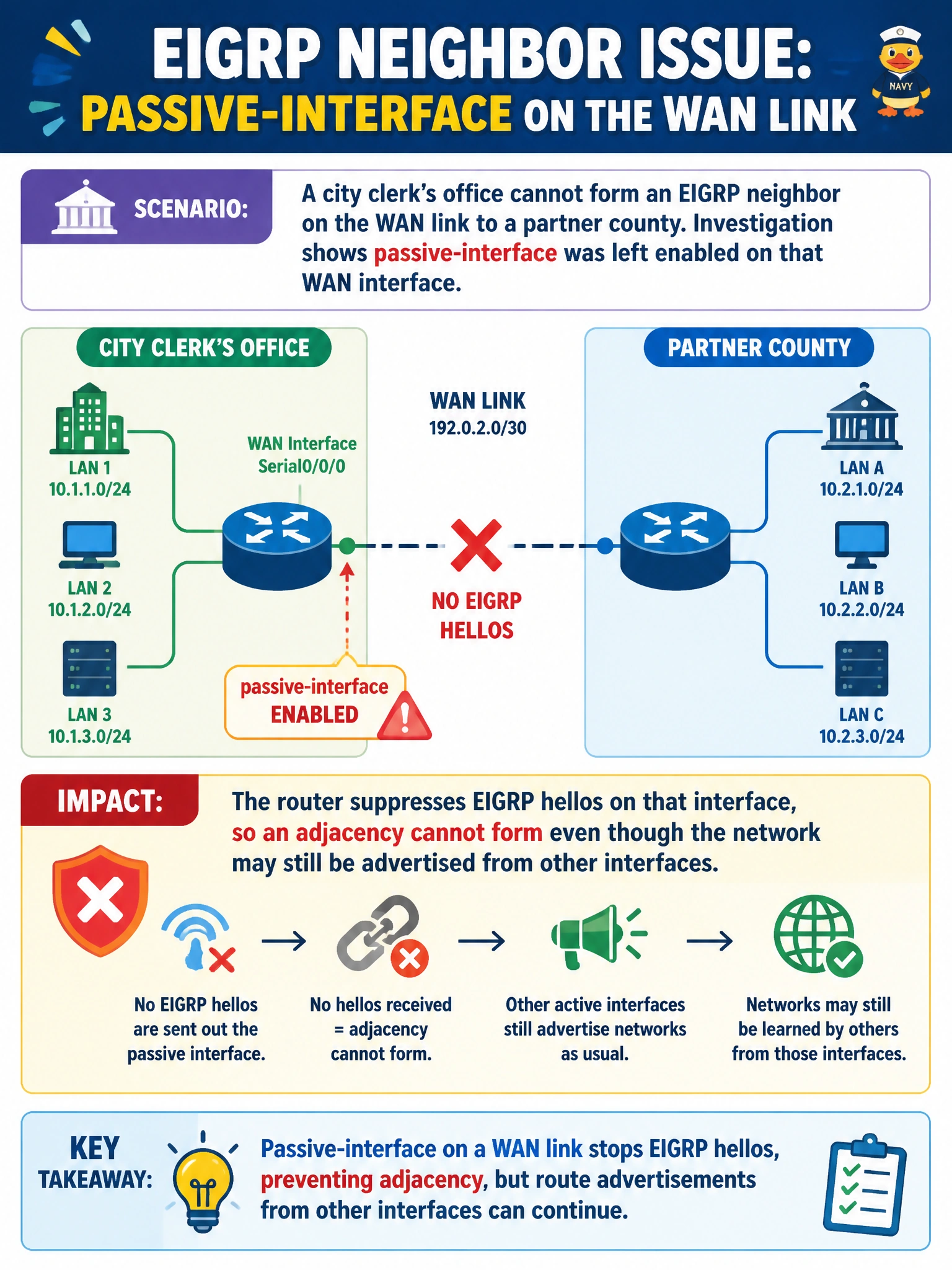
A city clerk’s office cannot form an EIGRP neighbor on the WAN link to a partner county. Investigation shows passive-interface was left enabled on that WAN interface. What is the impact?
Select an answer to reveal the explanation.
Short Explanation
Passive-interface is the "listen, don’t talk" sticky note on a LAN. On the WAN to the partner county it is fatal: no hellos out means no neighbor. Move passive to the user VLANs, not the uplink.
Full Explanation
Passive-interface on an EIGRP-enabled WAN link suppresses EIGRP hellos on that interface, so an adjacency cannot form with the partner county even though the connected network may still be advertised from other non-passive interfaces in the process. City clerk’s office troubleshooting that shows passive left enabled on the WAN uplink explains a neighbor-down with otherwise plausible addressing: the router is listening/advertising in a passive sense for that interface’s network inclusion behavior, but it will not actively form a neighbor on a passive interface. Passive belongs on user LAN/VLAN edges where you want the network advertised without forming neighbors—not on the partner WAN.
Claiming passive-interface doubles hello frequency fails by concept: it suppresses hellos for adjacency formation on that interface. Claiming passive only affects OSPF and has no meaning in EIGRP fails—both IGPs use passive-interface. Claiming neighbors form but the interface metric goes to infinity until cleared invents a false symptom; the adjacency simply does not establish.
Exam caveat: passive-interface default (passive-interface default plus allow-list) designs commonly catch WAN links by mistake during templating—verify exceptions after any global passive rollout. Operational check: remove or except passive on the partner-county WAN, confirm hellos egress, verify EIGRP neighbor up, and re-apply passive only on clerk access VLANs that must not form neighbors.