
A county courts network runs EIGRP for SCADA inside a VRF while a separate global EIGRP process serves office VLANs on the same router. What does this separation provide?
Select an answer to reveal the explanation.
Short Explanation
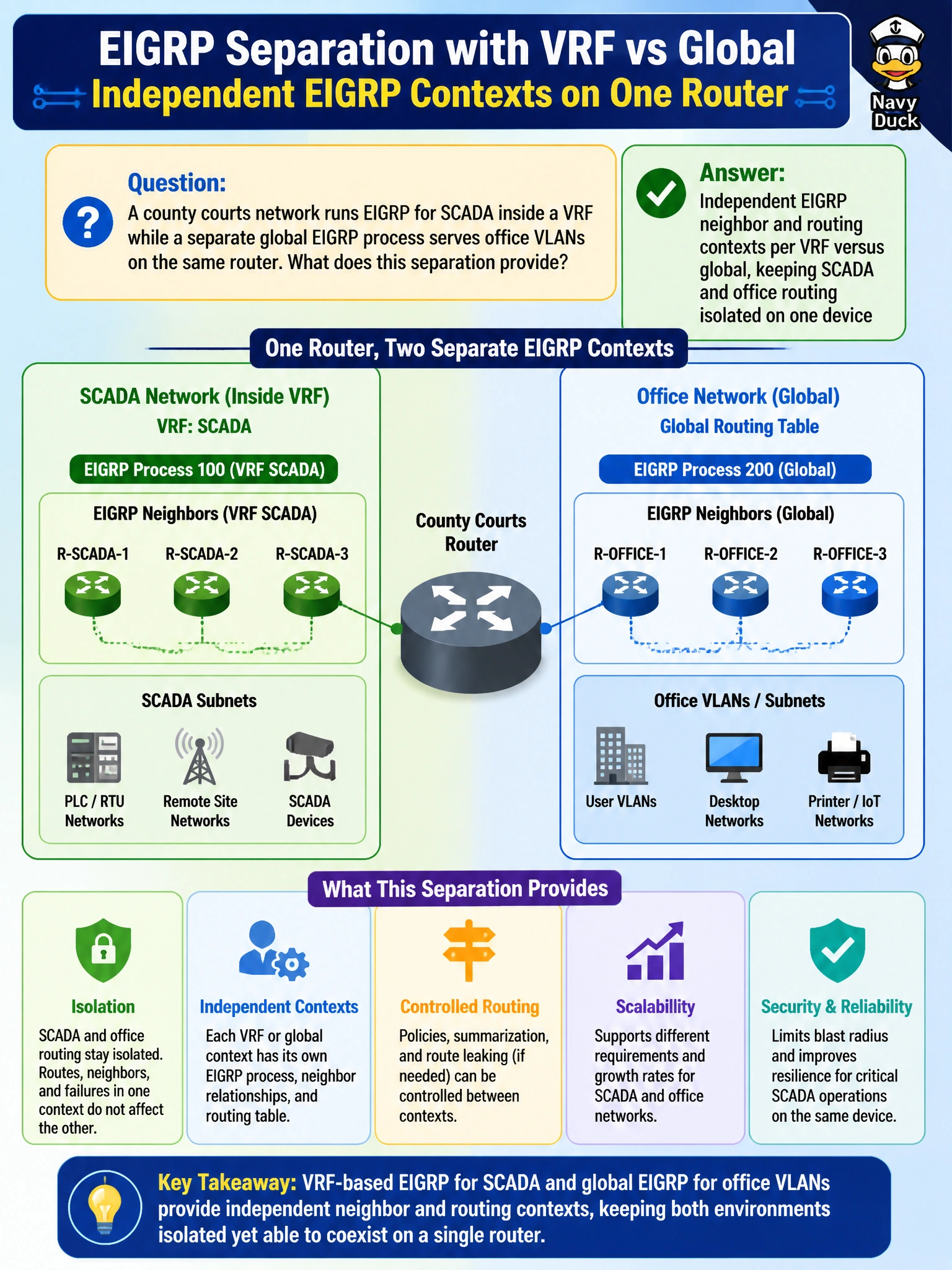
Same physical router, two different "rooms": the VRF room runs SCADA EIGRP, the global room runs office EIGRP. Neighbors, tables, and prefixes stay isolated unless you deliberately leak. That is how courts keep telemetry away from clerk VLANs.
Full Explanation
Running EIGRP for SCADA inside a VRF while a separate global EIGRP process serves office VLANs on the same county courts router provides independent neighbor and routing contexts. VRF-Lite (or VRF) separation keeps SCADA telemetry routing isolated from clerk/office prefixes on one physical device unless deliberate leaking is configured. Each context has its own EIGRP adjacencies, topology tables, and RIB entries, which is the point of placing SCADA in a VRF rather than sharing a single global table.
A single shared topology table so SCADA and office prefixes always use identical successors fails by concept: VRF separation exists to prevent that shared fate. Automatic route leaking of all SCADA prefixes into the global table without policy fails—leaking is explicit and controlled, not automatic wholesale. Replacing VRF-Lite with MPLS L3VPN labels on every court access switch overstates the design; VRF-Lite isolation on the router does not require labeling every access switch.
Exam caveat: process/VRF isolation does not replace filtering at redistribution or leak points—misconfigured import/export can still couple domains. Operational check: verify SCADA neighbors and prefixes exist only in the SCADA VRF EIGRP context, office prefixes in global, confirm no unintended leak with show ip route vrf / global comparisons, and document any intentional shared services prefixes.